Goldman Buford Leland Kimbrel Hancock
1839-1914
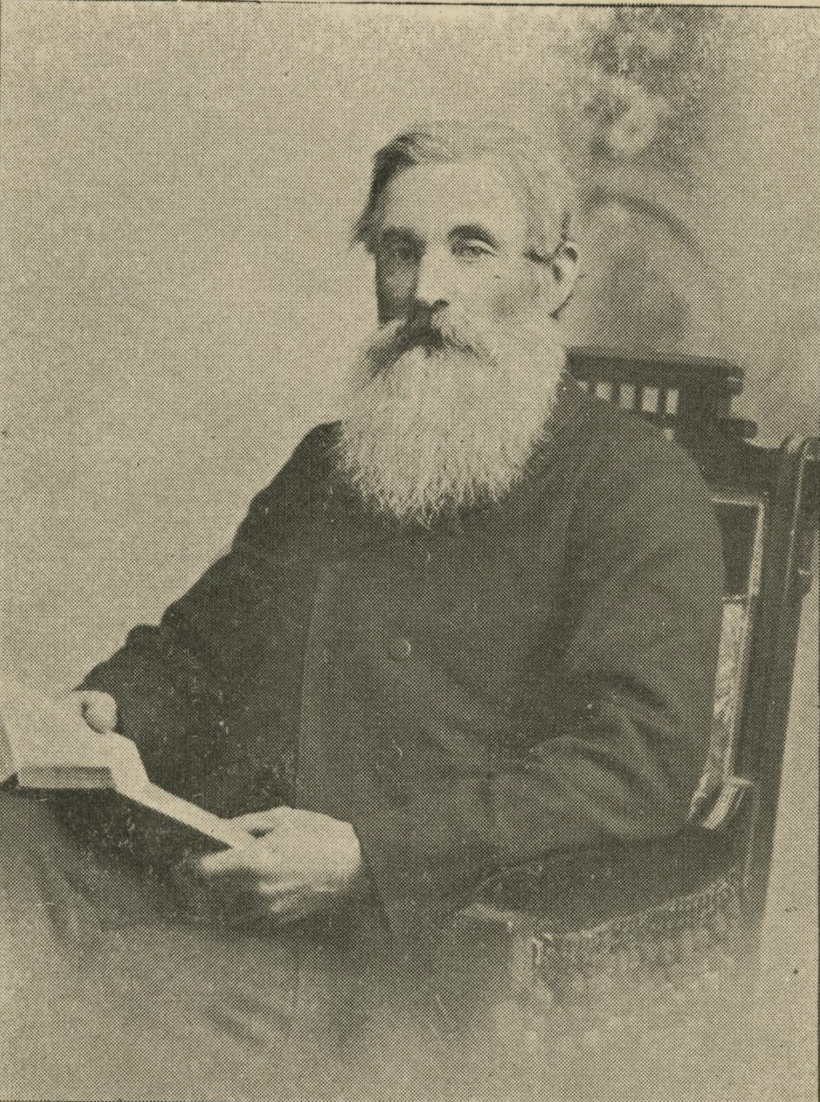
Used by Permission - Sewell Collection-ACU

The Life of G. B. L. K. Hancock
Goldman Buford Leland Kimbrel Hancock—better known in later years simply as G. B. Hancock—was a frontier-born preacher, debater, educator, and religious writer associated with the churches of Christ in the late nineteenth and early twentieth centuries. His life stretched from the rugged backwoods of antebellum Kentucky to the religious controversies and restorationist movements of the American Midwest. Remembered especially for his preaching, anti-Mormon debates, and thoughtful biblical writings, Hancock spent more than fifty years proclaiming New Testament Christianity.
Born on June 7, 1839, at Gap Creek in Wayne County, Kentucky, Hancock was the youngest son of Benjamin Hancock III (1779–1852) and Elizabeth "Betsey" Vickery Hancock (1798–1850). His father was a farmer, miller, justice of the peace, and Baptist preacher who exercised considerable influence in the community. Hancock later described his father as charitable and deeply religious, a man known throughout the region simply as "Uncle Ben." Family tradition held that the Hancock line was related to Revolutionary patriot John Hancock, though the exact connection was uncertain.
Goldman's childhood was marked by hardship and instability. His mother died when he was not yet four years old, leaving behind several children, including an infant daughter. Hancock's father died before Goldman reached thirteen years of age, leaving the family scattered among relatives and neighbors. In autobiographical sketches published in the Gospel Advocate in 1909, Hancock vividly recounted these difficult years, remembering the poverty of frontier Kentucky, the homespun clothing made from flax and tow cloth, and his longing for affection after the death of his parents. He eventually found a stable home with the Beck family of Kentucky, whose kindness deeply affected him. (See two articles he wrote below).
Raised in a religious environment, Hancock developed spiritual interests early in life. Though his father had been a Baptist preacher, Hancock eventually embraced the principles of the Restoration Movement, becoming a member of the church of Christ. According to his own statement in late 1908, if he lived until June 7, 1909, he would celebrate his fiftieth anniversary as a gospel preacher, indicating that he began preaching around 1859 at approximately twenty years of age. He exceeded that date by an additional five years.
On November 13, 1859, Hancock married Mary Minerva Burris (1842–1927) at College Mound in Macon County, Missouri. Their marriage endured nearly fifty-five years and produced a large family of fourteen children:
- Minerva Emmaline "Emma" Hancock (1860–1922)
- William Calvin Hancock (1862–1937)
- Clara "Clarinda" Elizabeth Hancock (1865–1925)
- Martha Ella Hancock (1867–1942)
- Benjamin "Ben" Abner Hancock (1869–1939)
- Madison Luther Hancock (1871–1956)
- John Hancock (1876–1876)
- Earl Hancock (1877–?)
- Susan "Sally" Pearl Hancock (1877–1905)
- Charles Tuggle Hancock (1880–1966)
- Oscar Jefferson Hancock (1883–1962)
- Ina Cordella Hancock (1885–1963)
- George Berry Hancock (1887–1887)
The family moved frequently through Kentucky, Missouri, Arkansas, and Indiana as Hancock pursued preaching opportunities and farming. Census and historical records place the family in Wayne County, Kentucky, in 1850; College Mound, Missouri, in 1860; Bee Branch in Chariton County, Missouri, in 1863; Carroll County, Arkansas, in 1870; Barry County, Missouri, in 1880; Stone County, Missouri, in 1900; and later Jenkins and Leann, Missouri, during the early twentieth century. Throughout much of his life Hancock supported his family through farming, but preaching the old-time gospel was his passion.
Hancock became widely known as a vigorous defender of primitive New Testament Christianity. He truly believed and taught that one could be a member of the church of the New Testament—nothing more, nothing less. He participated in several formal religious debates, especially against Mormonism and denominational theology. One of his most notable public discussions occurred in March 1900, when he debated J. M. McDowell of the Church of Jesus Christ of Latter-day Saints in Fayette City, Pennsylvania. Hancock affirmed that Joseph Smith was an impostor and that the Book of Mormon was fraudulent, while also defending the claim that the church of which he was a member was the true church of Christ.
His opposition to Mormon doctrine led him to author a book exposing the errors of Mormonism. In 1906 the Gospel Advocate described the work as "valuable" and encouraged readers to purchase copies both to benefit spiritually and to financially assist the aging preacher.
Hancock also engaged Baptists in public controversy. In July 1896 he debated Baptist preacher William Pinckney Throgmorton in Winigan, Missouri, discussing topics such as baptism and the operation of the Holy Spirit in conversion. Hancock strongly emphasized the necessity of the church and baptism in salvation. He declared during the 1897 Verona, Missouri debate with J. M. Bandy of the Missionary Baptists, "There is no other way under heaven to be saved except through the church."
Besides preaching and debate, Hancock possessed a serious scholarly side. Between 1906 and 1909 he contributed numerous articles to the Gospel Advocate, many of which reflected his detailed knowledge of Scripture, church history, and Reformation thought. Contemporary readers praised the precision of his biblical interpretation and his emphasis on foundational principles of Christianity. Fellow Christians commended the intellectual depth and spiritual earnestness of his writings.
In his later years Hancock also championed an ambitious educational effort—an industrial school for boys. Religious journals in 1903 spoke positively of the proposed school, which aimed to combine moral and practical training for young men. Supporters described the project as "a noble conception" and expressed confidence in Hancock's character and leadership.
Though respected by many, Hancock's final years were marked by declining health and financial hardship. Reports in the Gospel Advocate from 1908 describe him as lonely, feeble, and burdened with debt. Yet even in old age he continued writing and encouraging churches toward biblical faithfulness. One report noted that he had preached "in almost all the States and Canada."
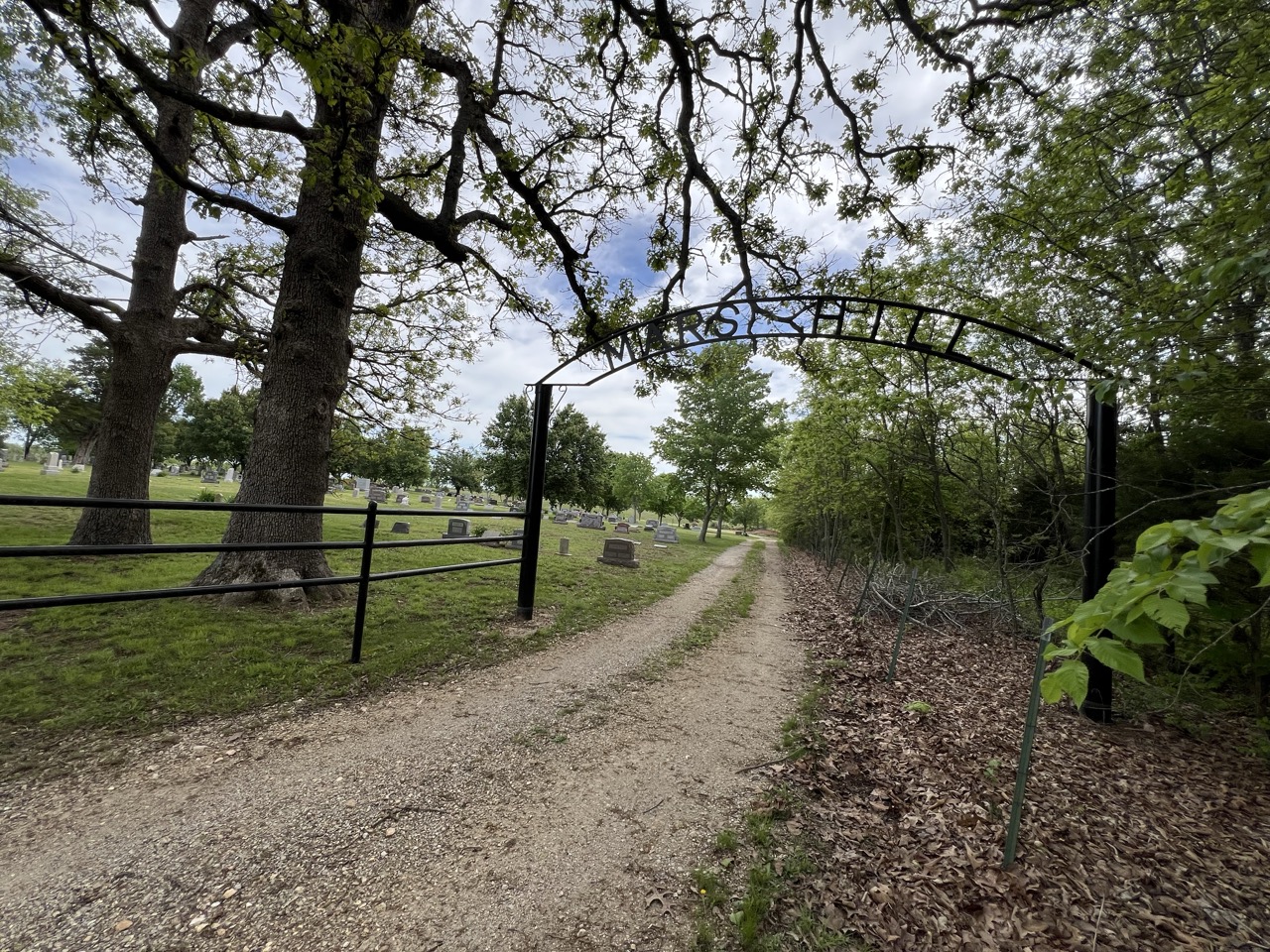
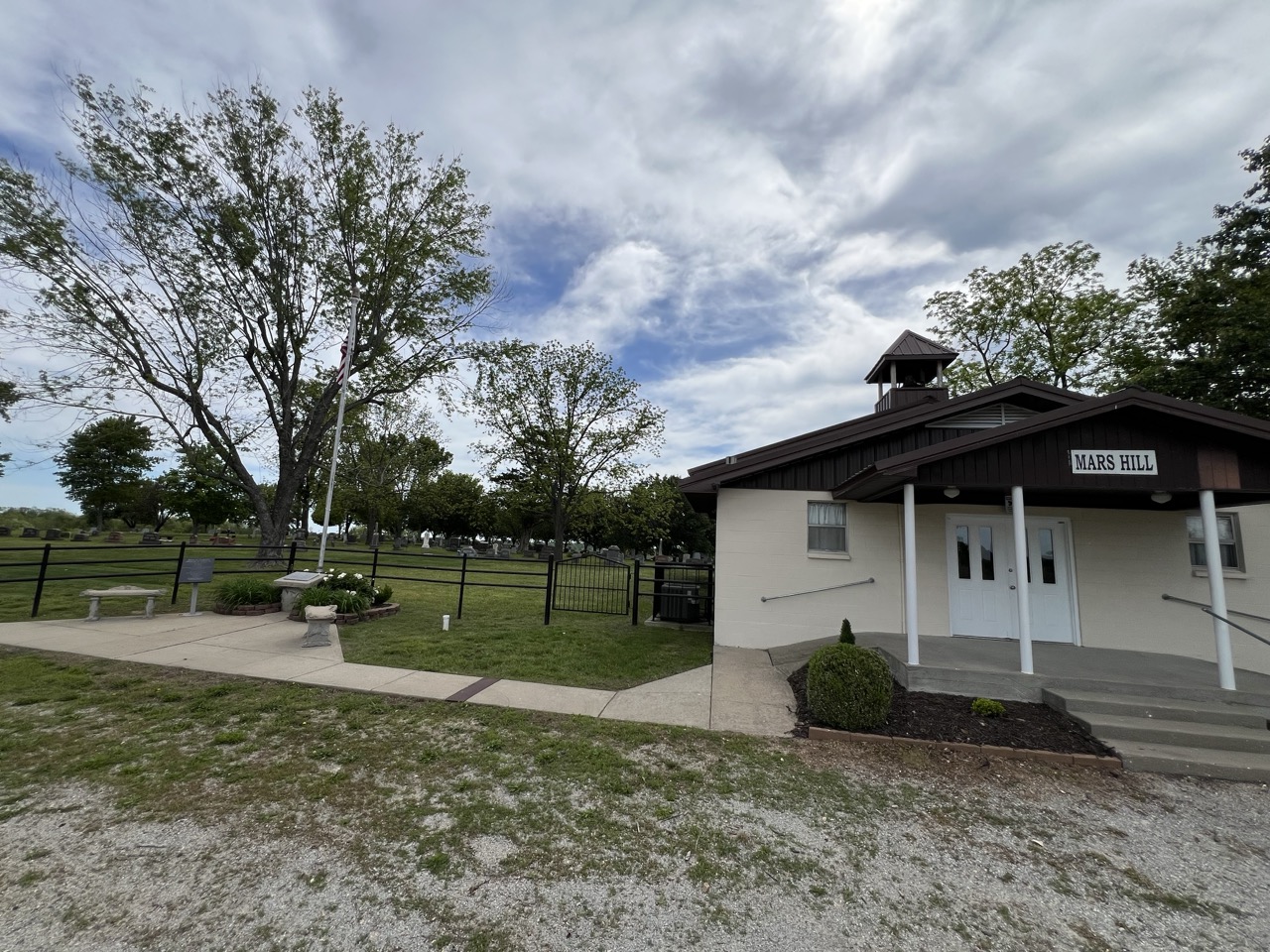
G. B. Hancock died on January 1, 1914, at the age of seventy-four. He was buried in Mars Hill Cemetery near Scholten in Barry County, Missouri. His wife, Mary Minerva Burris Hancock, died on February 5, 1927, and was buried beside him.
Today, Goldman B. Hancock is remembered as a devoted frontier preacher and foundational religious thinker whose life reflected both the hardships and convictions of nineteenth-century restoration Christianity. His autobiographical writings remain especially valuable for their vivid portrayal of frontier life, family struggle, and the spiritual ideals that shaped churches of Christ during a formative period in American religious history.
-Scott Harp, May 22, 2026
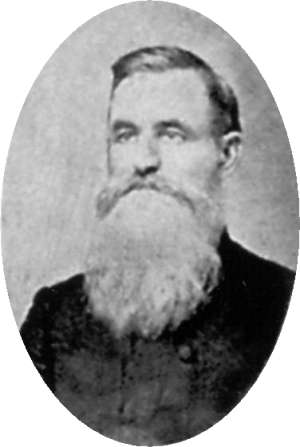
A PROPER DIVISION OF THE WORD OF TRUTH.
"Study to show thyself approved unto God, a workman that needeth not to be ashamed, rightly dividing the word of truth."
Certain things are here enjoined upon Timothy that are equally obligatory upon all who would be proclaimers of "the unsearchable riches of Christ." "Study." What for? To show themselves approved unto God. They are not to be men-pleasers. Paul says: "If I should seek to please men, I should not be the servant of Jesus Christ." Such is as true today as it was when Paul wrote. If approved unto God, they will not be ashamed; but if mere men-pleasers, shame awaits them. If one would escape the shame and be approved unto God, he must rightly divide the word of truth.
What is truth? "Thy word is truth." Nothing is of the truth unless it be of God's word. All that is of that word is false. No lie is of the truth. God has appointed that man should be sanctified through the truth. Falsehood is corrupting, for all falsehood is of the devil and is designed to thwart the purpose of God.
"Rightly dividing the word of truth." Upon this the acceptableness of our labor depends; upon this the sanctification of man depends; upon this the glory of God depends.
There is no Bible question, but what has a Bible answer. In the ninth chapter of the Epistle to the Hebrews, the apostle treats of the tabernacle that was erected by Moses in the wilderness and tells us emphatically that it was a typical institution, giving us, hence, in prophetical representation, the provisions of God in the church of Jesus Christ. The tabernacle proper was divided into two apartments, the holy place and the most holy place. The first of these, the holy place, represented the church of Christ on earth. That tabernacle was so securely enclosed that no light entered from without. The light for the priests in their ministrations was provided within; all the light, therefore, that they could have was that afforded by the seven lights of the golden candlestick. Paul's statement being true, that this was a type of the heavenly institution, the institution of which Jesus Christ is the head, the golden candlestick w~ a type of that which was to afford the light for the people of God under Christ. The type being a true one, the church was to have no light beyond what was represented by the golden candlestick. There is no light from God beyond what was therein represented. Therefore, if we can know what was represented by the golden candlestick, we can know the limitation of the light afforded to the church of Christ can know, hence, the bounds of inspiration and revelation in order to the glory of God and the eternal interests of humanity. If we inquire as to the meaning of this, and get an answer from the Word of God, our inquiring for a proper division of the word will be answered, and answered correctly.
In the fourth chapter of Zechariah, we have a record of his vision of the golden candlestick. There were two olive trees by the candlestick, one upon the right side and the other upon the left side. There were seven pipes, one for each division of the candlestick, and they furnished the golden oil for each bowl. Of the candlestick, the angel said to Zechariah: "This is the word of God." And of the olive trees it is said: "These are the two anointed ones [marginal reading and R. V., "sons of oil"], that stand by the Lord of the whole earth." In the eleventh chapter of Revelation we are told that these are the two witnesses. The type being true and the vision correct, we have certain facts, namely: The word of God is the only light that he affords his people. That word would be in two grand divisions, standing as two witnesses for the great Jehovah. That word as a whole was to be given in seven divisions. The inspiration, represented by the golden oil, was to be by virtue of the two olive trees. In consequence of these, there were to be, in man's behalf, two sons of oil.
This gives just what we have in the Bible. The two divisions are the Old and New Testaments, in other words, the two covenants. These properly viewed would give us seven divisions, one division answering as a center stem, with three divisions on either side. Matthew, Mark, Luke, and John were written for one purpose-namely, to give the demonstration that Jesus of Nazareth is the chief cornerstone of revelation, those four books being the true stem. Jesus gives the entire Old Testament in three divisions-namely: “The law, the psalms, and the prophets." This gives the three divisions on the one side. On the other side, we have just three divisions, namely: Acts of Apostles, the Epistles to the churches, and the book of Revelation. The olive trees represent the two covenants. Moses was the mediator in the first; he was, hence, the revelator-the lawgiver-for the people of that covenant. Jesus is the Mediator in the new; he is, hence, the revelator-the lawgiver-for the people of the new covenant. We have, hence, in Jesus and Moses the two sons of oil. And woe unto the man that would call in question the writings or the testimony of either, for God has carefully. guarded the counsel that he gave, upon which depends man's eternal interests, and in which the glory of God is involved.
How beautifully is the Bible adapted to man when viewed in the light of Zechariah's vision!
The first division, the Old Testament, was to give a demonstration that the God of Abraham, of Isaac, and of Jacob was the one true and living God. But that demonstration, the establishing of the unity --- Godhead was only preparatory to the great demonstration, namely, that Jesus of Nazareth is "the Son of the living God." Man, believing in God, that he is, and is a rewarder of those that seek him; and be in Jesus Christ as the Son of God and the Savior of the world, asks: "What must I do to be saved?" The answer to this question he finds in the book of Acts. Having complied with the conditions enjoined therein, and so adopted into the family of God, he inquires: "How shall I behave myself in the house of God? " The answer to this he finds in the Epistles to the churches. As the Christian fights the battles of life, he realizes that those who will live godly shall suffer persecution; and as he meets with trials, tribulations, disappointments, and privations, he needs special encouragement. Such is afforded in the book of Revelation; for, like Moses, he can, through that book, ascend to Pisgah's top and view the landscape over. He can see the beautiful city, the home of the soul, with its beautiful streets of gold and its gates richly set with pearls-that beautiful home where neither sickness, sorrow, pain, nor death will ever be known; for the former things will have passed away, and all things become new. Reader, shall we meet there?
-G. B. Hancock, Gospel Advocate, November 1, 1906, p.690
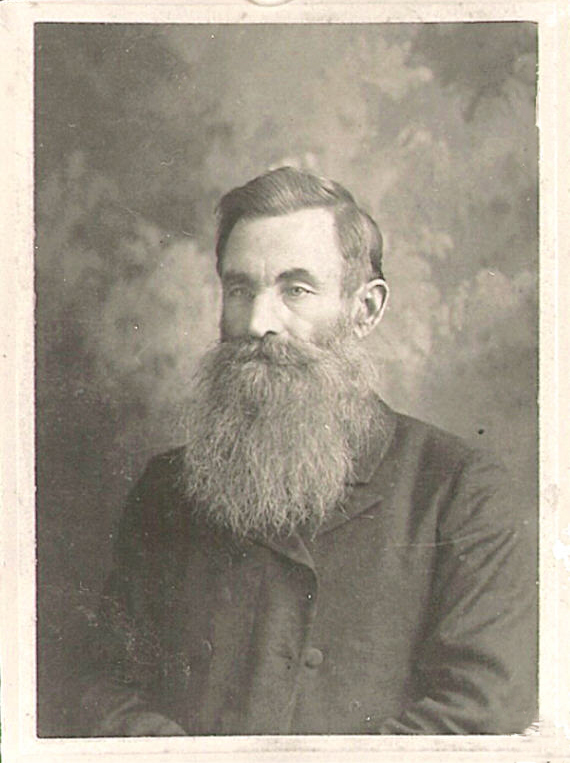
A BRIEF HISTORY OF MY LIFE.
BY G. B. HANCOCK.
Some of the readers of the Gospel Advocate having called for a history of myself, and believing that such will be an advantage to some, I have consented to comply with their request and give a brief of my life. I do not design, in the common acceptation of the term, to write an autobiography.
Biographies of noted and worthy men, that have been properly considered benefactors, when properly written, are among the most interesting and profitable of books. My sketches are not written with the idea that they will ever appear in book form, and the conclusion that I write with the idea that I desire to rank among the great and good of earth would do me injustice. Yet, as I always write with the motto before my mind, "He who writes for the public eye should write for the public good," I certainly conclude that in some respects these sketches will be beneficial, otherwise they would not be written.
My father, Benjamin Hancock, was born in North Carolina, near the Virginia line, in the year 1778 (as the family record was lost during the Civil War, I cannot give accurate dates). He was the son of Benjamin Hancock, a brother (as we learned from an old uncle on my mother‘s side) of John Hancock, of Revolutionary fame. My grandfather was a soldier during the entire Revolution. My great-grandfather was a very religious man, and had but three children. He wanted them to have the word of God. As Bibles were very dear, he could not afford a book for each of them; so he bought a Bible, for which he gave thirty dollars, and divided it into three equal parts, giving to each a third.
At an early date my grandfather moved to what was then known as the new purchase of Kentucky. As land was not valuable, convenience was the main item in selecting a home. They settled on Gap Creek. which was in the southern part of Wayne County. He was the second settler in that part, a family by the name of "Stocton" having preceded him. There game, timber, water, and Indians were plentiful; but they had to go one hundred miles to mill. At the age of forty-two years 'my father was married to Elizabeth Vickrey. To them ten children were born-six sons and four daughters. Three of the daughters died in early childhood. On June 7, 1839, the writer of these lines was born.
In some respects my father was an eccentric man. In naming his sons this appeared. The first son was named Jesse Emsley John Vitkrey Hancock; the second, William Luther Martin Daniel; the third, Benjamin Francis Henry Tuggle; the fourth, James Calvin Delay; the fifth, George Berry Dandridge Cruz; and the writer was named Leland Galrnon Buford Trimbrel. My oldest brother died when I was but a child. Except the third, the others, for the sake of convenience, just kept two of their initials.
At an early date my father erected a water mill on his farm, which did the grinding, or most of it, for the neighborhood. He was a farmer, a miller, a justice of the peace, and a Baptist preacher. He never attained to notoriety as a preacher, but was a man of considerable influence, and after he ceased to be a justice of the peace, when a difference would arise in the neighborhood, all appeared to be willing to leave it to "Uncle Ben," as he was familiarly known. He had no concern, so far as this world was concerned, beyond a reasonable supply of food and raiment. He was a friend to -the poor, the widow and orphan. He reared four orphans and looked to the extent of his ability after objects of charity. I heard in my childhood how many such objects have died in his house, but do not now remember. We will know after a while when the books are opened.
My father inherited the old homestead. The house was a hewed-log house, covered with chestnut shingles—covered when nails were not to be had. The shingles were pinned on to the laths.
When not quite four years old, my mother died, leaving a girl baby, something over a year old, the only girl in the family. Our father had to tend his mill, superintend the farm, and attend his meetings. Neighbor women were kind, but we were a family of neglected ones. My oldest brother had gone into the tanning business and was looking after a wife.
It was a good farmer in those days that could afford biscuit for breakfast on Sunday mornings. Uncle John Hicks came nearer doing so than most men in that part. Uncle John had a grown daughter, and brother often went to the Hicks' residence; and we were always rejoiced when we could think brother had gone to see Miss Hicks, for she would fill his coat pockets with biscuits for us children. And now, if I should at any place where I stop to hold a meeting find a family that could make biscuit that would taste half as well as those did, I certainly would make that my home while in those parts.
Brother married a Miss Huffaker, but in a little over a year they were both laid in the Otter Creek cemetery. Before I reached my thirteenth birthday father was called to go. He called me his "boy baby." He was old and feeble, and was sick only about two days. In the evening before he died he asked for his lips to be moistened. I got some water and a rag and wet his mouth. He then fixed his eyes upon me, and, with an effort that called for all his strength, he prayed for the blessings of God to rest upon his boy. These were his last words. We were then a broken family. The third brother took charge of the little girl; the boys each had to care for himself. If children who have a home and kind parents that they fail to appreciate could only spend a few months as we spent the next few years, it would perhaps be a good schooling.
After the death of my father I went first to live with a maternal aunt. This was a mistake—not that I could have gone into a nicer family than Doctor Fleming's. Kinder old folks or nicer children I could not have been with. Aunt was one of the nicest hands in that country to make cloth. She had a new suit made for one of her sons, but it was almost too small and she gave it to me; it was blue mixed jeans. The reason it was a mistake in my going there, I being my father's "boy baby," I wanted some one to pet me; but they had too many boys of their own to give much attention to my whims.
Gospel Advocate, April 1, 1909, p. 410-11.
A BRIEF HISTORY OF MY LIFE. NO. 2.
BY G. B. HANCOCK.
Father kept sheep and raised flax, and had cloth made twice a year. He would have jeans enough made in the fall to make the boys each two pairs of pants and a hunting shirt. In the spring he would have tow and flax cloth made. Each of the boys would get two pairs of tow pants. The larger boys that were wanting to get out in society would get a flax pair for Sunday use. Sometimes there would be sufficient flax scraps to make the "boy baby" a pair of pants. When such was the case, there would be one cheerful heart in the family. When the cloth would be ready, the women of the neighborhood would come en masse and cut and make the garments. Upon one occasion, a woman that did not understand her business as she might have done was given the task of cutting and making my flax pants. She missed it so far in cutting that when they were done I could not get into them. I was always of a forgiving disposition, but I am not conscious at the present time that I ever did forgive that woman.
Father had to economize, so the jeans cloth would be bark-colored. Aunt Fleming would make blue-mixed jeans. She not only made blue-mixed of a fine quality, but for her boys a Sunday suit, she would mix in Turkey red enough to give an extra appearance. It was winter time when I went to live with that family. Aunt gave me a nice-fitting suit of her extra jeans. Well, Joseph may have thought as much of his coat of divers colors, but I am sure he did not think any more of his coat than I did of my suit. And now, if I could have a suit of as nice jeans as that was, you preachers could have your Prince Albert, and welcome.
My father was a very indulgent parent. Except when I had to stay with little sister, I was my father's constant companion. Otter Creek Baptist meetinghouse was built on father's land. Gap Creek was between our residence and the meetinghouse. Father was old and tottery. In crossing the creek and in climbing the hill upon which the meetinghouse stood, he would brace himself on his right side with his cane and on the other by resting his left hand on my shoulder. Whenever I was with him I was a happy boy, whether on the road, the farm, or about the little water mill. After his death I missed his kind counsel, his words of encouragement, and, above all, his caressing love. I longed to be the object of some one's affection and tender care.
Uncle and Aunt Fleming were kind, but they had a large family of children and boys near my size, which made me feel that I was one there for whom there was no room.
Spring opened, and I longed for home. My oldest living brother had married and lived at the old home. I went to live with a cousin by marriage. I was taken sick, and they sent me back to my brother's to be cared for. When I had sufficiently recovered, I went into an adjoining county to live with a second cousin by marriage. They were inclined to be tyrannical. While there I determined to become a Christian, but was prevented. Although but fourteen years of age, I was decidedly of a religious turn of mind. I worked there about three months, for which they gave me two shirts made of common domestic.
A few miles from there, in what was known as "Caney Gap," lived an aged widow by the name of "Beck." She and a daughter, about thirty-five years old, lived alone, except what time F. E. Beck, a grandson and a Baptist preacher, stayed with them. They wanted a boy to stay with them. Hearing of me and being well acquainted with father, as he was one of their kind of preachers, they concluded I was the boy they wanted.
While we were at work one evening a finely dressed, fine-looking man, with a very pleasant expression, and riding one of the finest horses I had ever seen, rode to where we were and asked if that was Mr. _______. He introduced himself and inquired if I was the Hancock boy that was living there. He then made his errand known. He could see that he was not thanked for that visit. He took in the situation and said, "My grandmother and aunt need some boy to stay with them; and if we can get such a boy, we are able and willing to do a good part by him." Turning to me, he said: "Please let me know your decision soon." My decision was then made, but I dare not let it be known.
In a day or two I said to Mr. _______: "I had better go to Mr. Beck's and let him know my decision, as I promised." This was not met with approval; but as he was in some respects a man of honor, he could not object to me filling my promise. He asked if I wished to ride. I told him I would walk to Beck's that evening and back next morning.
I was back next morning, but not afoot. I dreaded that trip, but thought I could behave myself nice enough to escape a castigation. I went into the house and told the lady I wanted my clothes. She handed them to me. Mr. ________ was present, but did not speak to me. I saw that he wanted a chance to give me a piece of his mind. That chance he did not get.
A few days at the Widow Beck's convinced me that my fondest hopes were to be realized. I had found the place I had been looking for ever since my father's death. I was where I could be somebody's boy. "Grandma" and "Aunt Sallie" were kind as hearts could wish, and F. E. Beck was a gentleman. He was, of course, preaching under the commission as recorded in the tenth chapter of Matthew. A man that was living twenty-five miles from there was owing Mr. Beck some money. He happened to be in the neighborhood where Mr. Beck was holding a meeting. He called and offered to pay it, but Mr. Beck refused, saying that while preaching the Savior forbade him taking purse or scrip. The man had to wait till he could see Mr. Beck when he was not engaged in a meeting to pay that money.
-Gospel Advocate, April 8, 1809, pages 446-47.
Note: This article appears to have been the final issue where the autobiographical writings of G. B. Hancock appear. Yet, the story seems incomplete.
Report On Thompson-Hancock Debate
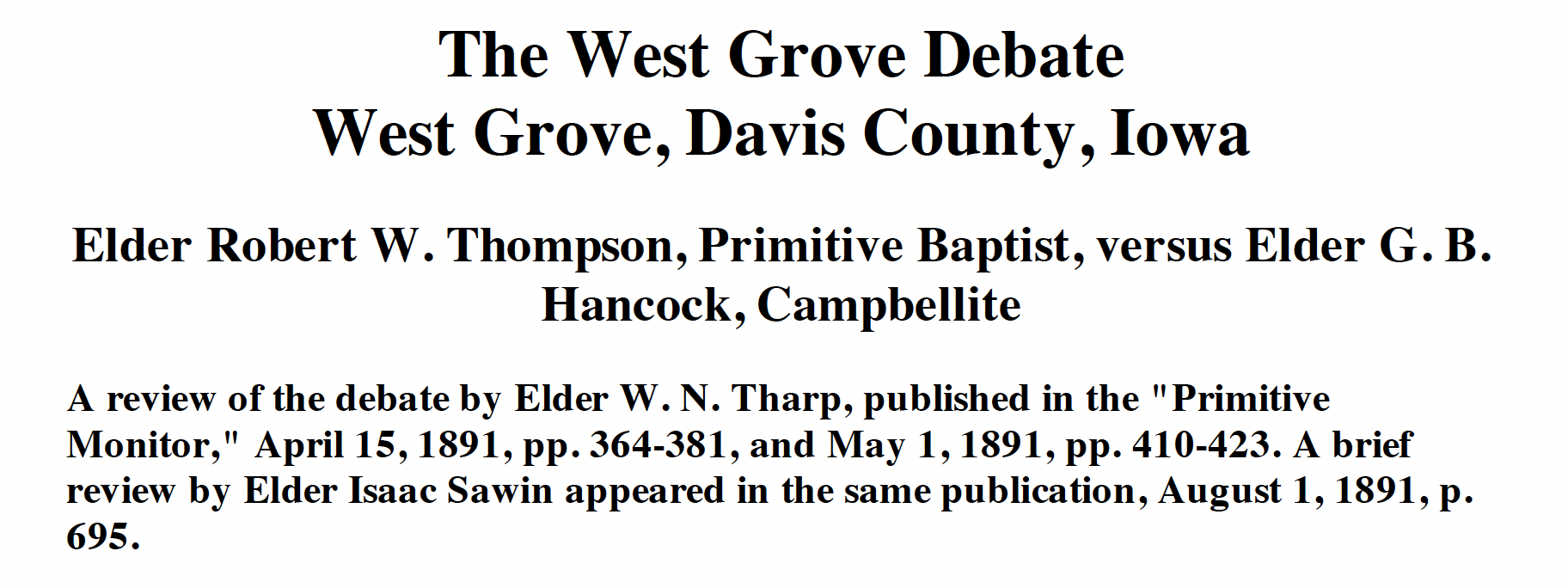
Report
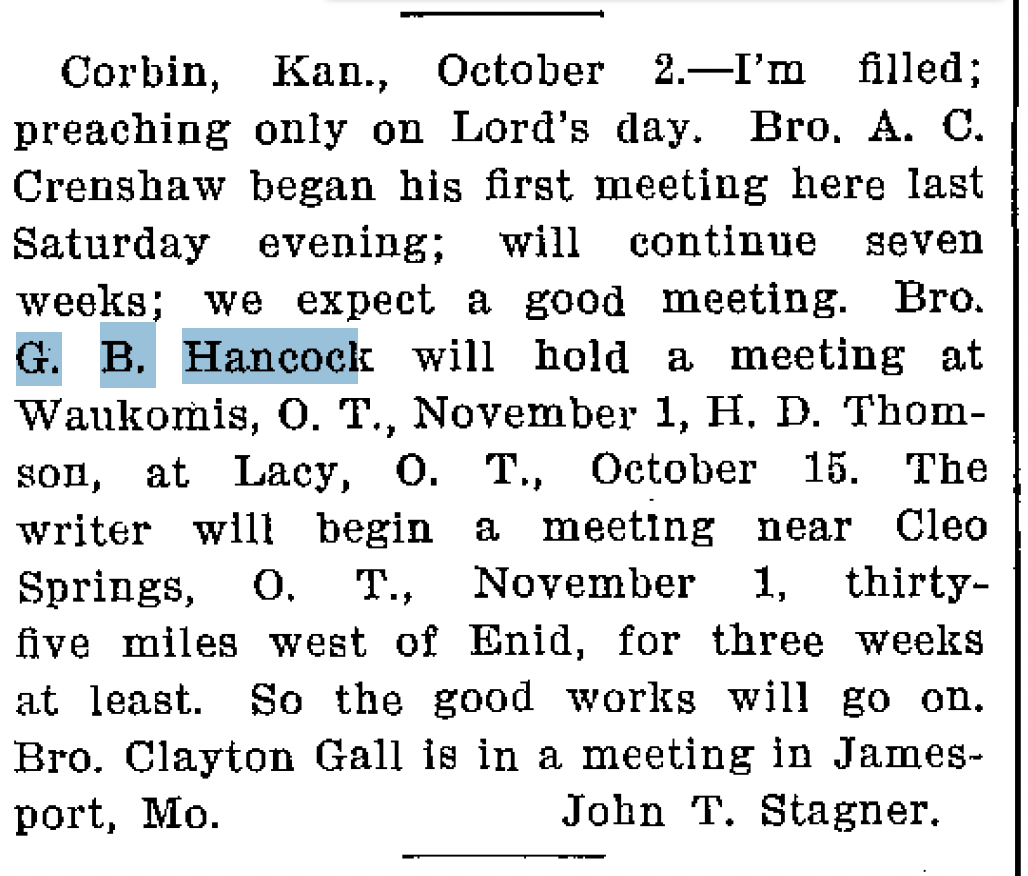
Christian Leader, October 10, 1899, p.12.
Report
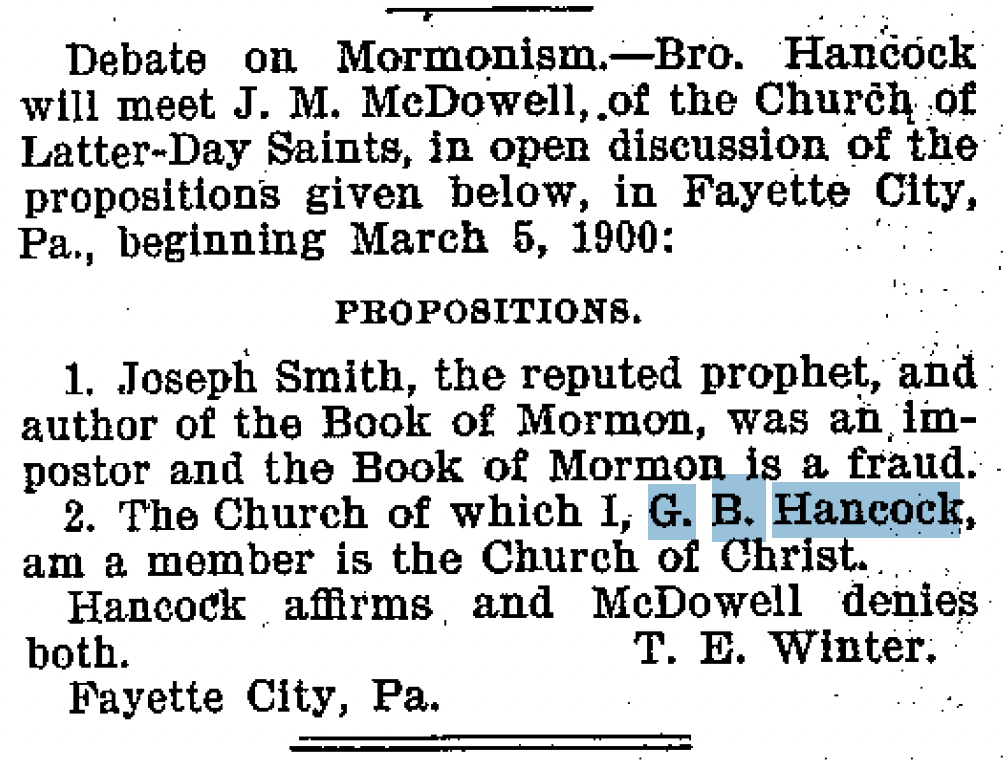
Christian Leader, February 6, 1900, p. 5.
Report
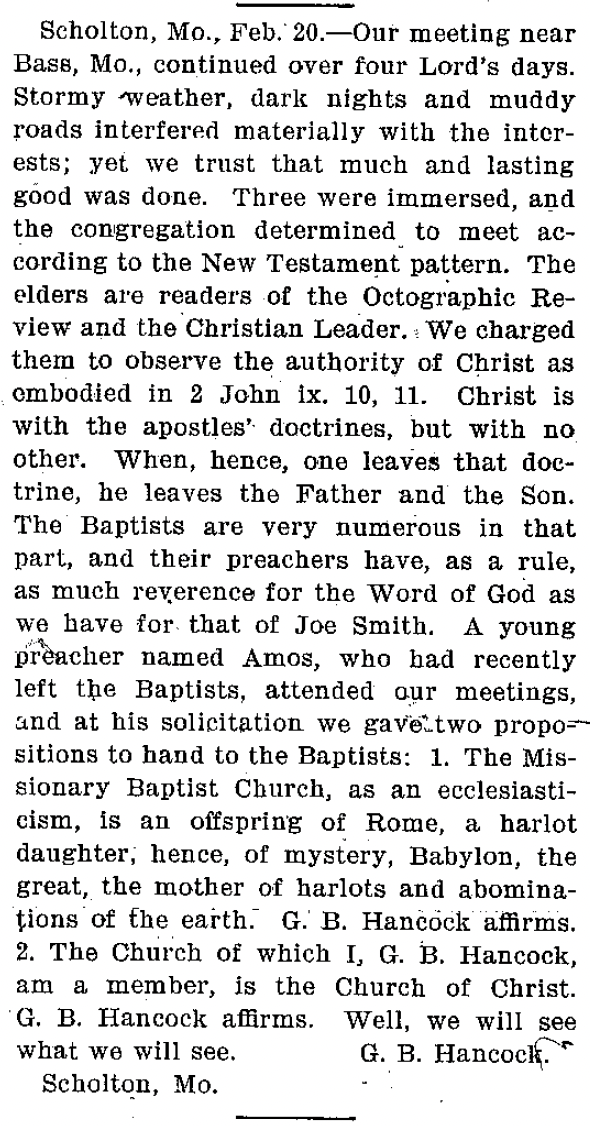
Christian Leader, February 2, 1903, p.12.
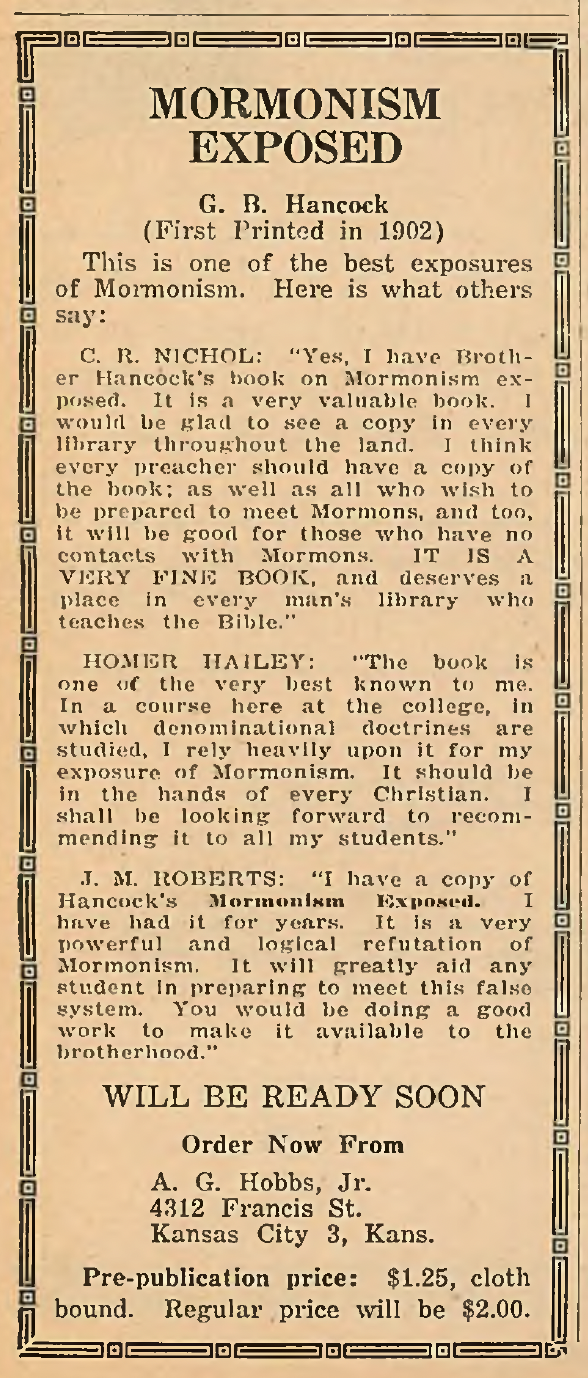
Firm Foundation - April 4, 1950, p.6
Another Advertisement
G. B. Hancock, MORMONISM EXPOSED,
Telegram Sermons Book Co., 151 pages, $1.95.
"Mormonism Exposed" is the reprint of an old book published by its author nearly fifty years ago, and is undoubtedly one of the finest refutations of Mormonism now in print. While it would be impossible to accurately change the title of this work, yet it is unfortunate that it had to be so designated. Some of the principles dealt with may be just as accurately used against the Christian Science doctrine, the Seventh Day Adventism, or any other whose validity depends upon some modern would-be prophetic revelation. In many areas of the nation, Mormonism is no problem, and so the true value of a work like this may be overlooked. Whether one must deal with Mormonism or not, this work can be read with great profit. G. B. Hancock, the author and an outstanding pioneer preacher of the previous generation, wrote the book with the intention of showing that Joseph Smith was an impostor and the Book of Mormon a fraud. The book was gotten out after a debate with them at Fayette City, Penna. He had been challenged for a debate several times but refused because, as the author put it, "They invariably sought propositions that gave them opportunity to play upon side issues and give simply a rehash of matter that they had delivered in lectures and preached in sermons till they had it by heart." This led Hancock to the proposition that Joseph Smith was an impostor and the Book of Mormon a fraud.
"Mormonism Exposed" is simply devastating to Mormon doctrine. The book should be in the library of every preacher. It is interesting reading, and not too hard to follow. While the arguments as a whole are sound and logical, the author's arguments from Old Testament symbolism are his weakest. But all in all, it is a good work.
Gospel Guardian, Vol. 3 #38, January 31, 1952
Directions To Grave
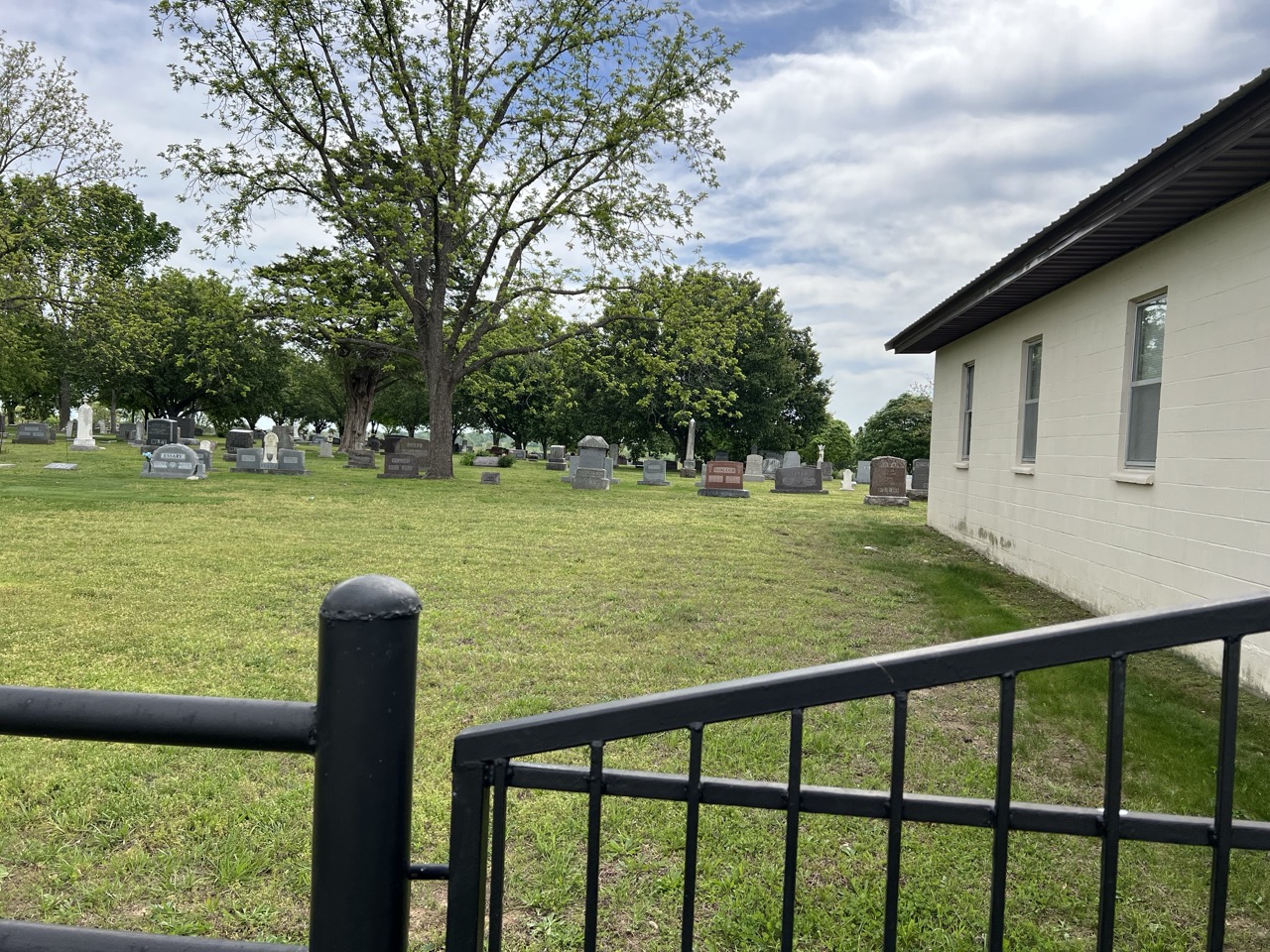
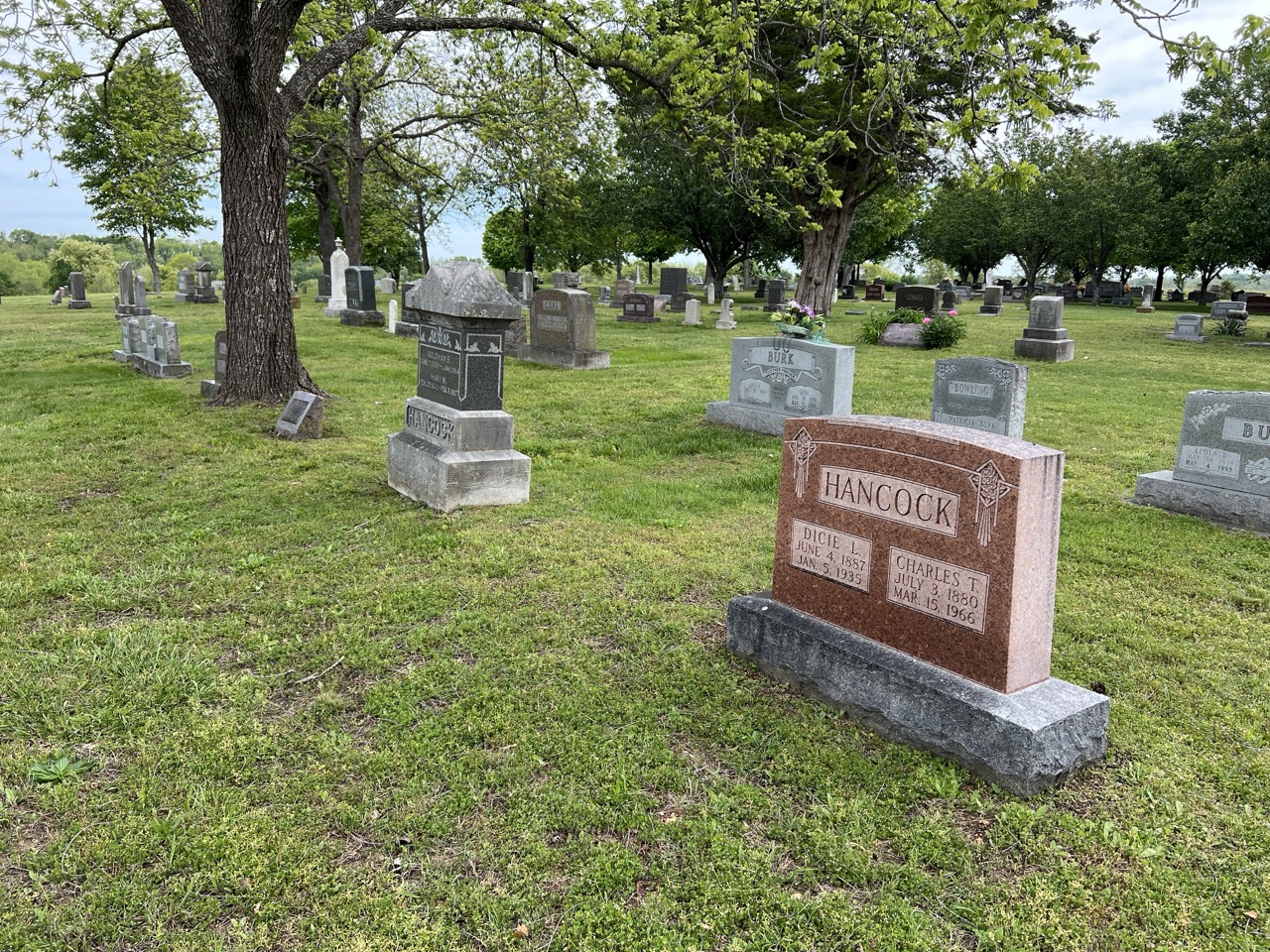
About 35 miles SW of Springfield, Missouri is the grave of G. B. L. K. Hancock family plot. Buried in the graveyard behind Mars Hill church, travel down Hwy 413/60. After passing through Billings, you will turn left where Hwy. 413 turns south. After passing through Crane, Mo, take State Hwy. Tt. Turn left of FM 1240, and head straight to the church. Go to the left of the church and head back into the cemetery. The Hancock family plot will be at the front.
GPS Location
36°52'29.5"N 93°37'43.7"W
or D.d. 36.874870,-93.628800
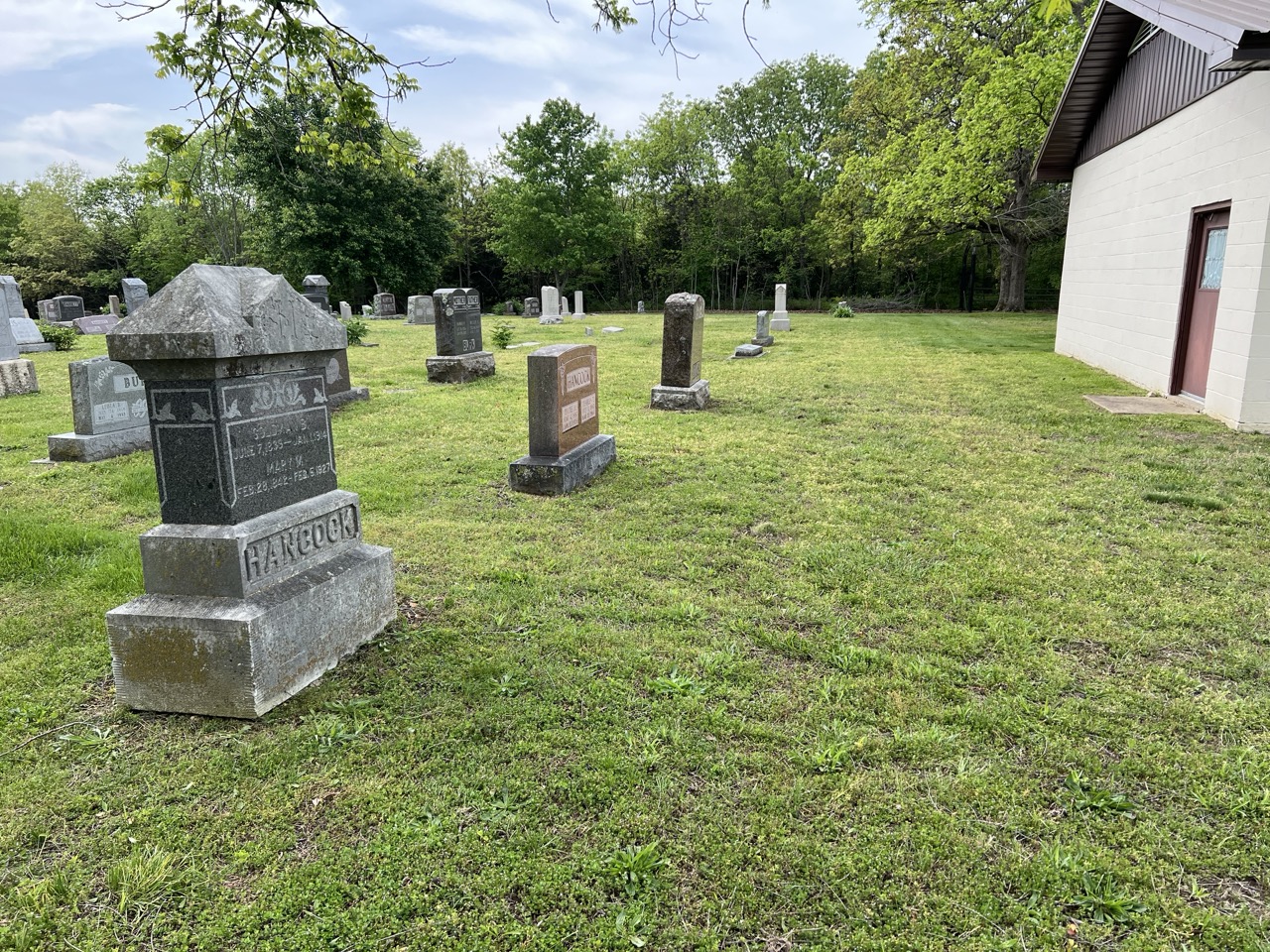
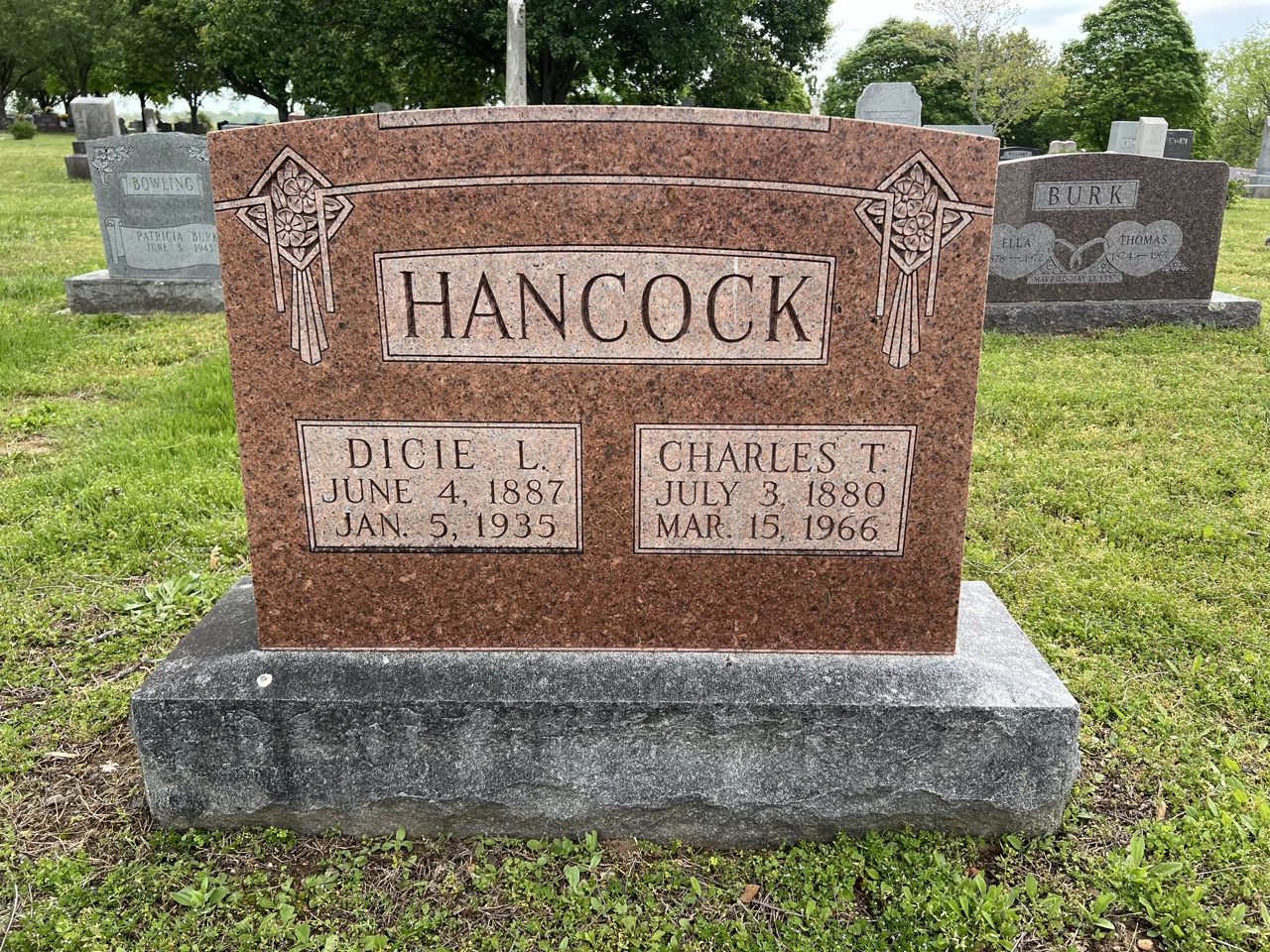
HANCOCK
Dicie L. - June 4, 1887 - January 5, 1935
Charles T. - July 3, 1880 - March 15, 1966
Son of Goldman & Mary Hancock
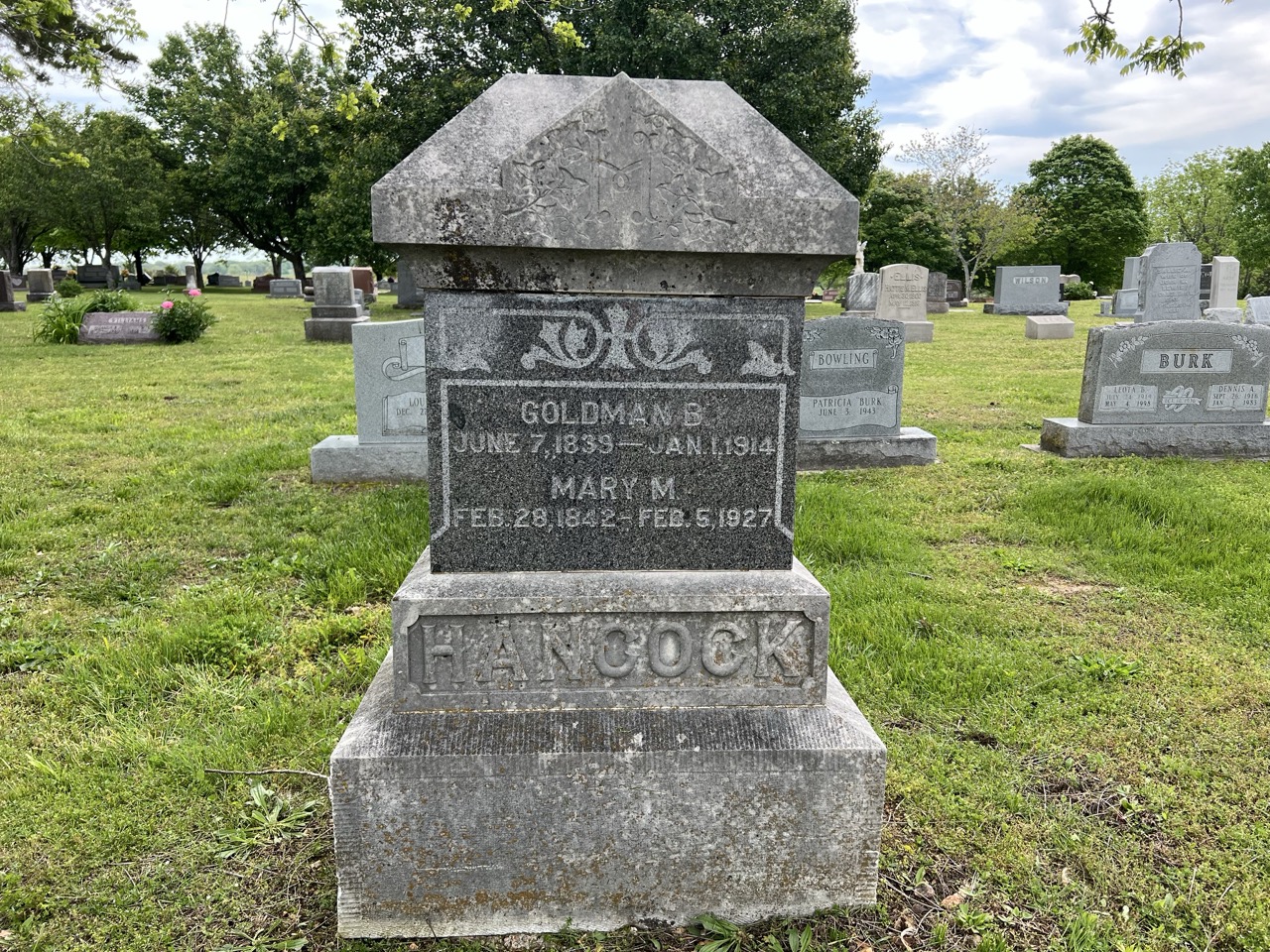
Goldman D. Hancock
June 7, 1839 - January 1, 1914
Mary M. Hancock
February 28, 1842 - February 5, 1927
HANCOCK
Photos Taken May 6, 2025
Webpage Produced May 21, 2026
Courtesy Of Scott Harp
www.TheRestorationMovement.com
Special Recognition: Your webeditor had the opportunity to visit the grave of Goldman B. Hancock in May, 2025, while involved in a gospel meeting at the South Hwy. 5 church of Christ in Lebanon, Missouri.