| Robert Richardson | |
1806-1876 |
|
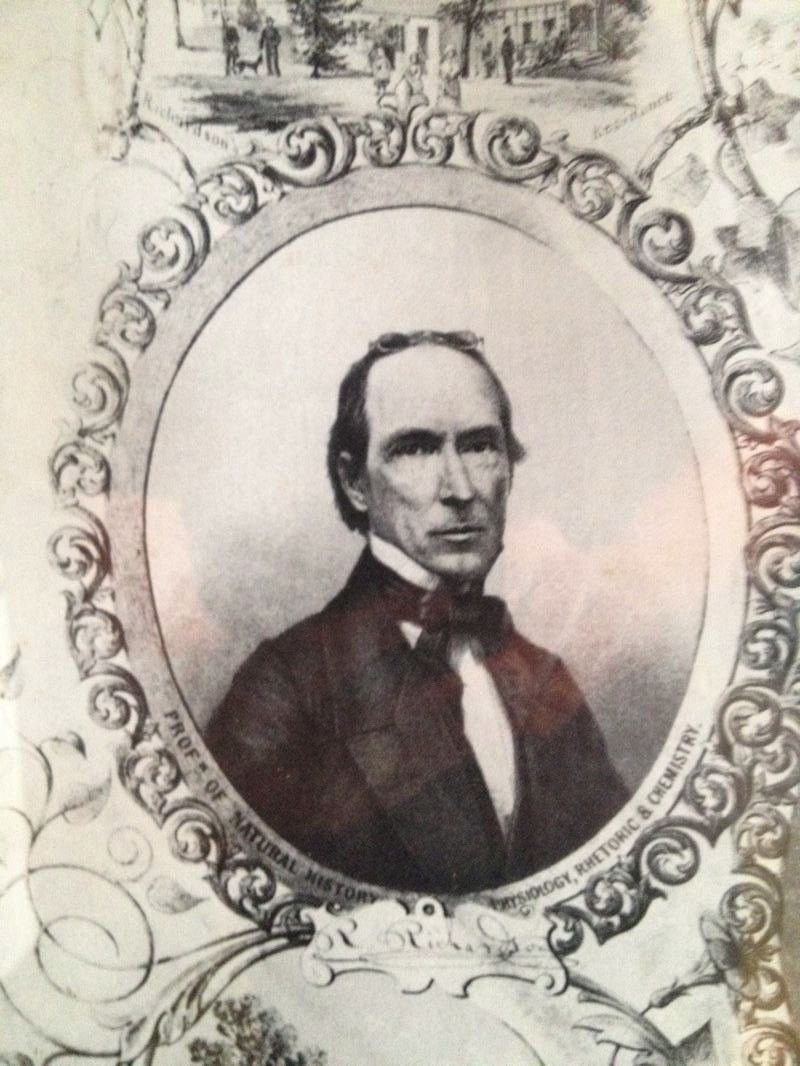
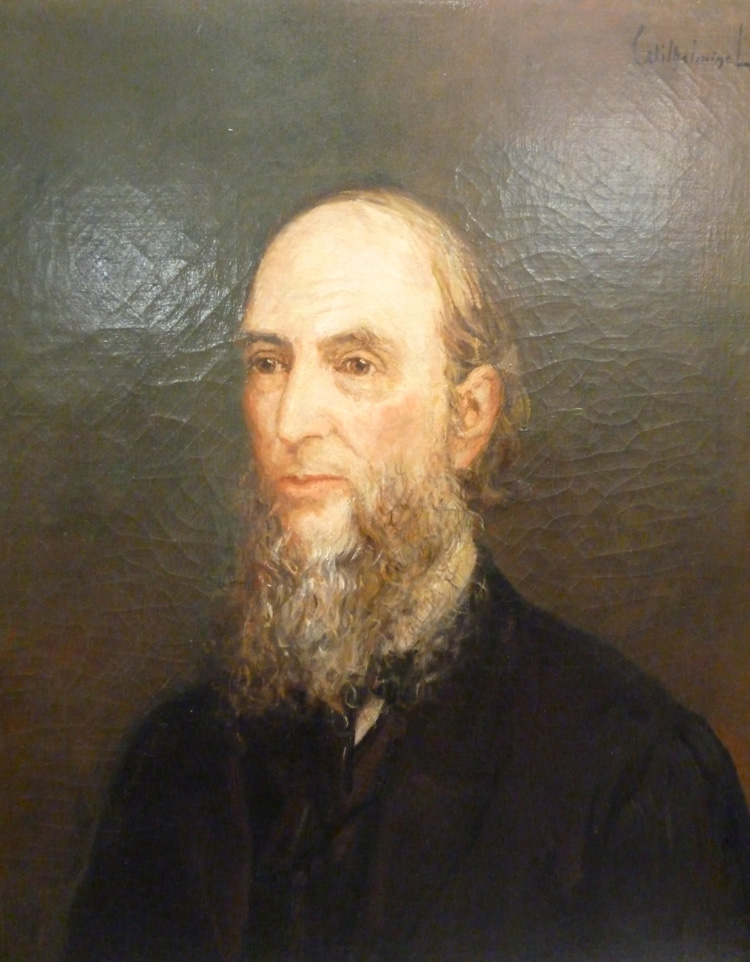 Photo of Painting In Bethany College Special Collections |
|
 |
|
| The Life Of Robert Richardson | |
Robert Richardson (1806-1876) was born in Pittsburgh, Pennsylvania and raised in the Episcopal (Anglican) Church. As a lad, he was tutored in his home by Elder Walter Scott, who later played a role in Robert's conversion to New Testament Christianity. He studied chemistry at the University of Pittsburgh. He received a medical degree in 1827 from the University of Pennsylvania in Philadelphia. In his early adult life, he again came under the influence of Walter Scott who taught him the gospel, and baptized him for the remission of sins in 1829. Alexander Campbell also played a great role in the shaping of his life both physically and spiritually. He moved to Wellsburg, Virginia (now W.V.) to set up a medical practice. After a short time he moved to Carthage, Ohio to do similar work as well as preach, but returned to Bethany in mid-1836 to work more closely with Alexander Campbell in the editorial work of the Millennial Harbinger. (MH,239). For the first fourteen years of his involvement with the Harbinger, he wrote letters and articles using various signatures, including his name, along with the aliases, Discipulus, Alumnus, and occasionally L-U-K-E. (MH,1843,567). When Bethany College opened in 1840, Robert Richardson was appointed to the Professorship in Chemistry in 1841, also serving as the college bursar, (MH,377). His wisdom and leadership led to his appointment as one of eighteen members of the original board of trustees for the college, (MH,1840,177). In 1849, Richardson became a co-editor of the Millennial Harbinger with shared duties between himself, Alexander Campbell and W.K. Pendleton. However, in the latter part of 1851 he developed eye problems that limited his involvement with the production of the paper. The following year or two health concerns continued, even to the point of removing his name from co-editorship in 1853. His lack of involvement was most distressing, and which led to apologies to his readers, (MH,1852,4; 1853,297). He rejoined the co-editor's staff in 1856, along with Robert Milligan, bringing the editorship to four, including brother Campbell and his son-in-law, W.K. Pendleton. (MH,p151,177). 1859 saw Robert Richardson's departure from Bethany for a period. He stepped down from his position on the Harbinger and as professor in the Chemistry department, moving to Harrodsburg, Kentucky to take on a professorship at the University of Kentucky. With the destuction of the university building February 16, 1864, the Richardson's moved back to Bethany to resume efforts in the cause of reform. Robert Richardson was added once again to the board of trustees of Bethany College, (MH,1865,381). He was given the title of Professory of Natural Philosophy, Chemistry and Natural History, (428-430). In 1867, Robert Richardson produced a volume, Principles and Objects of the Religious Reformation, urged by A. Campbell and Others. It began to be sold through a book store in Bethany, West Virginia. Upon the death of Alexander Campbell in 1866, Richardson was charged with the duty of editing the memoirs of Alexander Campbell. As he had spent so many years in the presence of the man, perhaps no one was more qualified than he in the undertaking of such a work. The first publication of the work was in two volumes beginning in 1868. The first volume of 560 pages was made available in July 1868, (MH,1868,413). At the end of the following year, a second volume totaling 668 pages, was announced in the December issue of the Millennial Harbinger, (MH,1869,704). The Memoirs of Alexander Campbell were produced by J.B. Lippincott & Co., Philadelphia, Pa., Robert Richardson outlived the sage of Bethany by ten years. At his death, his body was laid in a special place only a short distance from the Campbells. |
|
Sources: Issues of the Millennial Harbinger |
|
|
|
| Extract From William Baxter's Life of Walter Scott On The Conversion Of Robert Richardson |
|
The adoption of his views by one so capable of judging of their truth, and so able to defend them was, of course, highly gratifying to Mr. Scott, and the zeal and ability of the new convert soon showed that he was a more valuable accession than even his partial friend and tutor had supposed. Soon after his baptism, his pastor, the Rev. Dr. Hopkins, addressed him a letter of remonstrance and regret at the course he had taken, which called forth a reply, which, in a striking manner, set forth the weakness of a religion with much of a human admixture, and the power of the simple and unadulterated truth; or the weakness of a creed in comparison with the plain teachings of the Word of God. It was a happy circumstance that Mr. Richardson was so soon called upon to defend his faith, as it opened the way to a career of great usefulness; for, since that time his pen has been almost constantly engaged upon many of the most important religious questions of the day; and among all the writers who have used their pens in the advocacy of the "Reformation" he is not only the most voluminous, but the most polished and graceful. He has been more closely identified with the movement set on foot by the joint labors of Campbell and Scott than any other man in our ranks, and will go down to posterity as the historian of one of the greatest religious movements of modern times. His whole life has been spent in literary, religious, and scientific research. For eighteen years he was Professor of Chemistry in Bethany College, and at the same time co-editor of the "Millennial Harbinger," one of the ablest exponents of modern religious thought. The doctor also aided in the organization of the University of Kentucky from 1859 to 1863, and now, in the retirement of Bethphage, over-looking Bethany, he is still actively and usefully employed, ever and anon giving to the religious world, through the press, his best thoughts on the best of themes. May he be spared yet many years, and may his sun come to a golden setting. |
|
-William Baxter, Life of Elder Walter Scott, Cincinnati: Bosworth, Chase & Hall, Publishers, 1874, pages 211-215 Note: Baxter's recalled Richardson's baptism while he was still living. The release of this volume took place two years prior to Richardson's death in 1876. |
|
|
|
| Directions To The Grave of Robert Richardson | |
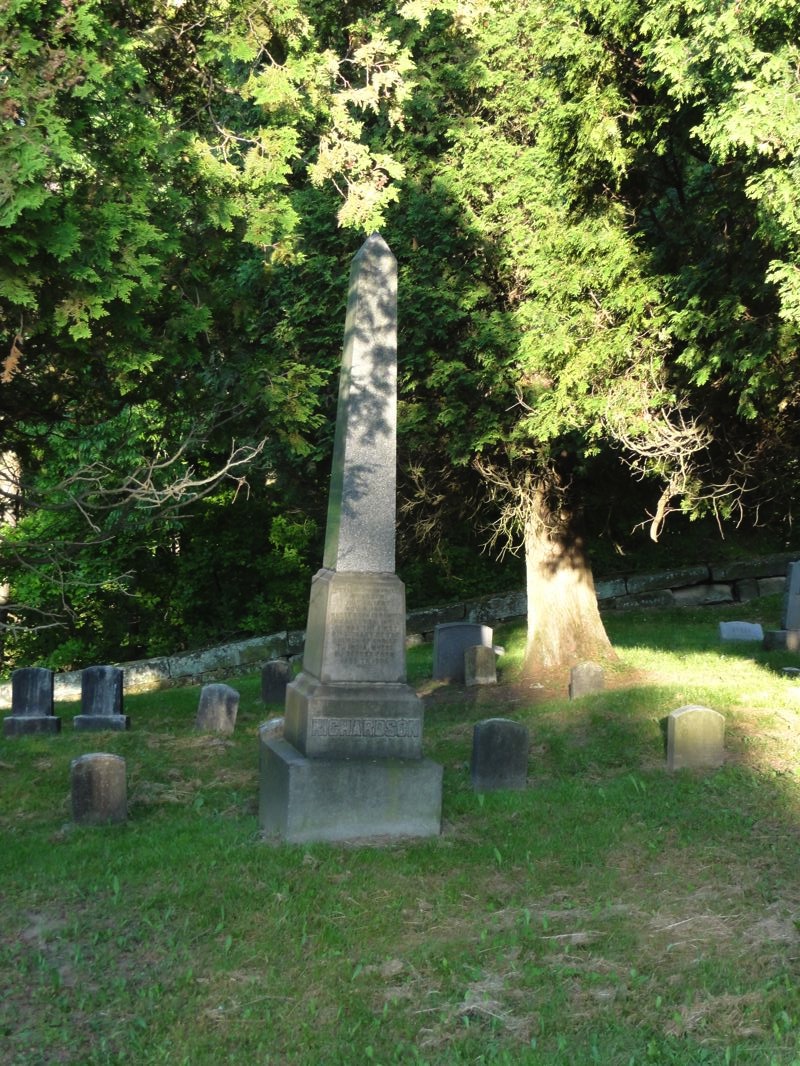
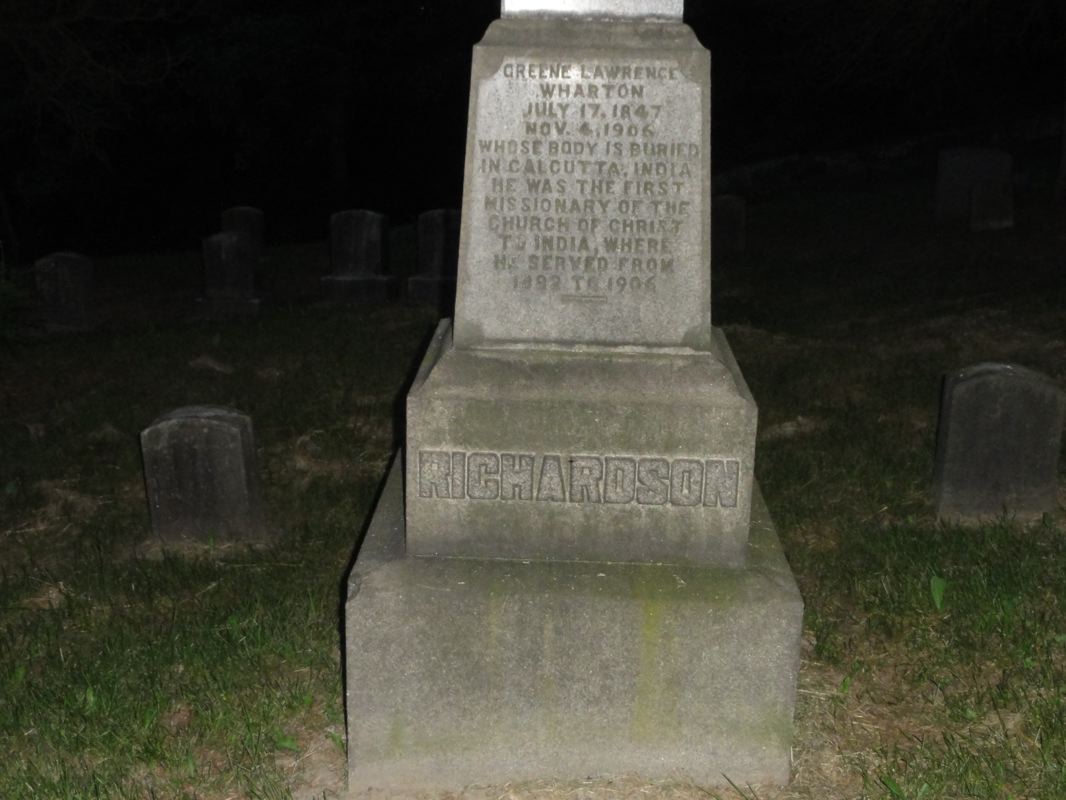
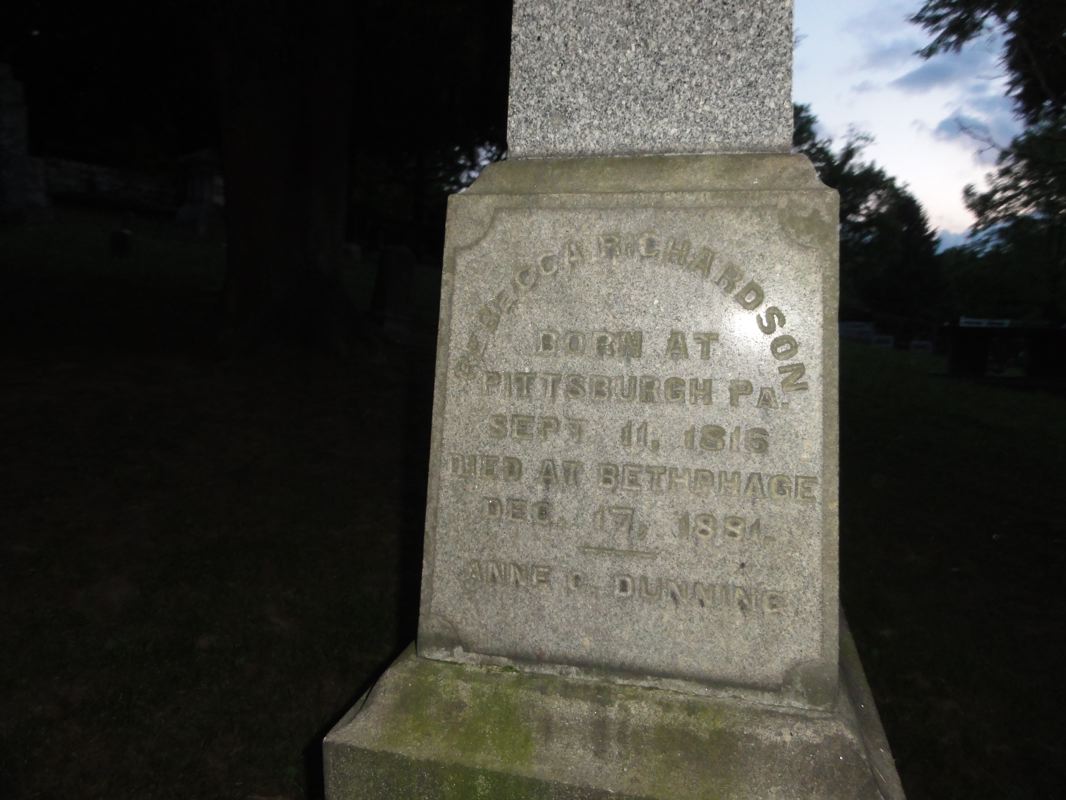
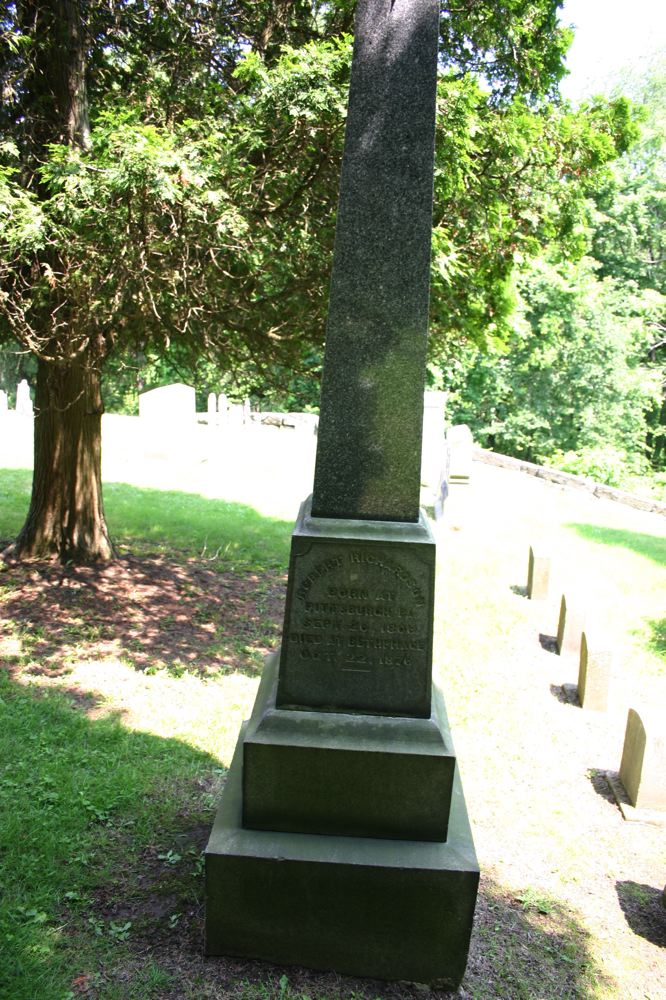
Robert Richardson is buried in the cemetery in God's Acre Cemetery in the remote hills of the panhandle of West Virginia. Access of approach to Bethany can be made four ways, one of which is not great if you are prone to car sickness. The approach from Wheeling, W.V. is very curvy, on Hwy. 88. Thus, it is better from Wheeling to go up Hwy. 2, following the Ohio River to Wellsburg. Turn right on Hwy. 27 and go around five miles and turn right on Hwy. 88. Access this way is straightest from Wheeling. Once arriving in Bethany, travel all the way through, passing the church building on the right, crossing Buffalo River/Creek, passing the soccer fields on the left, and continuing until you get to the Campbell Mansion. When you see the historical marker on the right, you should turn right, but keep to the left as you go up the hill toward God's Acre Cemetery. The cemetery is enclosed with large boulders. Enter the cemetery at the steps. From the steps continue past the tallest monument through to the smaller obelisk in the small thicket of trees. From Washington, P.A. - Take Exit 17/Jefferson Avenue on I-70, and head north, (away from Washington) on Hwy. 18/844. When 18 and 844 split, be sure to go left on 844. Go a few miles and turn left on Hwy 331/Brush Run Road. (There has for years been a red barn at the corner, making for a good landmark to know where to turn off Hwy. 844. onto Hwy. 331/Brush Run Road. Take 331 until it dead's end to Hwy. 231 where you will turn left. Hwy. 231 will dead back into Hwy. 331. Turn right and head into Bethany. The first glimpse of Bethany will be the old Campbell mansion on the right. Be sure to go through this house if possible. It is good to call ahead to make sure someone is able to show you through. You can not get in on your own. But, continue just past the mansion and turn left on the little road that give you access to the cemetery. Be sure to stay to your left as you make your way up the hill. The cemetery is enclosed with large boulders. Enter the cemetery at the steps. From the steps continue past the tallest monument through to the smaller obelisk in the small thicket of trees. |
|
|
|
Robert Richardson
|
|
|
|
|
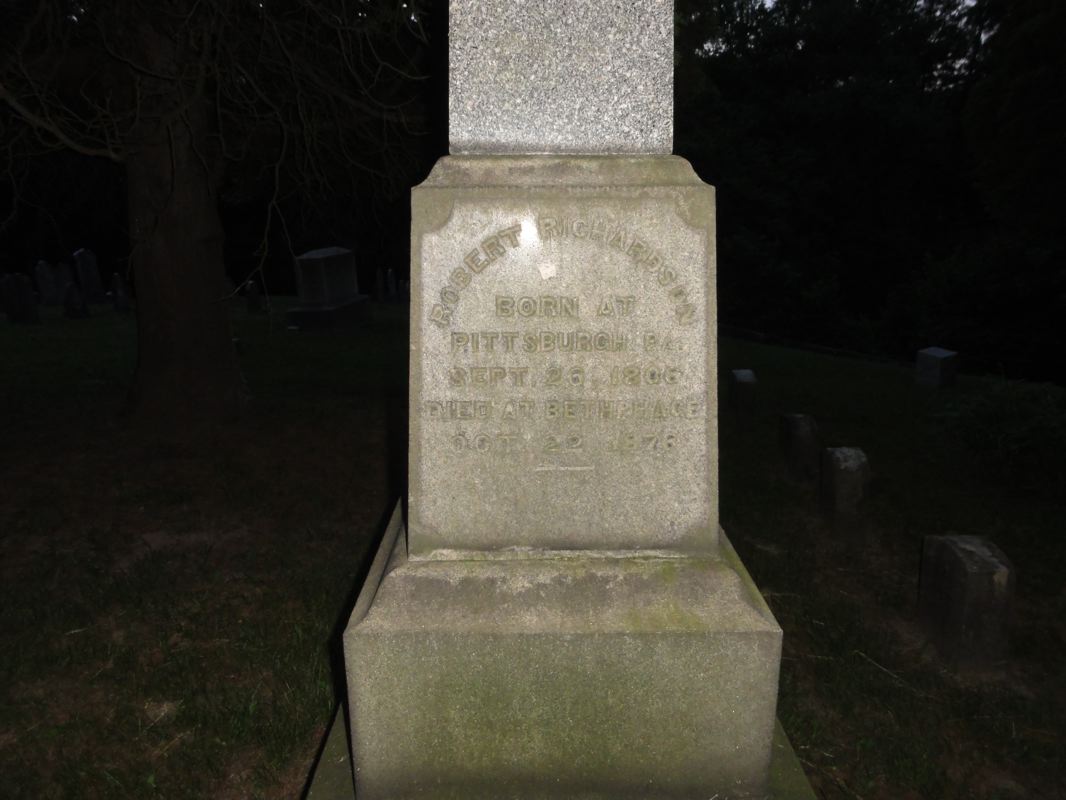
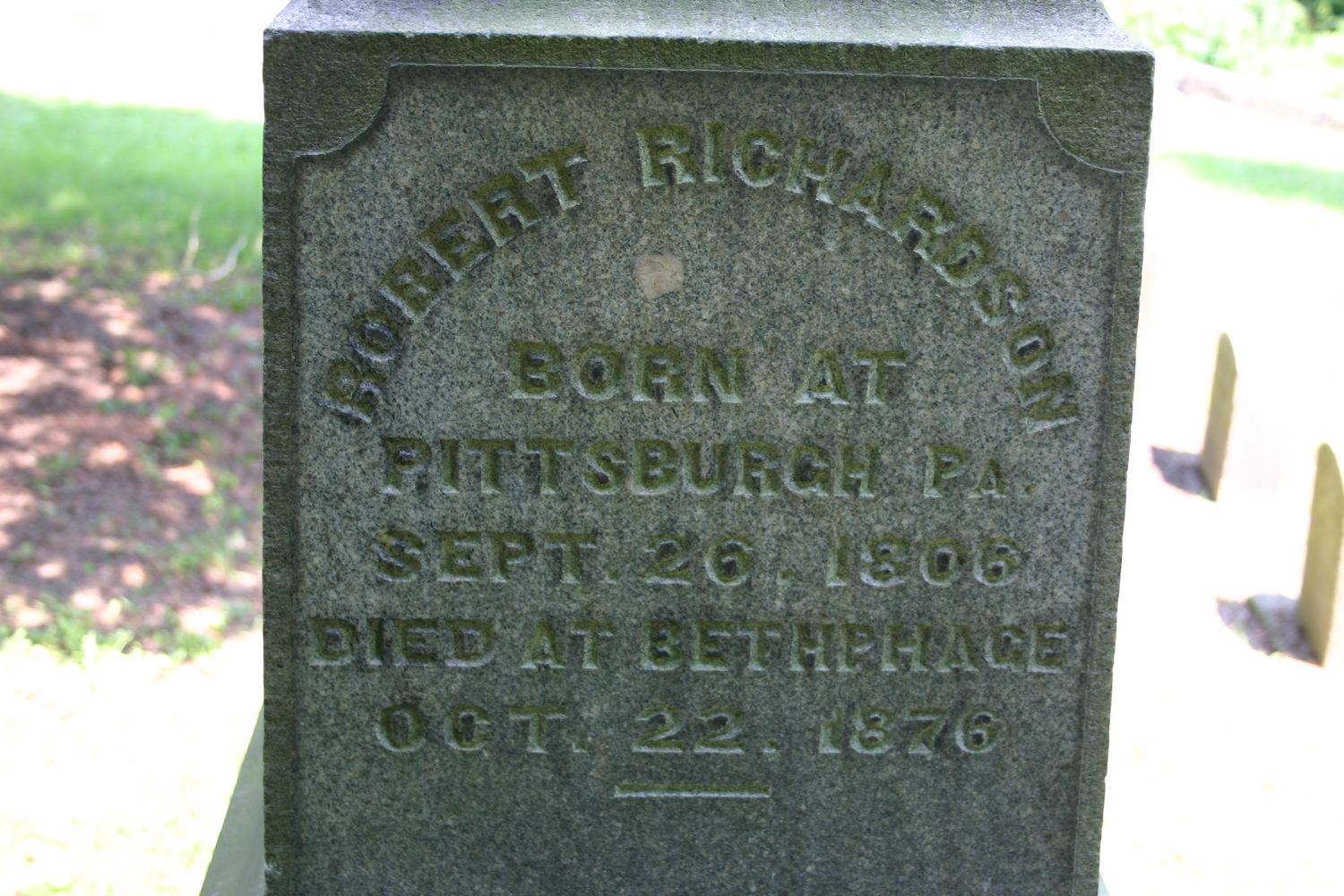
Photos Taken May 24, 2012 Special thanks to Tom L. Childers. Though your web-editor has visited God's Acre several times over the years, the visit in May, 2012 was the first time to have been able to spend more time at God's Acre. Tom and I were traveling together that week. We had met a group of students from East Tennessee School of Preaching for the purpose of giving a little color and "play by play" historical information to the group. Tom did most of the driving that week, and took several photos. |
|
|
|
| History Home History Index Page |