Napoleon Bonaparte Morris
1861-1915
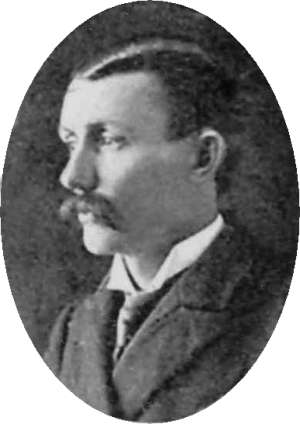

The Life of N. B. Morris
Napoleon Bonaparte “N. B.” Morris devoted much of his life to carrying the gospel through the rural communities of East Texas and northwestern Louisiana. A farmer by occupation and an evangelist by calling, he belonged to a generation of itinerant preachers whose work helped establish and strengthen churches of Christ throughout the region. Contemporary reports describe him as loyal, capable, courageous in his preaching, and unfailing in his willingness to go where the need was greatest.
Morris was born in Texas in November 1861, the son of William L. Morris (1840-1865) and Mary Ann Morris (1837-1925). His family lived in Panola County, an area settled by many families who had migrated westward from Alabama, Tennessee, and Mississippi. Among these settlers were adherents of the nineteenth-century Restoration Movement, with its plea for a return to the faith and practice of the New Testament church.
In 1885, in Logansport, DeSoto Parish, Louisiana, N. B. married Nellie Ann Connor (1864–1894). The story of their brief life together, lovingly passed down through generations, is as tender as it is heartbreaking.
It began in an age when the pioneer spirit still stirred in the hearts of many Americans. Nellie’s family was traveling toward Houston, Texas, hoping to claim a piece of land they could call their own, when a wheel broke on their wagon and left them stranded near the Morris homestead. In those days, hospitality was more than a kindness—it was a way of life. The Morris family welcomed the Connors into their home and gave them shelter while the wagon was repaired.
Only three years apart in age, N. B. and Nellie soon grew close, and affection blossomed into love. One day, the two set out together to wash clothes at the creek. Instead, they slipped away and were married.
Before long, the Connor family’s wagon was repaired, and the time came for them to continue their journey westward. One can only imagine the emotion of that farewell as Nellie watched her family’s wagon grow smaller in the distance, not knowing when—or whether—she would ever see them again.
During the nine years that followed, N. B. and Nellie welcomed two children: Willie Anne (1886–1971) and McCarty Venson (1893–1968). When the children were seven and one, the young family set out toward Houston in hopes of finding Nellie’s parents. Tragically, they were involved in a wagon accident along the way, and Nellie lost her life.
In the midst of his grief, N. B. was forced to leave the children temporarily in the care of a nearby family. He later returned for them, and together they made the sorrowful journey home to east Texas. They never reached Houston, and N. B. never made contact with Nellie’s parents.
To this day, the story ends with unanswered questions. Little is known of Nellie’s family—who they were, where they came from, or where their journey finally led them. Yet Nellie’s memory endures through the children she loved, the generations who came after her, and the precious story of a chance meeting beside a broken wagon that became a love never forgotten.
Following Nellie’s death in 1894, Morris married Bertha Ada Brewer (1876-1951), at Logansport on July 21, 1897. Four children were born to this marriage: L. H. “Spec” Morris (1899-1981), Theo Jewel Morris (1902-1939), Cleo Gay Morris (1907-2006), and Eugene Daughdrill Morris (1910-1956).
Although N. B. earned his living principally as a farmer, the defining work of his life was preaching. Andrew J. McCarty (1859-1919), who baptized him and was described as his “father in the gospel,” reported in 1896 that Morris had been baptized approximately three years earlier. His development as a preacher must have been remarkably rapid. McCarty called him “a first class gospel preacher” and reported that Morris had baptized 129 people during the preceding year. He further commended him as a man “loyal to the truth” who richly deserved the support of his fellow Christians.
These were more than generous words spoken by a friend. Reports appearing over many years in Firm Foundation and the Gospel Advocate reveal the breadth and persistence of Morris’s work. He traveled from community to community, often remaining for days or weeks to conduct what were then called protracted meetings. He preached, baptized into Christ, restored former members, helped congregations appoint elders and deacons, and arranged to return on regular monthly appointments.
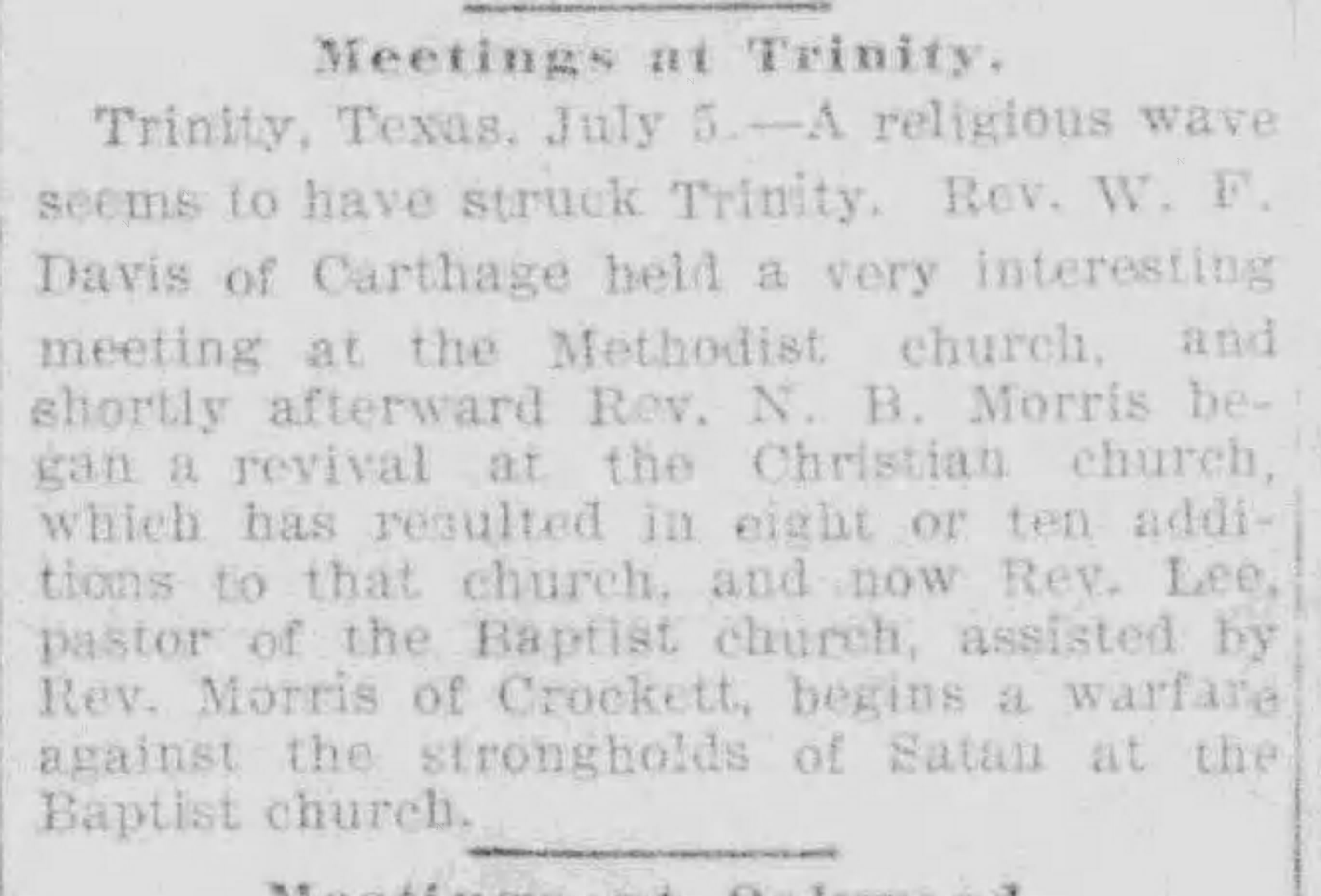
At Trinity, Texas, in the summer of 1897, Morris conducted a meeting that resulted in ten confessions and baptisms and two additional members received by relation. R. T. Walker reported that Morris preached the word “boldly” and did not shrink from declaring “the whole counsel of God.” The report also noted that Morris had been preaching monthly for the Trinity congregation and had acquired many warm friends there.
In the fall of 1897, Morris moved into Claiborne Parish in northwestern Louisiana with the stated purpose of advancing the cause of Christ in that region. By February 1898, he was preaching near his home and in neighboring Bossier Parish, including the vicinity of Plain Dealing. He also conducted a meeting at Antrim, a sawmill community on the Cotton Belt Railroad. H. H. Montgomery wrote that Morris intended to devote much of his time to places where few preachers were available. Montgomery praised the manner as well as the substance of his work, observing that Morris declared the whole counsel of God “in a kind and impressive manner.”
That description is especially revealing. Morris was evidently firm in his convictions, but those who observed him also remembered the kindness with which he presented them. His ministry joined doctrinal clarity with a sincere concern for people. He did not wait for comfortable circumstances or established congregations to summon him. He went into isolated and poor communities, endured demanding travel, and preached wherever an opportunity opened.
A report published in the Gospel Advocate illustrates the physical extent of this labor. During one five-week preaching tour, Morris and a fellow evangelist worked in Shelby County, Texas, and then traveled into Louisiana and Arkansas. At Union Grove, thirty-six people were baptized during seven days of preaching. Additional meetings followed at other locations before the two men separated to continue their respective appointments. Such journeys were undertaken without modern roads or convenient transportation. They required stamina, personal sacrifice, and an unwavering sense of duty.
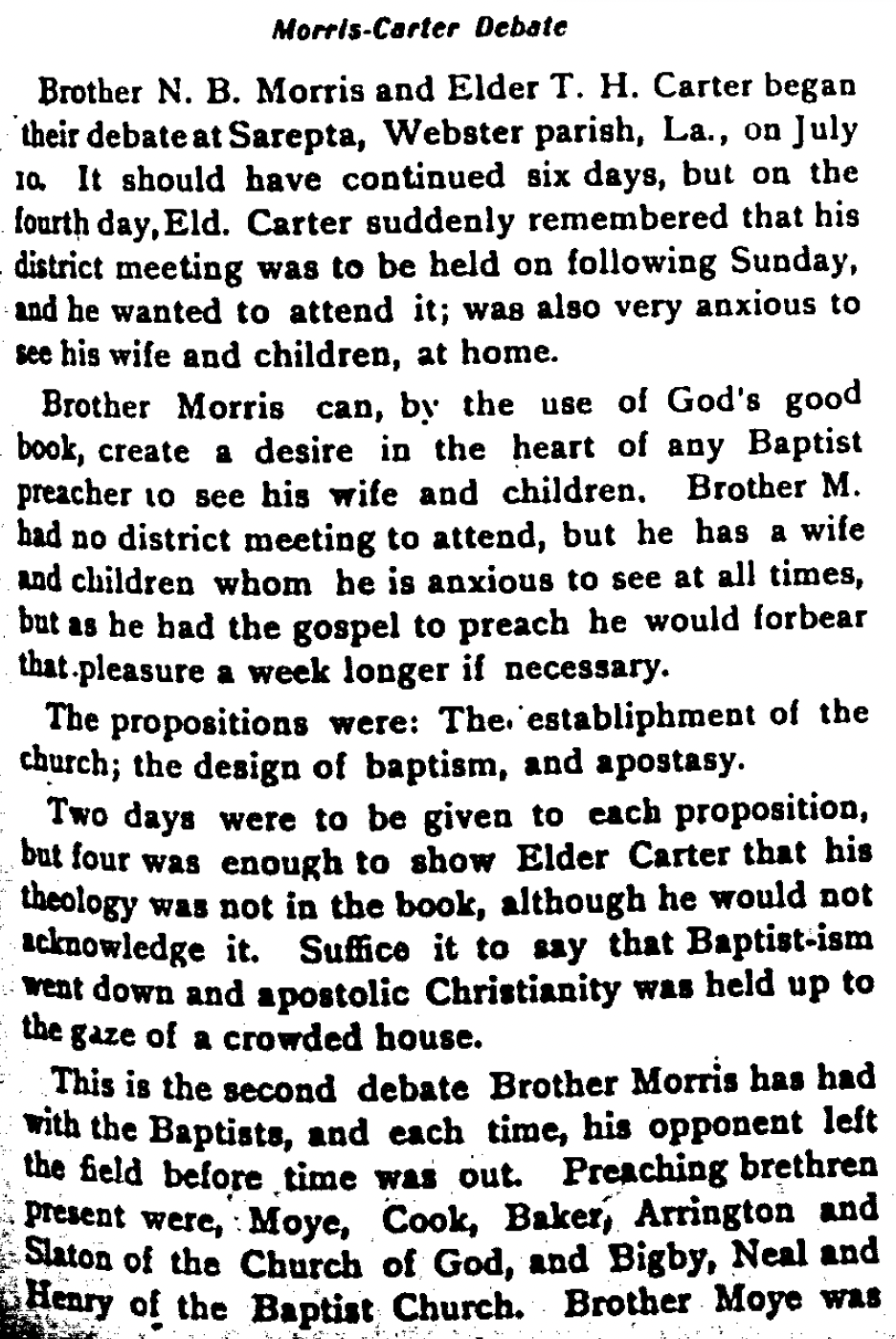
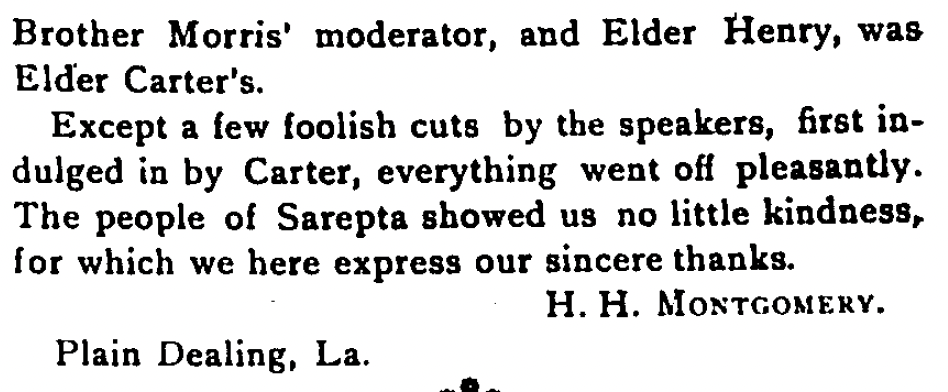
Morris was also known as a defender of his religious convictions in public debate. In July 1899, he met the Baptist elder T. H. Carter to discuss the establishment of the church, the purpose of baptism, and the possibility of apostasy. Another debate with a Baptist preacher named Moye was also reported. Although the surviving information about these discussions is incomplete, their subjects reflect the doctrinal questions that occupied churches of the Restoration Movement during Morris’s lifetime. His willingness to participate indicates both his knowledge of Scripture and his readiness to defend what he believed to be the truth.
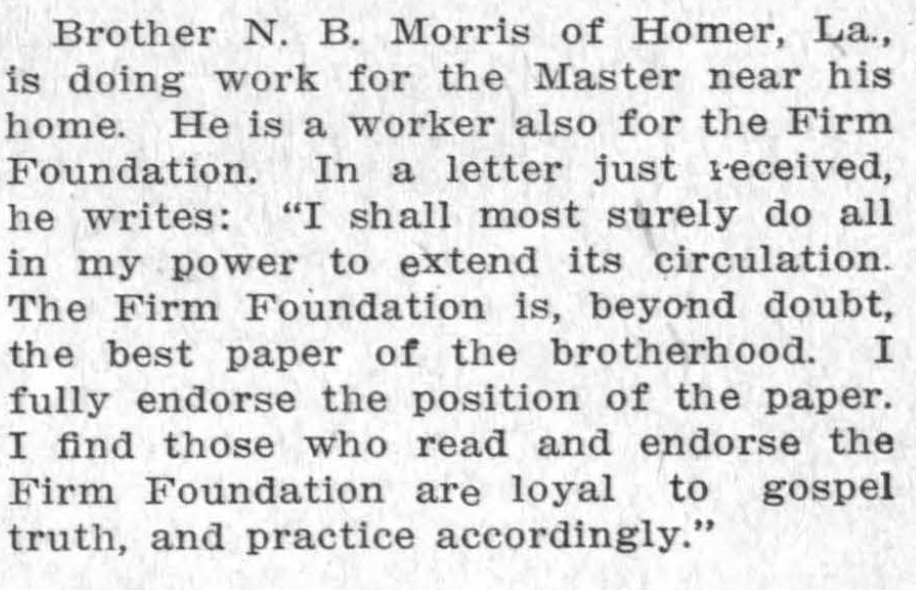
By 1910, Morris was living and working in the Homer and Summerfield area of Claiborne Parish. He continued farming while maintaining an active preaching schedule. He also worked on behalf of Firm Foundation, which he endorsed because of what he regarded as its loyalty to gospel teaching.
His work with the Union Grove congregation near Homer provides a particularly meaningful example of his ministry. The congregation had become discouraged, and some members had grown negligent. With Morris’s assistance, it was reorganized with twenty-eight members and elders and deacons were appointed. When he returned to preach, sixteen more people were received, bringing the membership to forty-four. Frank Kinder described Morris as “an able and loyal gospel preacher” who deserved the support of the brethren. Morris then agreed to continue preaching for the congregation each month.
His services remained in great demand. In August 1911, Firm Foundation reported baptisms at Arcadia, Texas, followed by a meeting at White Rock that had already produced a confession and six restorations. The notice added that Morris’s time was fully committed until November. Behind that simple statement lies a life crowded with travel, sermons, personal instruction, baptisms, and the care of scattered congregations.
N. B. Morris died at Camden in Polk County, Texas, on November 11, 1915, at approximately fifty-four years of age. Family information indicates that his death resulted from arsenic poisoning and appeared to have been self-inflicted. It has been suggested that, while suffering from severe diabetes in an age before insulin treatment became available, he may have been attempting to obtain relief from his illness. This sorrowful and uncertain circumstance should therefore be approached with compassion and should not be allowed to overshadow the faithful course of his life.
He was laid to rest in Barnum's Pine Grove Cemetery in the East Texas country where he had spent so many years preaching. The words placed upon his grave stone express how his life was remembered:
“I have fought a good fight.
I have finished my course.
I have kept the faith.”
Those words from the apostle Paul form a fitting memorial. N. B. Morris was respected not because his life was easy or untouched by sorrow, but because he answered the call to serve. He planted and strengthened congregations, helped appoint their leaders, preached in communities others might have overlooked, baptized many believers, reclaimed the discouraged, and stood firmly for his understanding of the Scriptures. His contemporaries called him first-class, able, loyal, bold, kind, and impressive. Their reports consistently portray a good man who did the work of the Lord readily and without hesitation.
His earthly course ended under a cloud of personal suffering, but the larger record of his life is clear. Across the farms, sawmill settlements, small towns, and country congregations of Texas and Louisiana, N. B. Morris left the enduring influence of a servant who went where he was needed, preached what he believed, and kept the faith.
Sources
A. J. McCarty, “In the Field,” Firm Foundation, June 9, 1896, p. 6.
A. H. Speer, report from Lovelady, Gospel Advocate, September 24, 1896, p. 621.
R. T. Walker, report from Trinity, Texas, Firm Foundation, July 20, 1897, p. 8.
H. H. Montgomery, report concerning work in northwestern Louisiana, Firm Foundation, February 15, 1898, p. 56.
Reports of the Morris–Carter and Morris–Moye debates, Firm Foundation, 1899.
N. B. Morris, notice concerning his work for Firm Foundation, January 4, 1910, p. 3.
Frank Kinder, report from Homer, Louisiana, Firm Foundation, March 22, 1910, p. 5.
Evangelistic report, Firm Foundation, August 29, 1911, p. 5.
United States census and family-history information supplied by descendants.
Alva Morris von Heimburg, family correspondence, August 3, 2026.
-Scott Harp, August 10, 2026
Possibly 1897 Wedding Photo
N. B. Morris & Bertha Ada Brewer
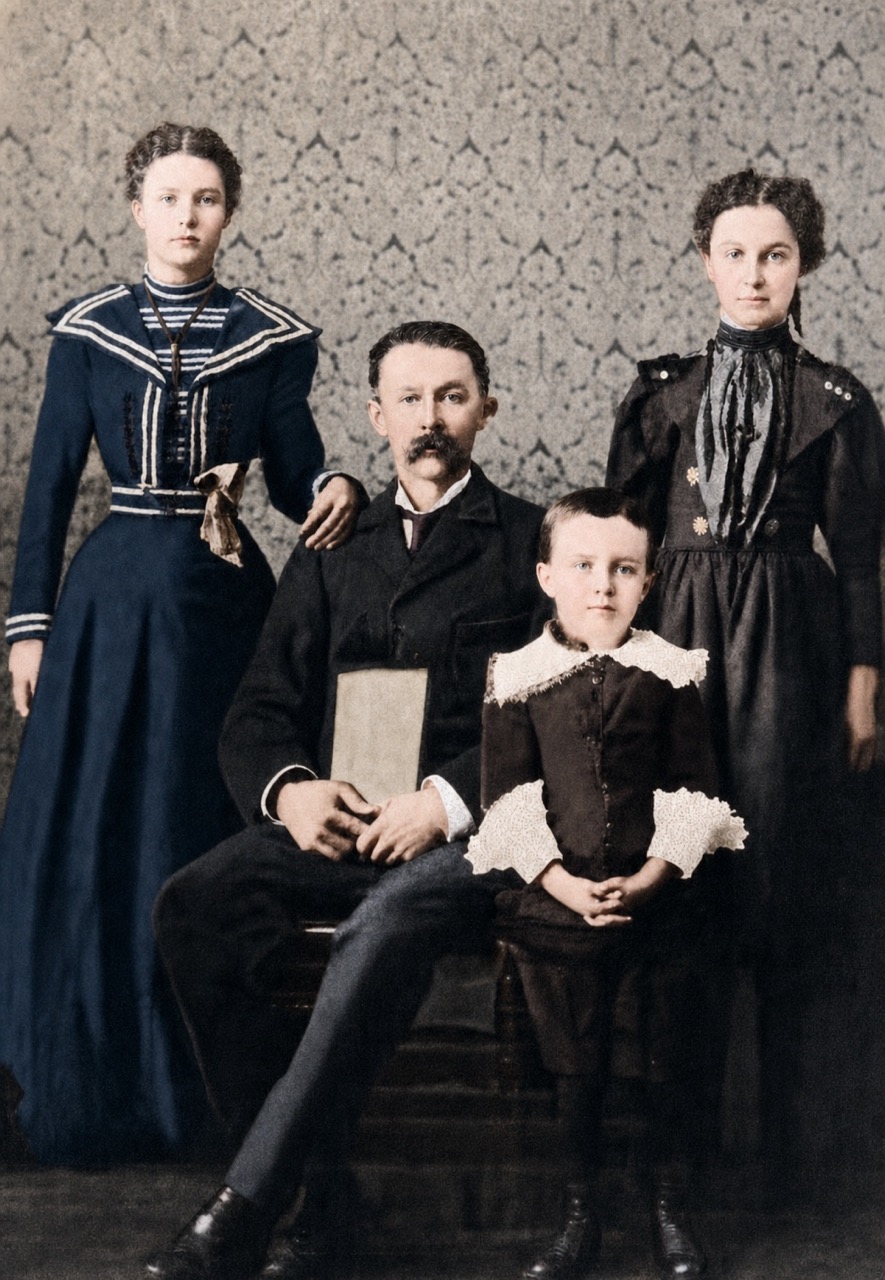
LtoR - Ada, N. B., Mac and Willy Morris
July 21, 1897
Reports
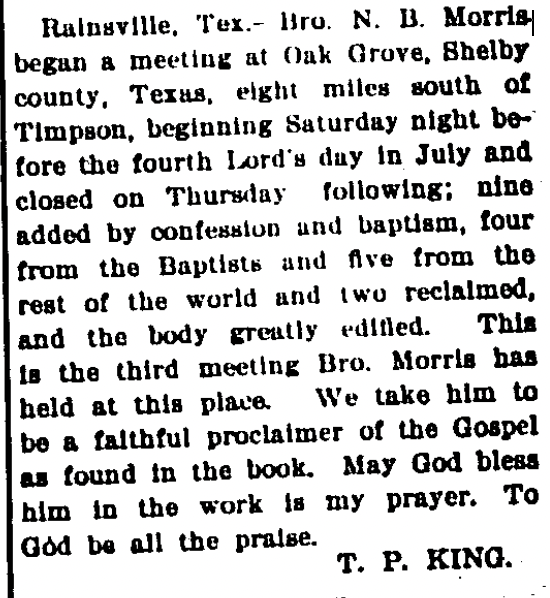
Firm Foundation, August 17, 1897, p.5
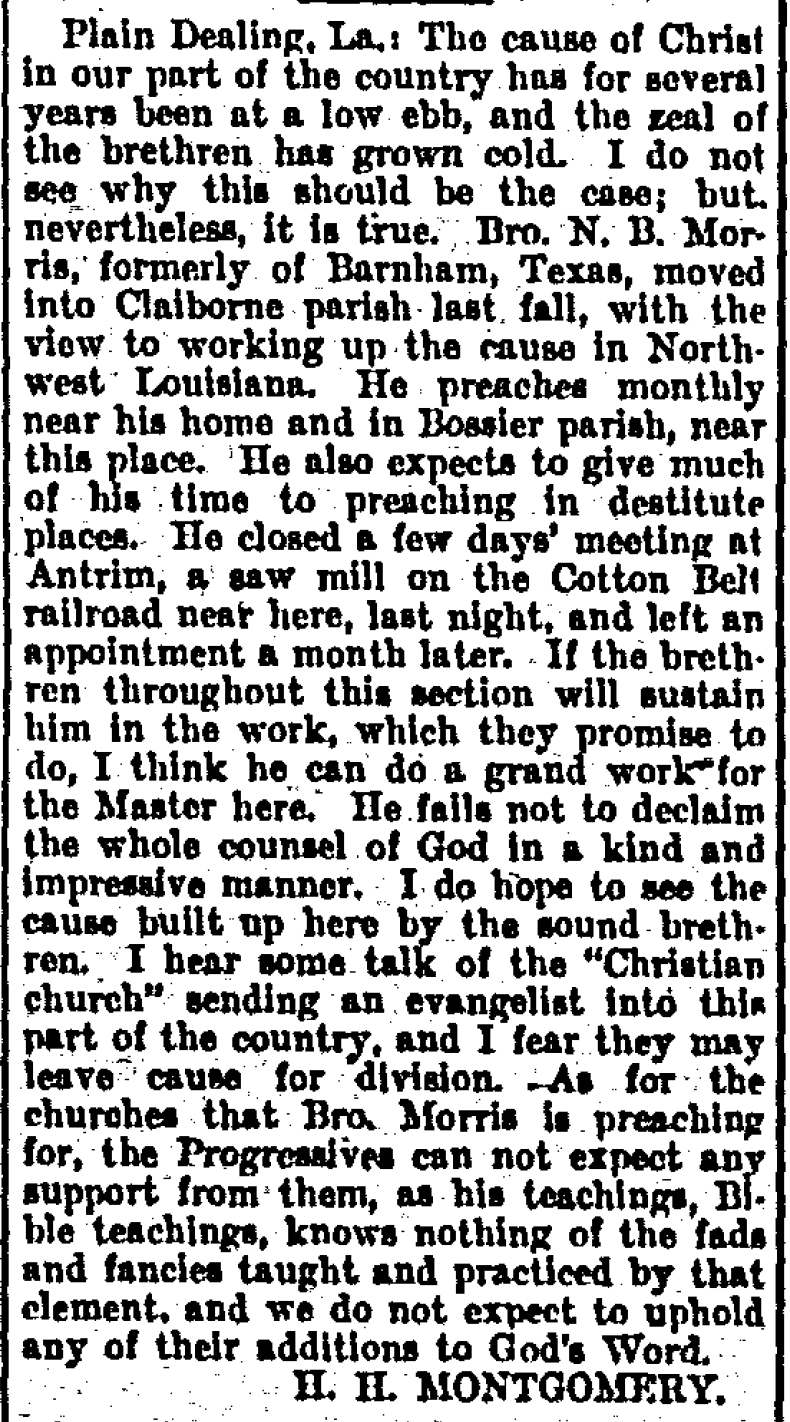
Firm Foundation, February 15, 1898, p. 56
Firm Foundation, July 25, 1899, p. 473
Firm Foundation, January 4, 1910, p. 3
The Houston Post, Houston, Texas
Wednesday, July 7,
1897, p.9
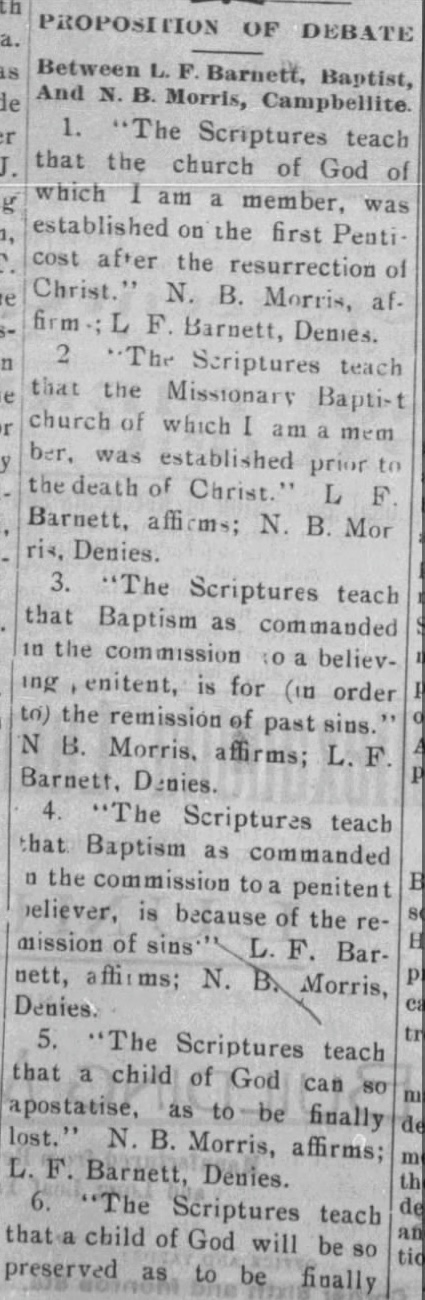
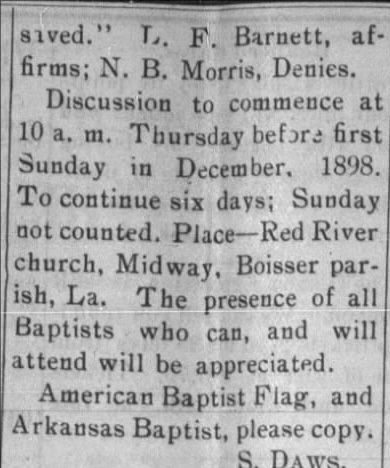
The Baptist Chronicle, November 10, 1898
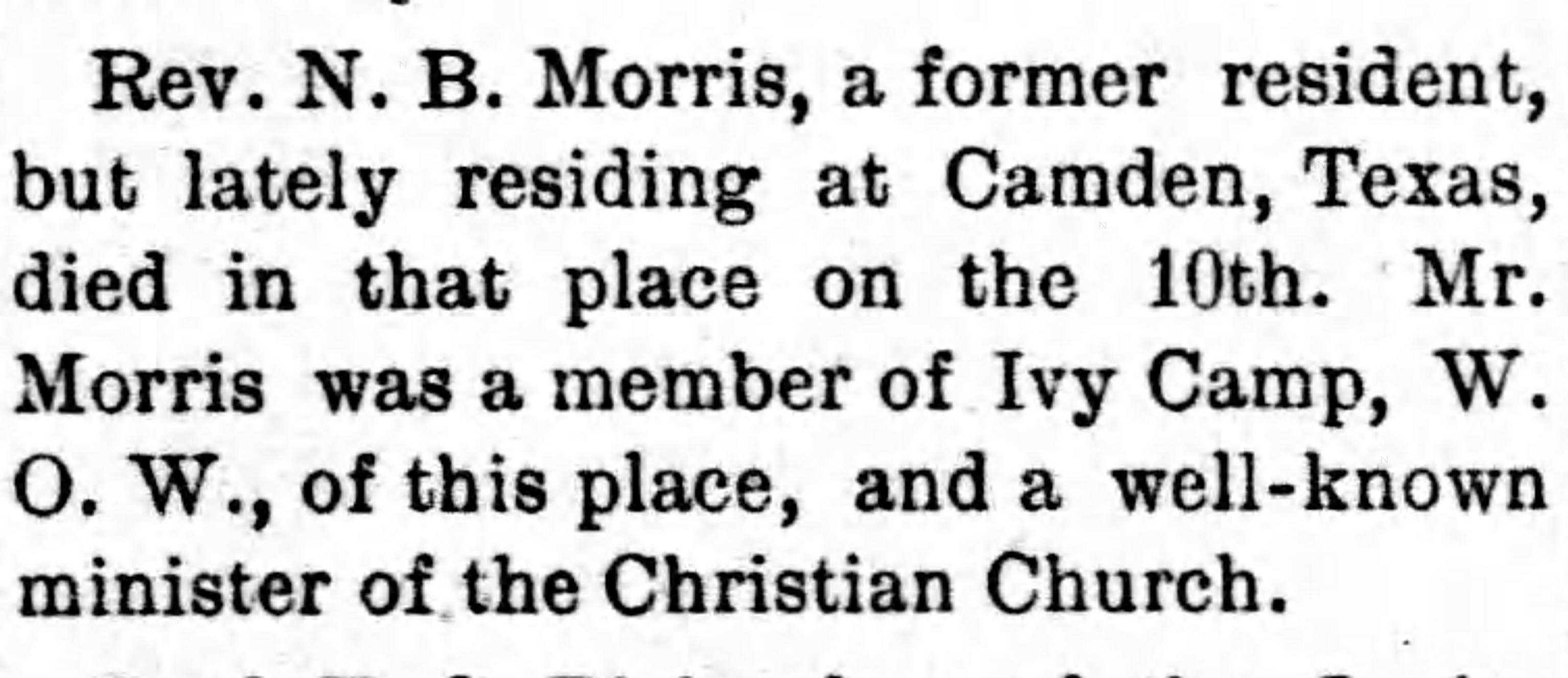
Bossier Banner Progress, Bossier City, Louisiana
Thursday, November 18, 1915, p.3
Directions To Grave
N. B. Morris is buried in the Pine Grove Church Cemetery in Barnum, in eastern Texas, SE of D-FW and NE from Houston. The church address is 214 Pinegrove Church Rd., Corrigan, Texas, 75939. Head east out of Corrigan on Hwy. 287. Just as you are about to enter Barnum, turn right on Barnum Loop Rd (Hwy. 62). Then turn right on Pinegrove Church. Rd. The cemetery is located near the church. The exact location in the cemetery is uncertain to this writer, so you will have to look around for it. It should be easy to find as the marker is a Woodman Of The World marker. GPS below is of the cemetery location.
GPS Location
30°57'00.9"N 94°41'48.6"W
or D.d. 30.950260,-94.696820
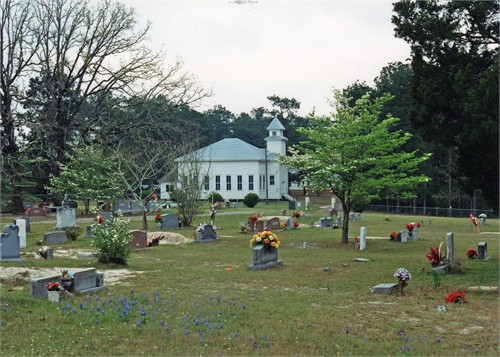
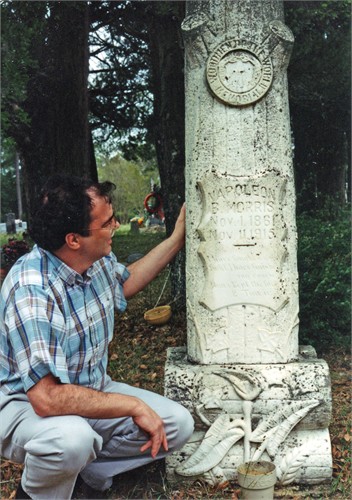
Photo of grandson of N. B. Morris at the grave
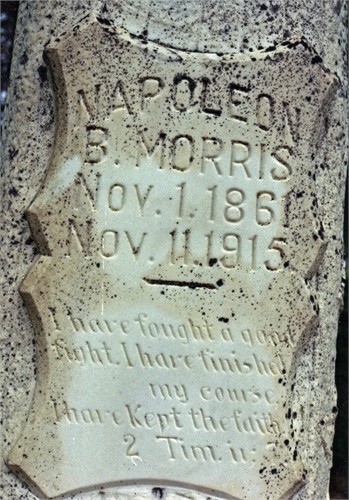
Napoleon
B. Morris
November 1, 1861
November 11, 1915
I have fought a good
faith. I have finished
my course.
I have kept the faith
2 Timothy iv: 7
Photos taken or provided by family members
Webpage produced: 08.10.2026
Courtesy Of Scott Harp
www.TheRestorationMovement.com
Special Recognition: I first became aware of N. B. Morris several years ago as being one of the over one hundred preachers featured on D. S. Ligon's Portraiture of Gospel Preachers in 1899. Just recent to the production of this page (August, 2026) I was contacted by Morris's 80 year old grandson, Alva Morris von Heimburg with information on her grandfather. As I usually do not produce a webpage for a Restoration Movement preacher until I visit the grave, I will usually build a page when a family member sends me information and photos at least of their grave. Special thanks to Alva for providing the information, photos, etc. to make this page possible. Also, thanks to my good friend and late fellow laborer in all things Restoration Movement, Tom L. Childers, who passed away in November, 2025. He is truly missed. He provided the scan of the Ligon Portraiture picture you see at the top of this page.