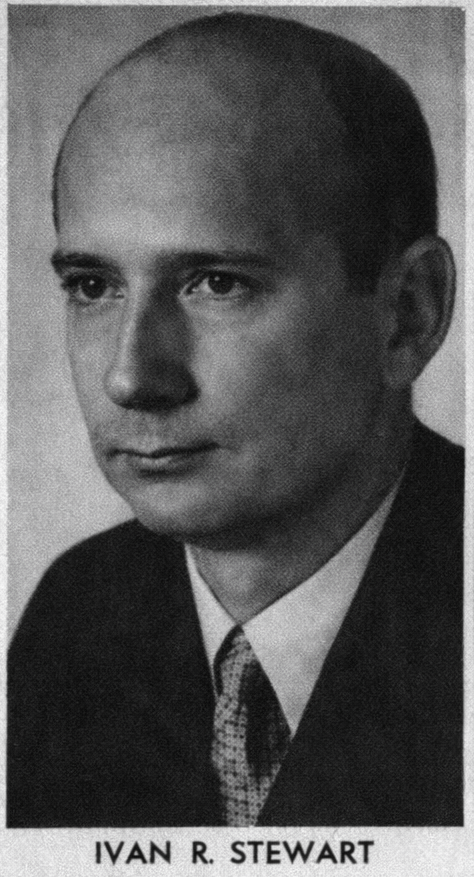
Ivanhoe Robert Stewart
1922-2022
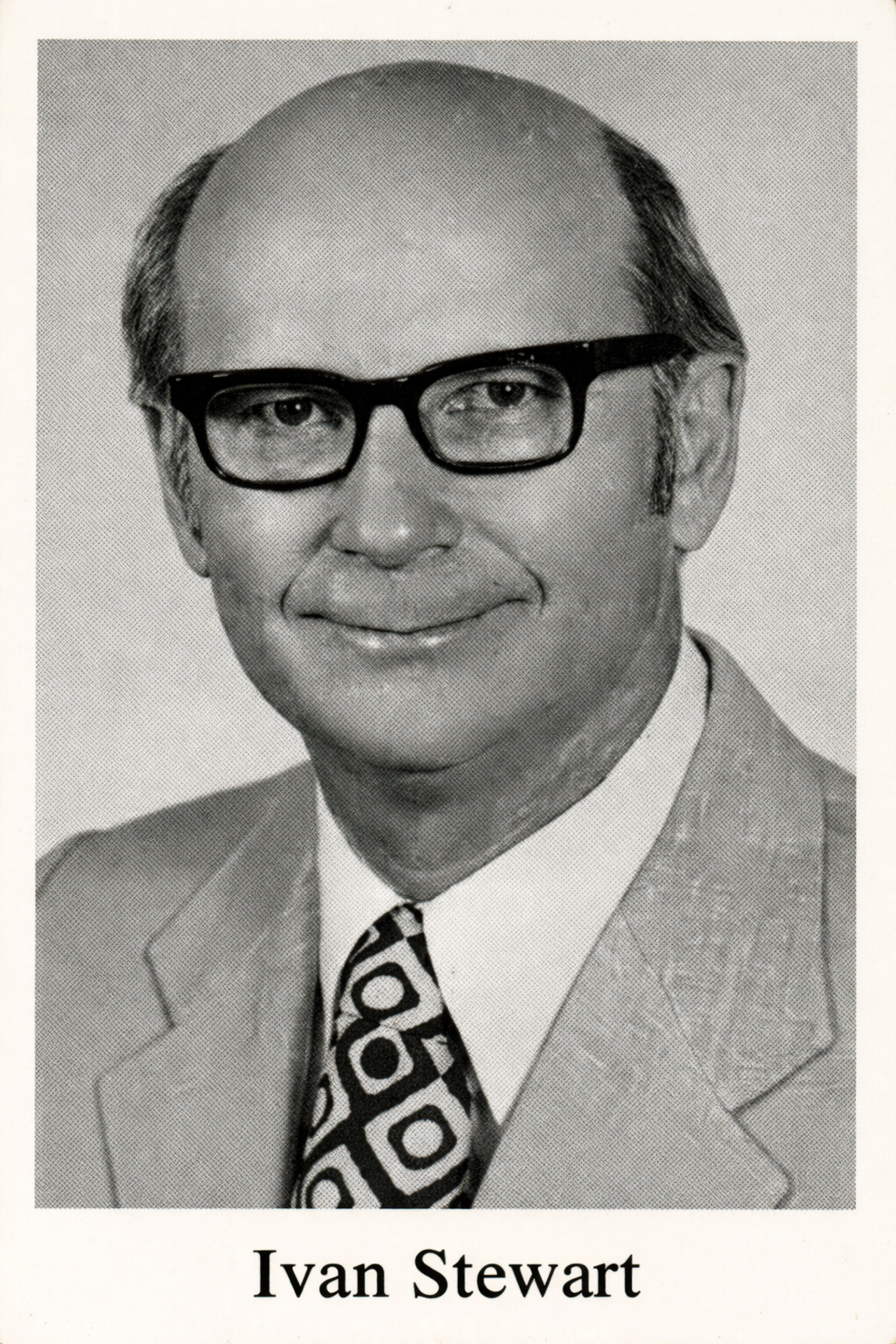

Ivan Robert Stewart: A Biographical Sketch
“I live, eat, and sleep this soul business,” said Ivan Stewart in 2007 during one of his last soul-winning campaigns. And so he did. Ivan was a man of contrasts. He could be confrontational one moment and avuncular the next. If you were around him very long, he would strike you as both inflexible and compromising, demanding and forgiving, opinionated and open-minded—a maverick on certain issues and orthodox on others. He reminded you of what another true believer, the apostle Paul, might have been like.
How did this veteran of Pearl Harbor and Guadalcanal, this representative of the “greatest generation,” come to be a successful trainer of soul-winners and the leader of numerous evangelistic campaigns over the past 70 years? His story parallels the history of churches of Christ in the latter half of the twentieth century.
The Early Years (1922-1950)
Born in Gainesville, Texas, on October 24, 1922, to a Catholic mother and a backsliding Methodist father, Ivan Robert Stewart had little in the way of a spiritual upbringing. His only memory of religious training from his mother was learning the bedtime prayer, “Now I lay me down to sleep.” He briefly attended various churches and went to a summer camp organized by Episcopalians, but his religious education was spotty at best.
The family moved to Shawnee, Oklahoma, the year Ivan entered the ninth grade. He graduated from high school there in 1940 and, eager to escape a domineering mother, joined the Navy on November 4 of the same year. The Navy sent him first to San Diego for training and then shipped him out to Pearl Harbor with a PBY (flying boat) Patrol Squadron where he was serving on December 7, 1941, at 7:55 a.m. when the first wave of bombing began.
Knocked to the ground by an explosion some fifty feet away, Ivan remembers being so terrified his “knees turned to rubber,” so much so he could not walk at first but had to crawl along the tarmac amid the planes on fire. Later that day, he helped pull burned and injured bodies off damaged battleships. He never forgot the smell of burning oil pouring from those sinking ships. The strafing of machine guns had missed him by only inches, and he often had nightmares brought on by post-traumatic stress.
Ivan came home on leave in March, 1944. He began corresponding with a hometown girl, Pauline “Polly” Copher, met her for the first time on November 4, 1944, and married her in Santa Ana, California, on November 21, 1944. The couple honeymooned in Hollywood. Polly, born on August 10, 1921, had recently been baptized by Perry Cotham, and her influence on Ivan took immediate effect. She was a committed Christian who would not make a marriage vow to “obey” her groom since he was not a Christian. That situation was soon rectified early in 1945 when J. Emmett Wainwright baptized Ivan into Christ at the El Cahon congregation in San Diego.
Their first child, Sharon Rae, arrived on October 29, 1945. Ivan slowly began teaching Bible classes and preaching occasionally. By December of 1946, he had decided to leave the Navy. Polly was diagnosed with tuberculosis and had two stays in local sanatoriums. Ivan could visit her only three times a week. Owing to Polly’s illness, they remained in Southern California where Ivan enrolled at George Pepperdine College (now Pepperdine University) in the summer of 1947, majoring in Bible and New Testament Languages. He studied Bible under Frank Pack, Dr. W. B. West, and Mrs. Velma West, who taught him biblical Greek.
Ivan received his diploma from Pepperdine in 1950. It was signed by George Pepperdine himself, along with E. V. Pullias, the brother of longtime Lipscomb president Athens Clay Pullias, and Hugh Tiner. At Pepperdine, Ivan had encountered the Paden brothers—Cline, Harold, and Ivan—who intended to do mission work in war-torn Italy. He wanted to go with them, but could not raise support. His first regular preaching stints were in La Habra, Anaheim, and Alhambra, California. Nonetheless, Ivan did develop a six-lesson correspondence course, Foundation Facts for Salvation, that was translated into Italian, French, and German for use in European missions.
From these early years certain influences clearly emerge. The military taught Ivan to be disciplined and organized, skills he would later utilize to effect in his campaigns. Experience as a shoe salesmen introduced him to techniques of persuasion. His college experience gave him tools for ministry, like Greek, and led him to seminal books such as Ashley S. Johnson’s Sermons on the Two Covenants that would later play a role in the development of his evangelistic approach.
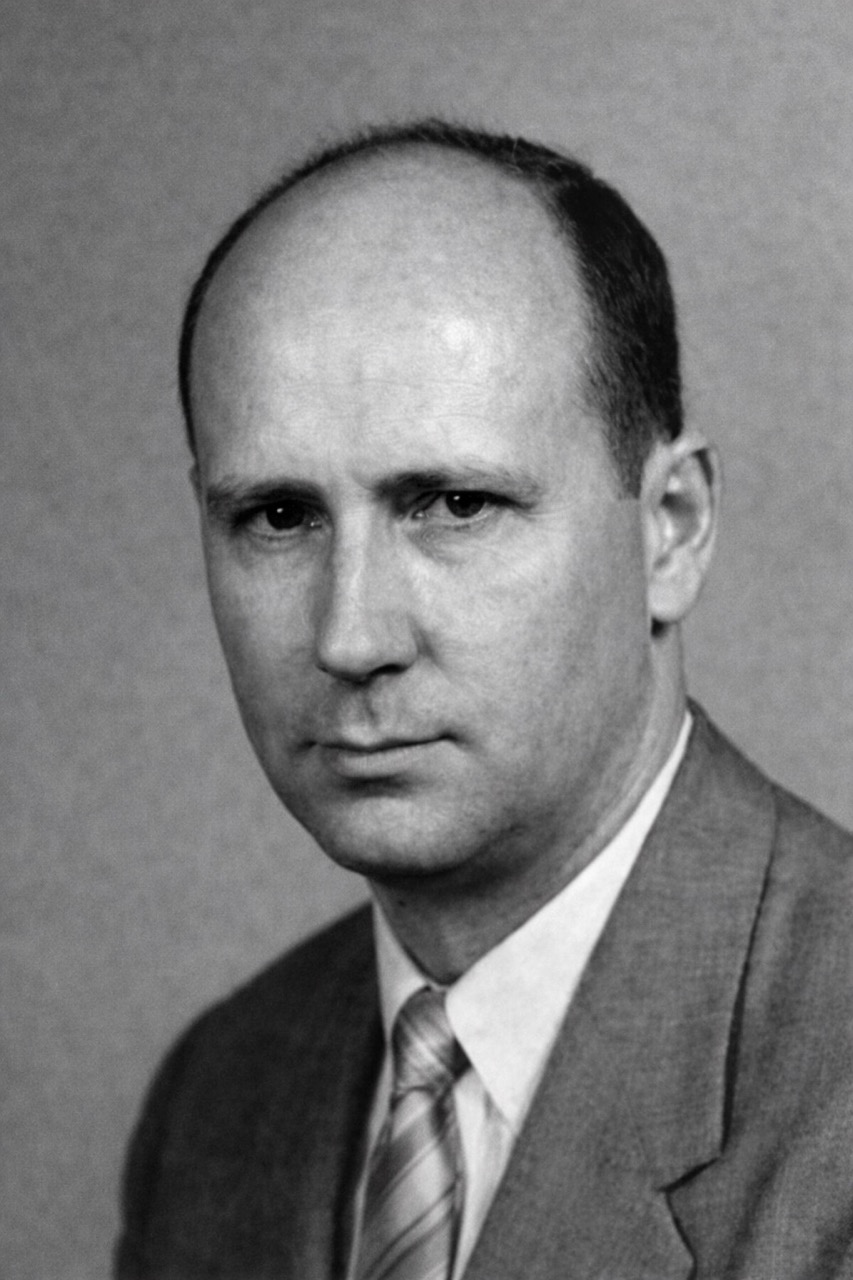
The Maturing Years (1951-1961)
Ivan and Polly wanted to return home to Oklahoma. Unfortunately, preaching positions there were difficult to come by in 1951, so the young family of three moved to the Washington, D. C., area as missionaries charged with the responsibility of doubling a tiny congregation in West Hyattsville, Maryland. The salary was so low they had to live with members of the church, but Ivan baptized twenty-eight people in two years. This success caught the attention of Fred Walker, a preacher in nearby Arlington, Virginia, later to become a professor of speech at David Lipscomb College (now Lipscomb University). Fred invited Ivan to come to Skyline Bible Camp and work as a spiritual counselor to the teenagers. Many of them were baptized, and Fred exclaimed, “How are you doing this, Ivan? You’d better write this down!”
Meanwhile, his family was growing. Michael Ivan was born on September 16, 1952, and Rebecca Sue followed a year later on September 17, 1953. Searching for a preaching job closer to home, Ivan rode a train to the Lipscomb lectureship in Nashville and then a bus to the Abilene Christian College lectureship in Texas. In Abilene, he met elders from the Netherwood Park congregation in Albuquerque, New Mexico, who offered him a preaching position. He and his family worked under these men for seven years, during which he took Fred Walker’s advice and published From House to House: A Manual on Personal Work (1956).
Otis Gatewood’s You Can Do Personal Work (1951) had inspired Christians to do the work of evangelism, but it lacked detailed instructions on precisely how to go about it. From House to House filled this void, and The Old Paths Book Club bought the entire first printing. Ivan quickly sold the second printing following his presentations at the Abilene Christian Lectureship. The brotherhood was hungry for direction, and this first book, still in print, sold more than 50,000 copies. Willard Collins, former president of David Lipscomb, hailed From House to House as “a classic in its field.”
Success led Ivan to a new preaching job in Wichita, Kansas. In 1960, he completed an M.S. degree in psychology at Wichita State University and left Kansas for a new post in Colorado Springs, Colorado. Soon the elders in Albuquerque invited him to come back there. During this second stay in New Mexico, Fred Walker, who was leading summer evangelistic campaigns for David Lipscomb College, invited Ivan to lead the personal teaching on a June 1962 campaign to Glasgow, Scotland. A few months before this campaign began, Ivan had tested some ideas in Espanola, New Mexico, where overflowing crowds at a small congregation greatly encouraged him to make campaigning his personal ministry.
The Campaigning Years (1962-1977)
The excitement and success of campaigns to Wellington, New Zealand, and Edinburgh, Scotland, in 1963 were quickly followed by tragedy, grief, and disappointment. On September 11, 1963, Ivan and Polly’s daughter, Sharon, was killed, along with five other Oklahoma Christian students, in a car/train accident that occurred during a driving rainstorm as they were returning to campus from Wednesday-night services. Coupled with this, a program called Campaigns for Christ International, based in Lubbock, Texas, failed because many congregations opposed using professional fund raisers for mission efforts. Ivan had been hired to direct this program and was let go within a year when support could not be found.
Ivan and Polly moved back home to serve the 25th and Geraldine congregation (now the Northwest Church of Christ) in Oklahoma City. There Ivan preached and led campaigns for seven years. Some of these included Brisbane, Australia, in 1965, Philadelphia, Pennsylvania, in 1967, and Ontario, Canada, in 1970. He considered his most successful domestic campaign to be one he led to Hawaii in 1965. In addition to campaigns, Ivan also taught Saturday workshops on personal evangelism that became increasingly popular.
Campaigning grew into a full-time work as Ivan moved his ministry to Arlington, Texas, in 1970. Under the oversight of the elders of the Randol Mill congregation (now the North Davis Street Church of Christ), Ivan founded “The School of Practical Evangelism.” There he trained ten to twelve students a year and conducted three campaigns a year to cities such as Baltimore, Maryland (1972), Colorado Springs (1975), and Seattle, Washington (1976). International campaigns reached as far as Wellington, New Zealand (1973), Salisbury, Rhodesia (1974), Benoni, South Africa (1975), and Sydney, Australia (1976). The staff of the school consisted of Ivan, a secretary, a fund-raiser, and a bookkeeper. The school became an experimental lab for his approach to soul-winning. Out of his experience and research came a second book, Go Ye Means Go Me (1974), that Frank Pack called “the most fascinating and sophisticated book of personal work techniques of our time.”
According to Ivan, “Preachers and elders are in the behavior modification business.” In Go Ye Means Go Me, Ivan brought to bear his formal training as a psychologist. He proposed an “open Bible” method of evangelism whereby personal teachers are in “the share/share business rather than "the tell/tell business.” Rather than engaging in “theological gymnastics” with a person by giving canned answers to all sorts of religious objections, Ivan suggested letting the seeker “find his own way” by reading the scriptures for himself or herself in a process of guided discovery. This book also sold more than 50,000 copies.
During these campaigning years, Ivan put to work his graduate studies in psychology. He concentrated on the question of persuasion and on how best to present the gospel convincingly. He honed the organizational and logistical aspects of his campaigns. His monthly newsletter, Campaign Voice, was mailed to over 20,000 addresses. He continued to refine the chain of scriptures he used to teach the gospel until it reached its final form in the three Open Bible Study (1975) lessons and worksheets.
These years also impressed upon him the insecurity of working under elders who could be quixotic, arbitrary, or ineffective. He learned the lessons of a brotherhood suspicious of church cooperation. His sometimes painful experiences sowed seeds that eventually grew into a desire to make his ministry financially independent of any local congregation or eldership.
The Independent Years (1977-2009)
In 1977, Ivan and Polly Stewart moved back to Oklahoma City where they bought a house and ran Ivan’s ministry out of a home office. His last major international campaign was to Adelaide, Australia, in August 1981. From 1977 to 1998, he conducted about three evangelism workshops each month for congregations across the nation. These Ivan Stewart Personal Teaching Improvement Courses ran from Friday through Sunday. Ivan charged tuition to each student (sometimes paid for by their congregations) and sold study manuals and materials as well. He always emphasized “Bible school evangelism,” whereby Bible school teachers were encouraged to set the example in leading young people (ages 13-18) to Christ.
Ivan sold the publishing rights of his copyrighted materials in 1989 to Leon Estep, a professor at Southern Christian University (now Amridge University). Leon began to conduct the evangelistic workshops using Ivan’s methodology. In 2004, Leon sold these rights to Rick Alexander of Newcastle, Oklahoma, who continued to market Ivan’s materials and conduct workshops for congregations interested in learning and implementing the Open Bible Study System approach to personal evangelism.
Though retired, Ivan continued to think and write. His book, You and Your Congregation Can Seek and Save More Souls (2004), explained his concept of “ripple campaigns.” Ripple campaigns were small evangelistic campaigns aimed at helping individual congregations grow. His idea was for twelve experienced campaign workers to travel 300 miles or so to a smaller congregation in order to pair up with twelve trained members of that congregation in order to contact prospects and conduct open Bible studies. These small, low-budget campaigns with a strong training component were intended to create a ripple effect of encouraging churches and spurring growth. Ivan’s last ripple campaign was to Dodge City, Kansas, in September, 2007.
The Final Years (2009-2019)
After leading over 4000 Christian workers on some forty-nine campaigns across the world and the United States, Ivan Stewart continued to think about soul-winning well into the ninth decade of his life. "The happiest moments I have,” he used to say, “are seeing new births into Christ.” In keeping with that, he self-published a new book, Prospecting for Souls, in 2011 and still another, Shepherds and Shepherding in 2014. During these years, Ivan's evangelistic books and materials were distributed first by Roger Shepherd, an associate professor at Amridge University, Montgomery, Alabama, and most recently by Jim Mitchell, minister of the Cherokee Hills Church of Christ in Oklahoma City, Oklahoma. Amridge University conferred an honorary doctorate on Ivan in 2012.
Ivan and Polly Stewart had an almost symbiotic relationship. As he often said, “I could not have accomplished this much in my time without the help of my devoted companion.” Polly was indeed his confidant, his sounding board, and his gray eminence. In their retirement years, the Stewarts worshiped and worked at the North MacArthur Church of Christ in Oklahoma City.
Polly died on July 4, 2009, from complications of a brain aneurysm at the age of 87. Ivan and Poly had been a team for 65 years. Within a few weeks, however, mutual friends told him there was a lady he ought to meet, Maryfern White, the widow of Ken White. Ivan and Maryfern hit it off immediately and married on October 15, 2009, just 100 days after he lost Polly. Although twelve years Ivan’s junior, Maryfern shared his commitment to the kingdom of God and its increase. As for his part, he made a point of telling her every day that he loved her. Ivan Stewart passed from this life on April 24, 2019, at the age of 96 and a half due to complications resulting from pneumonia and congestive heart failure.
“Ivan Stewart could sell ice to Eskimos,” said Paul Lakey, former professor of communication at Abilene Christian University and long-time friend of the Stewarts. Ivan was a builder, an organizer, a writer, a devoted husband, a craftsman, a dreamer, an innovator, a promoter, a proud grandfather, a soul-winner, a problem solver, an entrepreneur, a psychologist, a teacher, an independent contractor, a word maven, a coach, a discipler, a matchmaker of preachers and congregations, a creative thinker, a persuader, and a doer. May God bless all those who, like Ivan, have given their lives to bringing souls to Christ.
-John H. Williams is a member of the church of Christ on McDermott Road in Plano, Texas. Contact him at john@tritebuttrue.com
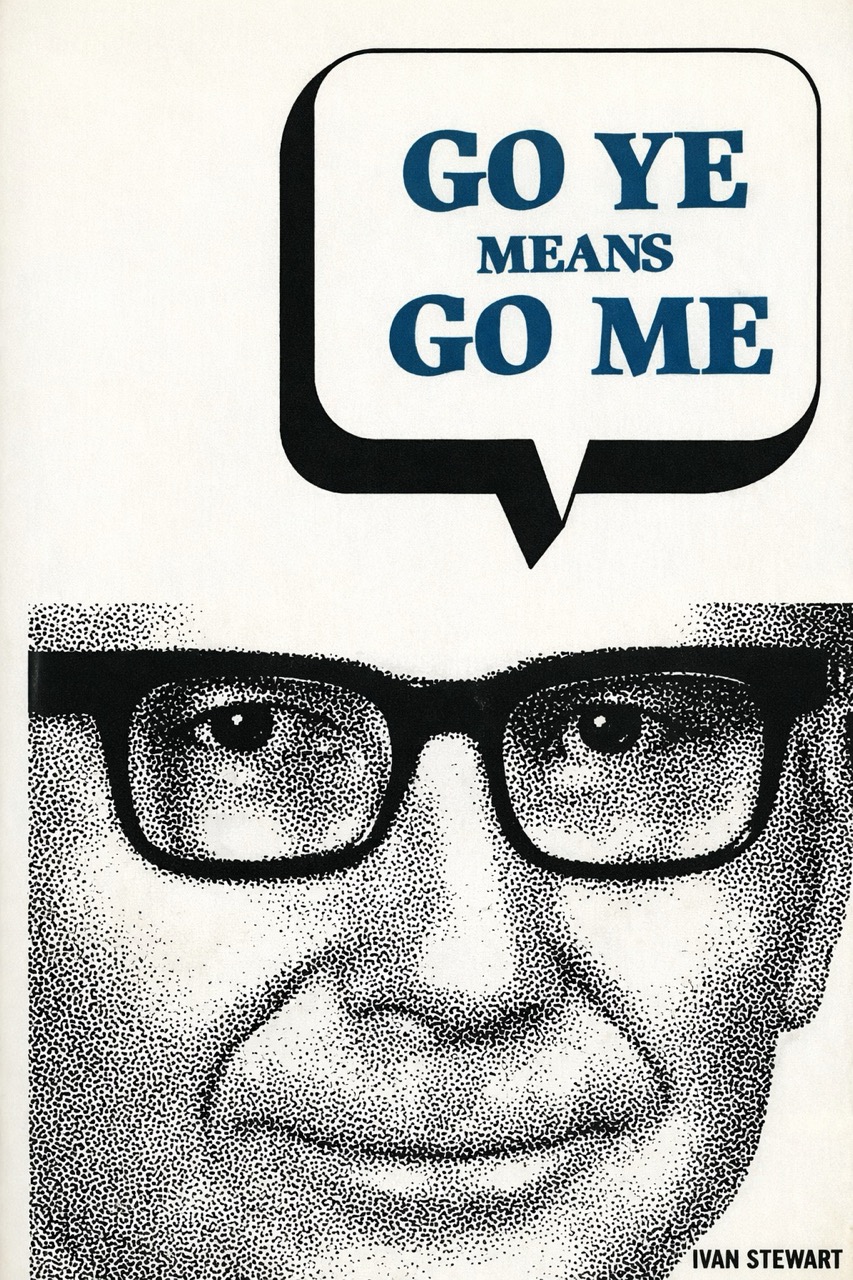
GO YE MEANS GO ME
PREFACE
WHY? WHY? WHY? WHY?
During the past 27 years, I have been involved in evangelism publicly and privately, in and out of the pulpit, in and out of the United States. Many times these questions have been asked: (1) Just how were you led to Christ? (2) How did you become so interested in evangelism? (3) How did you get involved in campaigns for Christ? and (4) Why did you write the Open Bible Study? I have been surprised to have been asked these questions — but perhaps answers to these questions will make it possible to better understand the thrust of this book.
LED TO CHRIST
In 1940, I entered the U.S. Navy and was at Pearl Harbor, Territory of Hawaii, when the Japanese attacked. I was not a Christian. That Sunday morning is still as vivid as it was December 7, 1941. I remember a plane flying over Ford Island Naval Air Station where I was stationed with a Patrol Squadron using PBY’s. On that morning something fell on the hangar from a plane flying low over the seaplane hangar. The first impression was that the plane had lost something and about that moment the concussion from the bomb that hit the seaplane hangar was felt, knocking me to the seaplane ramp where I was stunned for a few moments. Realizing that something was serious, I ran across the seaplane ramp through another seaplane hangar. Realizing further that these hangars were the targets for bombing, I ran for protection under a water tower, which also proved not to be safe. I then tried to run, but my feet would hardly carry me, and I fell into a ditch alongside the airfield, which was later strafed with the line of bullets missing the edge of the ditch by only six inches. I became religious for a short time with a group that was called the Navigators in Honolulu but this was short-lived. The next few years were spent in the South Pacific in the Fiji, Guadalcanal and Russell Islands. During this period, the life of a “sinful sailor” life prevailed, but periodically I found the need for God and on several occasions tried to gather men together to sing, pray and study God’s word. At one point, it appeared that we would stay in the South Pacific forever. I erected a tent and invited a number of sailors to Sunday worship. Only a few came and it was not long till I drifted back to my old way of life.
In 1944, I returned to my home town of Shawnee, Oklahoma (on leave). I had met my wife, Pauline Copher, many years earlier as a student in High School but it was not till I was home on leave from the Pacific that we met again. Polly, as all affectionately know her, only a short time before, had become a member of the church of Christ through the influence of a girl friend. Prior to that she had attended the Baptist, Methodist and United Brethren churches, seeking the truth. She had not been taught she should marry a Christian — we were married November 21, 1944. Even though she had been a member of the church for only a short time, she was taught that she should be faithful to God and insisted on attending services with or without me. It was my attitude, “One church is as good as another,” and “the church of Christ is too narrow-minded.” She did help me to realize that all of the churches could not be right, so an earnest effort was put forth to see which church was right. Finally, after reading and studying, it dawned upon me that God had spoken in the Bible and that I should listen to Him. Polly continued attending services regularly. As newlyweds, we wanted to be together and this resulted in my attending with her. We studied privately and publicly and it was not long till J. Emmett Wainwright baptized me.
Not long after entering the church, I was called upon to teach and even gave one public “sermon.” Our long-time plans were already being laid. I was a Chief Petty Officer, Permanent Appointment (I’d turned down Warrant Officer to be able to remain stateside) and was well on my way to retirement and security. Plans were to have a shoe store upon retirement. Even with these strong possibilities and plans, one evening, after much private prayer and consideration, I asked Polly — almost in the same vein as if to propose again — “How would you like to be a preacher’s wife?”
BECAME INTERESTED IN EVANGELISM
During high school I took woodwork and drama to get through — those were the things that interested me most. When in college, preparing for the ministry, it became clear that preaching alone was not getting the job done. About that time, Morgan Harlan came to the campus as a part-time teacher. Often, he would come to class, asking the class to pray for an individual student with whom he was studying privately, and would later tell the class of a baptism resulting from these private studies. This impressed me, because I saw few baptisms occurring after sermons — the very work for which I was preparing. I tried some of his ideas, studying with others. During the first six months, no one was baptized. I thought, “I’ll quit — I’m a failure.” Yet, because I saw the truth through an open Bible and because someone was interested enough in me to keep studying with me, the thought continued to plague me that the way to win others was through an open Bible — truly it was the power of God unto salvation.
One day, an appointment was made with a young preacher of a denomination whose attitude was that he was going to convert me to his denomination. He did not want to study where he preached. We parked the automobile in a park and opened all the car doors and opened our Bibles. His heart was opened as we studied and he was baptized. This was the first taste of success. The message came through as to what method should be used in winning souls — the open Bible.
During the war, my mind often turned to such thoughts as, “If we could only help people, we could eliminate wars.” “If the Japanese had studied the Bible they would not have attacked Pearl Harbor.” I remember preaching a sermon many years later entitled, “The Devil Attacked Us” based upon the Japanese attack at Pearl Harbor. I often thought, “I wonder if I could ever return to Honolulu and preach the gospel,” “I wonder if I could ever return to the Fiji Islands to preach Christ,” and “Oh, if I could right the wrongs of some of the sins I committed in years before at these places.” Upon graduation from college, Harold Paden, a dear, dear friend, asked me to go to Italy with him. Polly had tuberculosis then and was in a sanitarium, which prevented even the slightest consideration of that matter. I continued to preach in the pulpit and to study privately with people in their homes. The experiences in private studies provided illustrations and practical sermons but my emphasis continued to be in the field of personal evangelism.
INVOLVEMENT IN CAMPAIGNS
In 1952, we moved to the Washington, D.C. area to preach. While there, Fred Walker (now professor at David Lipscomb College, Nashville) invited me to work with him at a Youth Camp. During the camp I studied with students who had come to camp from non-Christian homes. We studied under trees while others were involved nearby in recreation. The tight camp schedule was constantly being interrupted with these students wanting to be baptized. Fred Walker said, “Ivan, why don’t you put into writing how you do this?” I replied, “I don’t know how I do it — I just do it. Furthermore, I took woodwork and drama in high school and nothing in college in writing — I can’t write a book.” He insisted and I began to observe myself to see how it was being done. In time, a pattern was seen and it surprised even me that there was a pattern. It took several years, but in 1955 the book From House to House was completed. Now many thousand copies of this book have been distributed throughout the world, and it is used in most of our Christian colleges and in some denominational colleges.
When the Joywood congregation in Nashville, Tennessee invited Fred Walker to preach in a campaign in Glasgow, Scotland, he, in turn, called and asked if I would direct the personal work. Directing personal work was not a part of my experience at that time — much less campaigning — but I accepted. To make preparation for the campaign, the good elders of the Netherwood Park congregation in Albuquerque, New Mexico (with whom we were very closely associated over a ten year period) permitted me to direct a “campaign” in a nearby area so that I could have some “experience.” Espanola, New Mexico was chosen and ten Christians went to knock on doors on Saturday and Sunday. A total of nine souls was baptized. Much was learned about campaigning and now I was “prepared” for the Scotland campaign.
My work began involving me in campaigns each year in addition to local work. Many brethren suggested that since campaigning was predominately personal work that we arrange a permanent campaign effort. During several campaigns, much thought was given as to how campaigning could be an established, regular work with year-round training, preparation and actual campaigning, involving brethren from throughout the brotherhood. The 25th and Geraldine eldership in Oklahoma City invited me to begin such a work while serving as minister.
Both the local work and campaigning grew rapidly and within two years another man was employed as minister and I began spending full time in campaigning. From that time till this, I have been associated with permanent Campaigns for Christ and now also the School of Practical Evangelism — both efforts now are overseen by the elders of the Randol Mill Road church of Christ in Arlington, Texas.
OPEN BIBLE STUDY (OBS)
Almost from the beginning, when called upon to speak at Christian College Lectureships and congregations, introductions included the term Open Bible Study. A chain of Scriptures was given in the book From House to House with procedures. These Scriptures were chosen because they answered the questions most people have, they told the story of how to obtain salvation, and they gave the fundamentals of the “Will of God” in an order which could be described as building a house. When other problems were introduced (that are not covered in the chain), then side-track Scriptures could be used. Men do not put a roof on a house first but rather build the foundation first and other elements of the house at the right time and in the right place until completed. Campaigners and personal workers were encouraged to mark their Bibles with the chain of references so they could move smoothly from one Scripture to another. In a few years, we produced the Personal Evangelism Portfolio, which had the Scriptures printed and remarks underneath. In a few years, brethren insisted that a filmstrip be produced, using the same chain of Scriptures and projected with an accompanying tape recording. All of these works continue to be used.
During the 1967 campaign in Ottawa, Canada, a mail strike was called. This hampered the enrollment of people in the Bible Course Foundation Facts for Salvation. What seemed to be an obstacle was really a blessing. The first lesson was delivered in person to the sinner and an appointment was made to return and grade the lesson. This proved very effective; actually Christians were replacing stamps with feet. A shorter course was needed. Another one was written, but it failed. The reason was that the course was written in “church of Christ” language. Then contacts were made to 200 homes asking, “If you had one question to ask about Christ, church or religion, what would it be?” This gave the answer as to how it should be written. The chain of Scriptures originally used in the book From House to House was written into the Open Bible Study and proved to be most effective. Open Bible Study did not just happen — it was the result of many years of work. This work represents tested methods and techniques, which are not high flung theories dreamed up, but have been tested by many brethren around the world. While these ideas may be new to many, it is suggested that each reader test these things for himself.
CAMPAIGNING
Campaigning has occupied most of our thoughts during recent years; however, it has also offered opportunity to test these principles further. At one of the monthly Practical Evangelism Workshops in Arlington, Texas, campaigners listed activities or works that are done in campaigning that are not normally done in local work which could be used effectively in other aspects of the Lord’s work. While these are not described in this preface, they are throughout the book. Some of these activities or works are as follows:
1. Eliminate tradition
2. Persistent improvement — not replacement
3. House to house evangelism
4. Telephone evangelism
5. Emphasis on soul winning
6. Office procedure to aid in saving of souls
7. Pray at the moment a need is expressed
8. No complaining
9. Uniformity of teaching methods
10. Cooperation — Openness
11. Involvement
12. Spontaneous Devotionals
13. Greeter Duty
14. Nursery duty for men and women
15. Ushering
16. Public Service controlled timewise
17. Rap Sessions — Fairness
18. Reflective Teaching
19. Welcome Circle
20. Follow-up Program with Letter to Myself and Brother’s Keeper
21. Personal Work with Delinquent Christians
It is the purpose of this book to show how lessons learned on Campaigns for Christ may be adapted to local soul saving efforts.
Ivan Stewart
January, 1974
P.S. By the way, the Lord has given me opportunity to preach in Fiji and Hawaii. In fact, I’ve led two campaigns to Hawaii.
-Preface to Go Ye Means Go Me, by Ivan Stewart, pages XI-XVII.
Newspaper Clippings
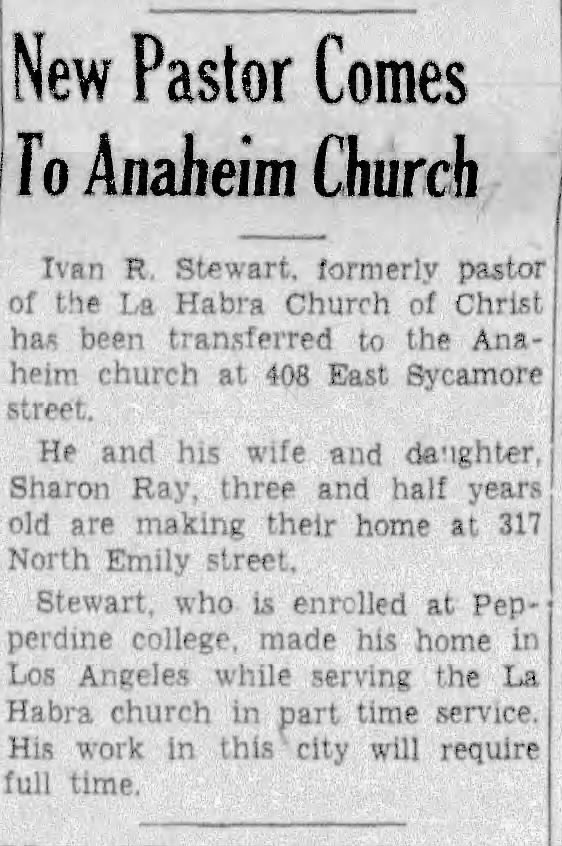
Anaheim Bulletin, Anaheim, California
Saturday, August 6,
1949, p.3
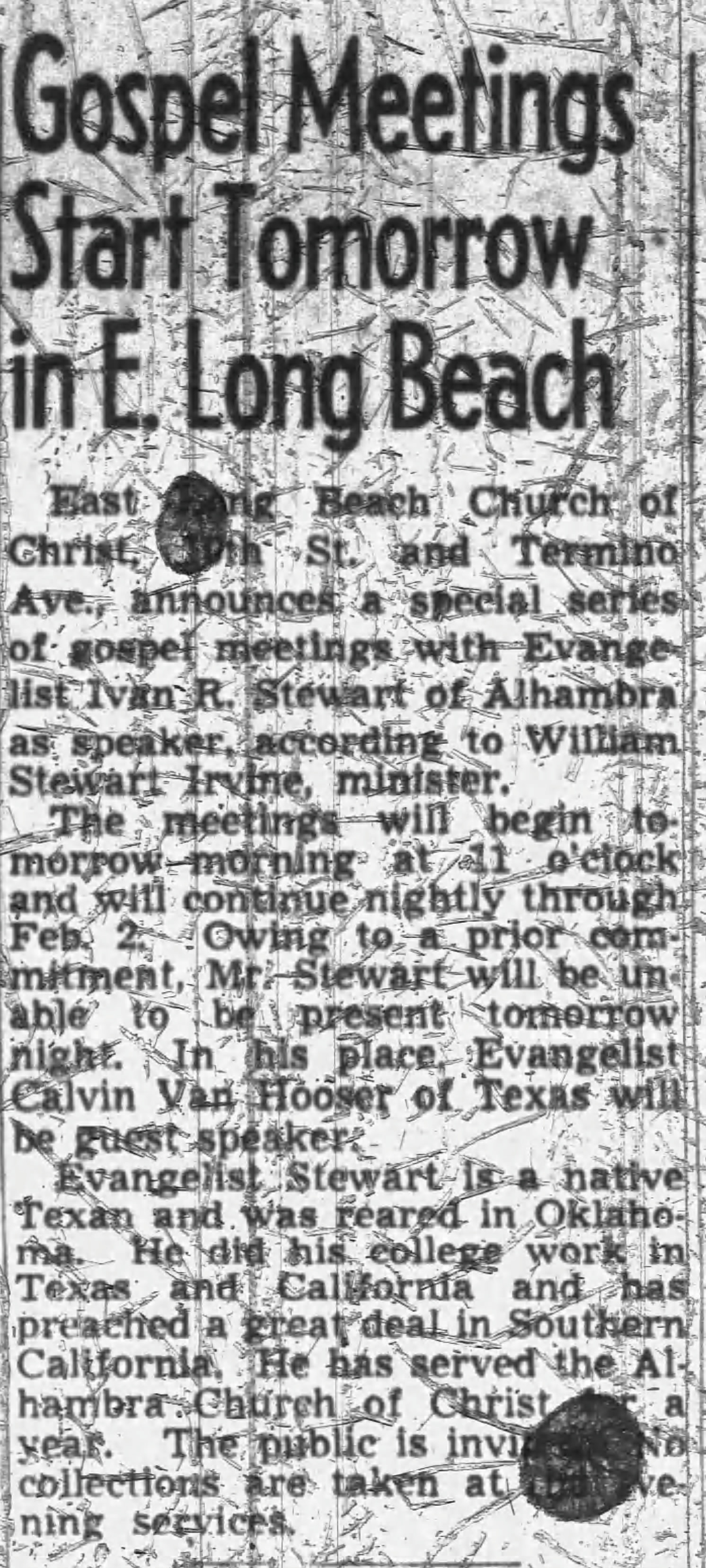
Press Telegram, Long Beach, California
Saturday, January 20, 1951, p.9.

Evening Star, Washington D.C.
Saturday, February 9, 1952, p.8.
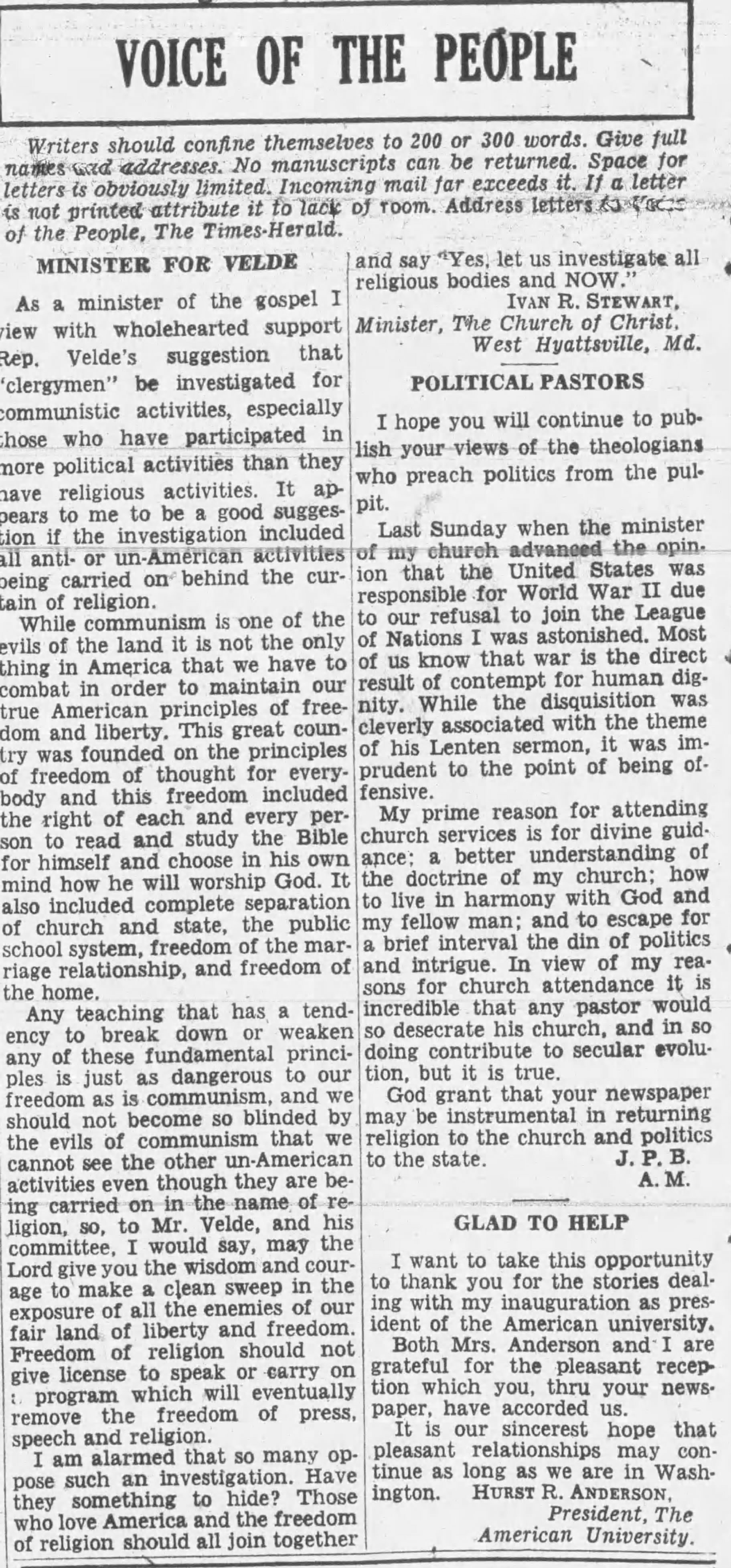
Times Herald, Washington District Of Columbia_
Wednesday, March 18,
1953, page 10.
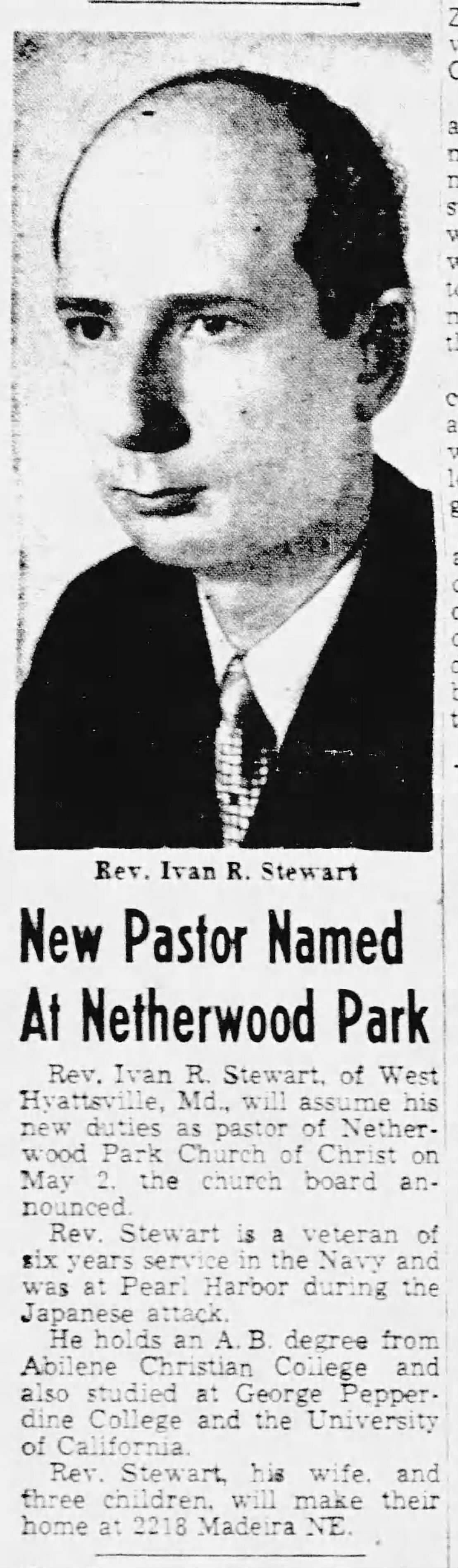
The Albuquerque Tribune, Albuquerque, New Mexico
Tuesday, April 20, 1954, page 24.
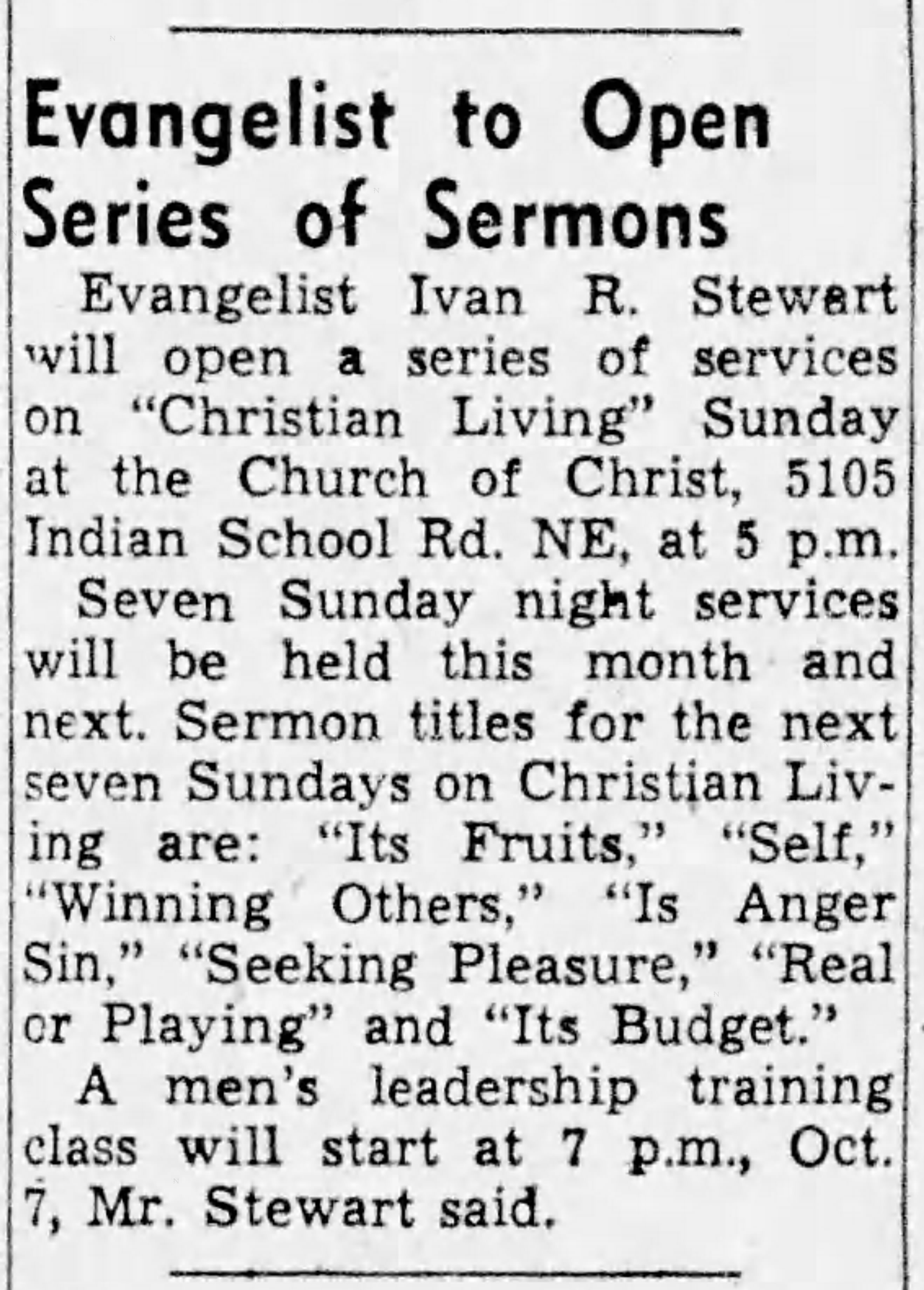
The Albuquerque Tribune, Albuquerque, New Mexico
Saturday, October 2, 1954, page 5.
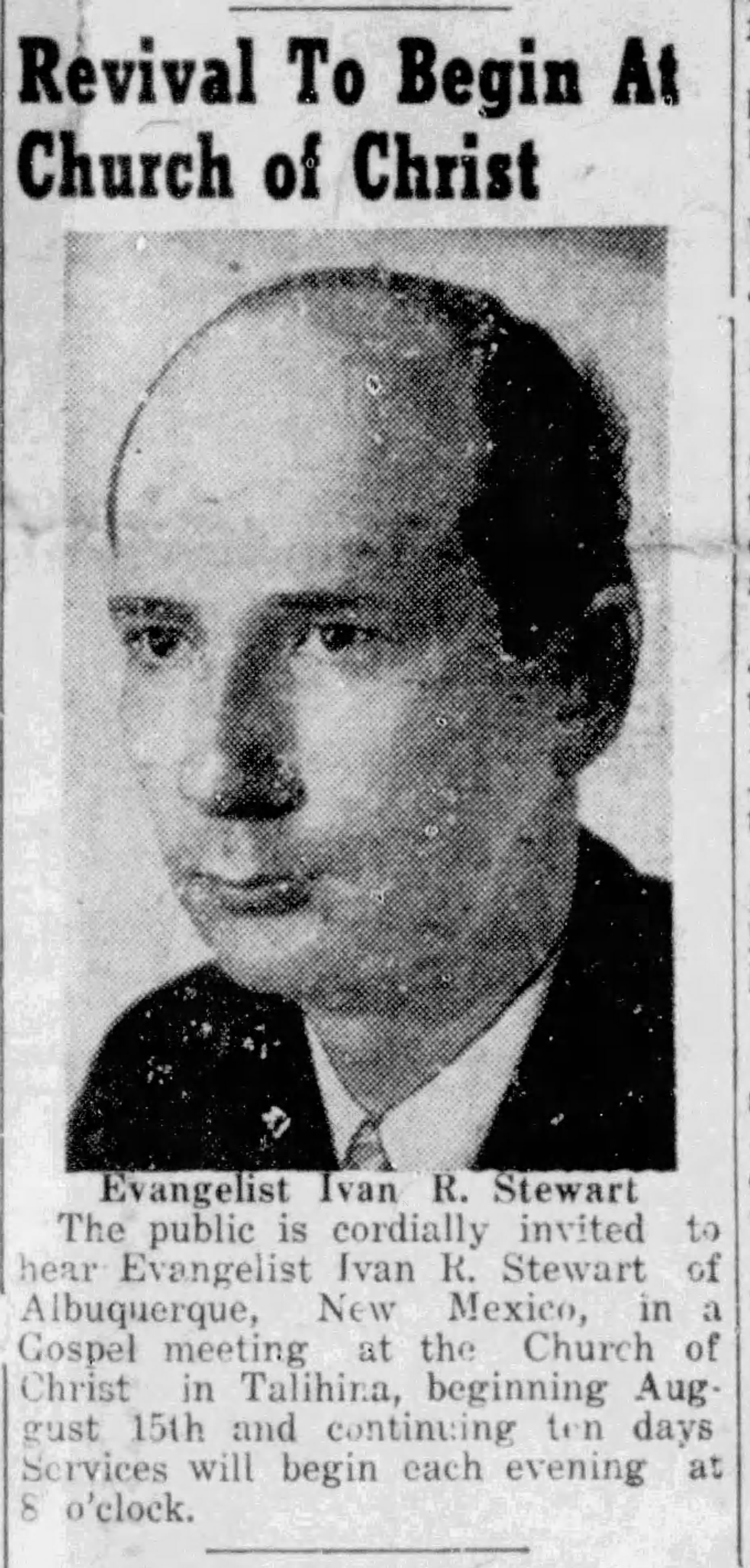
The Talihina American, Talihina, Oklahoma
Thursday, August 11, 1955, p.1
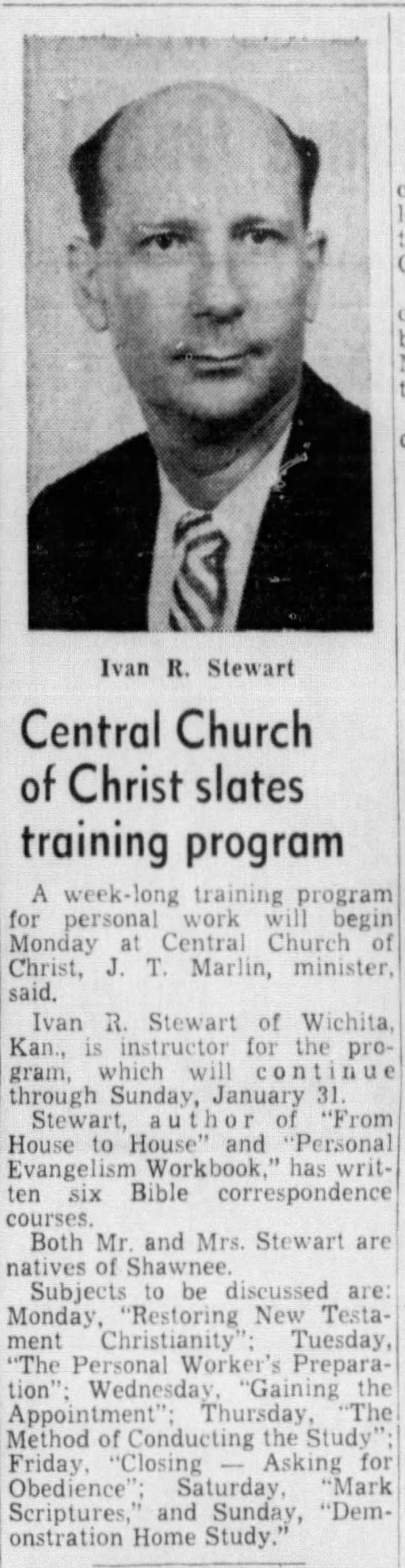
Shawnee News Star, Shawnee, Oklahoma
Saturday, January 23, 1960, p.5.
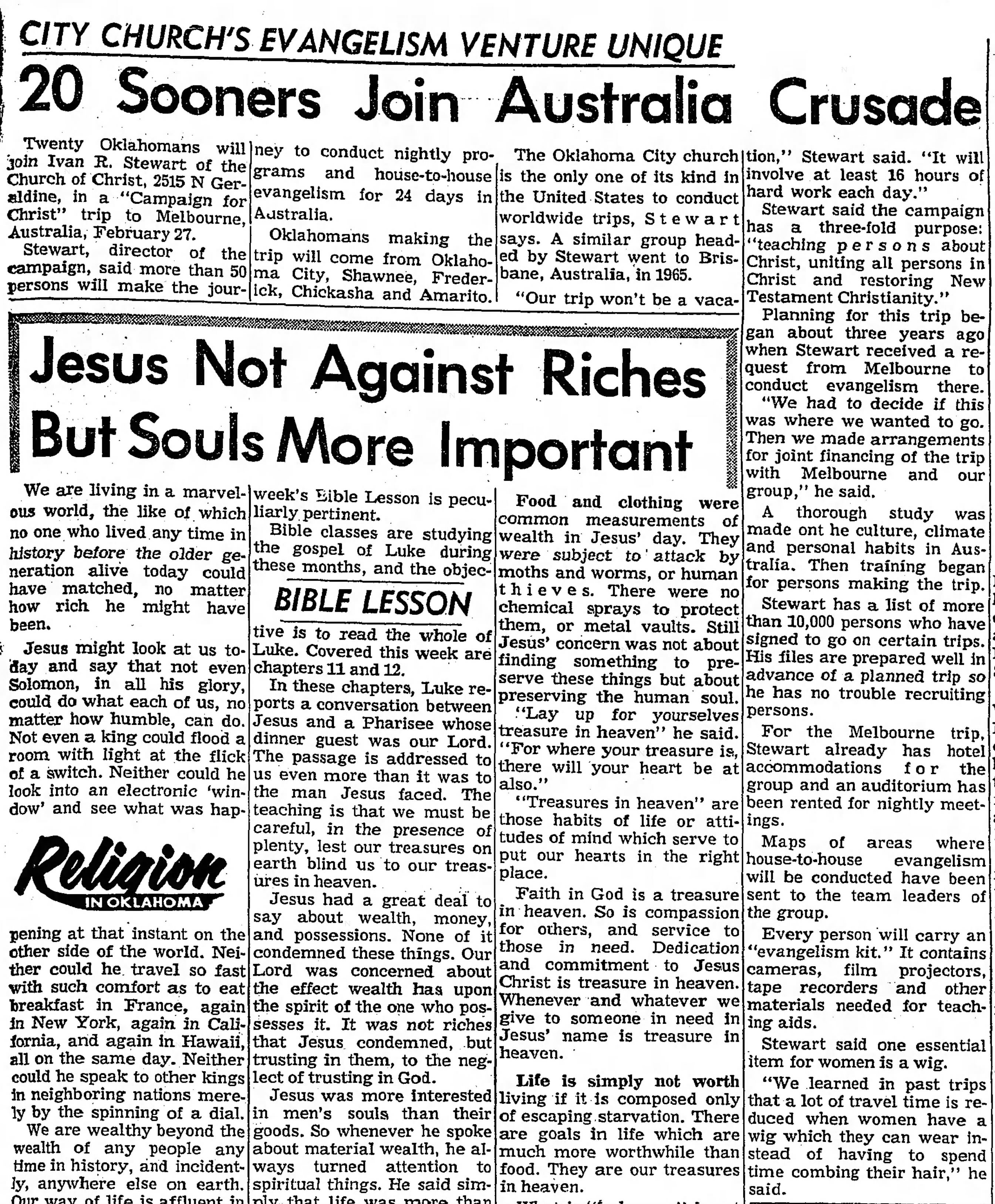
The Daily Oklahoman, Oklahoma City, Oklahoma
Saturday, February 4, 1967, p.11.
Obituary
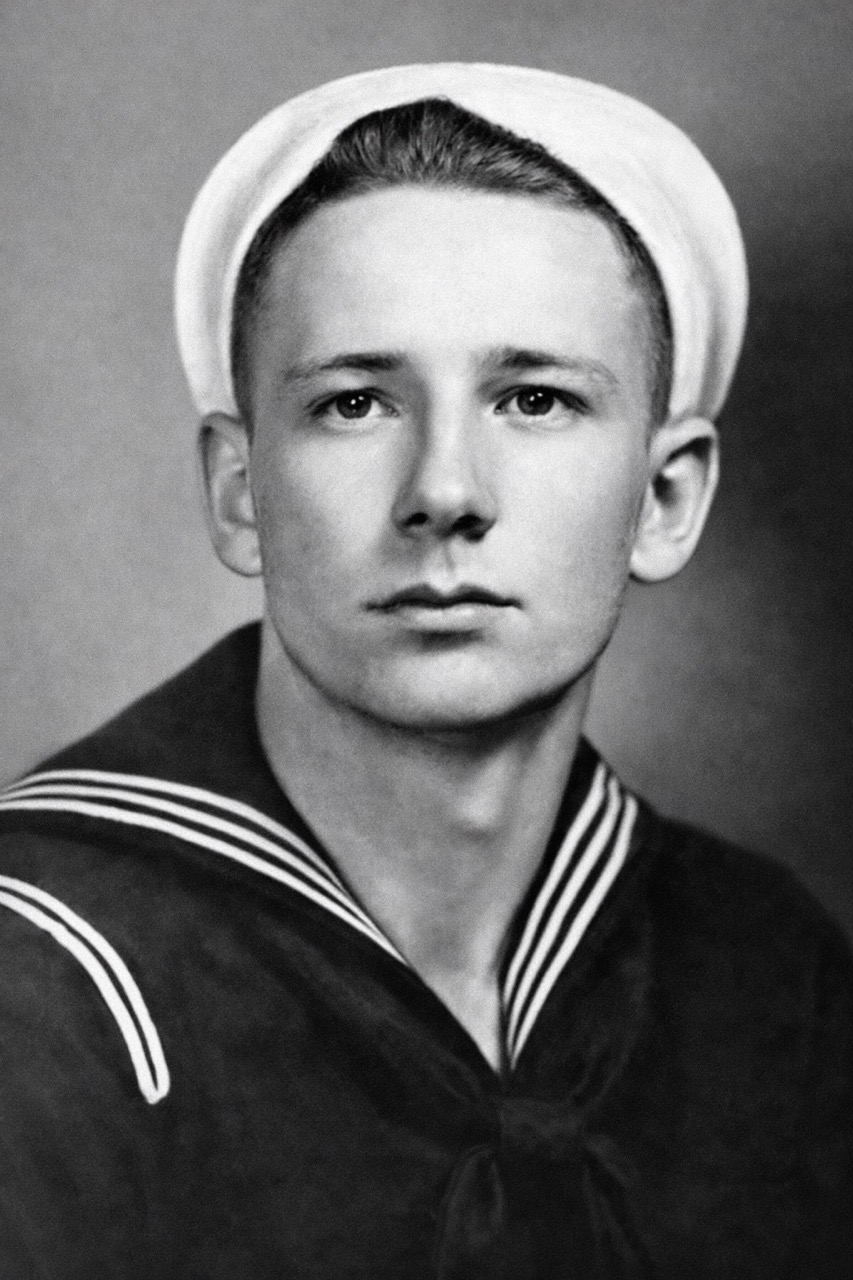
Ivan Stewart
Oct. 24, 1922-April 24, 2019
OKLAHOMA CITY
Ivan Stewart, age 96-1/2 to the day, passed away April 24, 2019. He was born to Lester Robert and Emma Mary Stewart in Gainesville, TX. He graduated from Shawnee High School in 1940. He joined the Navy Nov 6, 1940, and was a Survivor of Pearl Harbor, Dec. 7, 1941; having been knocked down from the first bomb dropped on Ford Island, he was strafed and pulled men off the burning and exploding battleships. He proudly served his country for six-plus years during WWII with an aircraft carrier in the South Pacific. He attained the rank of chief petty officer Oct. 1943 at age 21, and was reported to be the youngest ever chief petty officer. He married Pauline "Polly" Copher, of Shawnee, OK, in Santa Ana, CA, Nov. 21, 1944. He was grateful to Polly for bringing him to the Lord. To this union was born Sharon Rae, Michael Ivan, and Rebecca Sue.
After deciding to serve the Lord as a Church of Christ minister, he received a BA, MA and his Doctorate degree, along with teaching and counseling certification and became a published author, with his most recent work published when Ivan was 93. After Polly's death, he married MaryFem White in 2009.
He was preceded in death by his parents; his brother, Arthur Stewart; his sister, Sylvia Griffey; his daughter, Sharon Rae; and his wife of 65 years, Polly Stewart. He is survived by his wife, MaryFem Stewart; his son, Michael Ivan Stewart, of Austin, TX; his daughter, Becky Sue and husband Gregg Standridge, Nonnan, OK; son, Kevin White and wife Christine, Edmond, OK; daughter, Karla Pummel, of Woodward, OK; his sister, Virginia Willis; 11 grandchildren and six great-grandchildren, and many nieces, nephews and Christian friends from around the world.
Visitation will be Monday, April 29, 2019, 1-8 p.m. at Buchanan Funeral Service with the family greeting guests 5-7 p.m. His life will be well celebrated at 1 p.m. on Tuesday, April 30, 2019, at the North MacArthur church of Christ in Oklahoma City with burial to follow at Memorial Park Cemetery with Military Honors.
Donations to further the work he started may be sent to Quito School of Biblical Studies, do Faith Village church of Christ, Wichita Falls, TX; or The Youth Education Mission, c/o Bridge Ave church of Christ, Weslaco, TX.
Ivan lived Acts 20:20.
-Published in The Oklahoman, Oklahoma City, April 28, 2019
Directions To Grave
The Stewarts are buried in the Memorial Park Cemetery in Oklahoma City, Oklahoma. The grave is located in Section 4B Lot 100, Spaces 3-4. See Map Here. The GPS location below is a guess based on photos below.
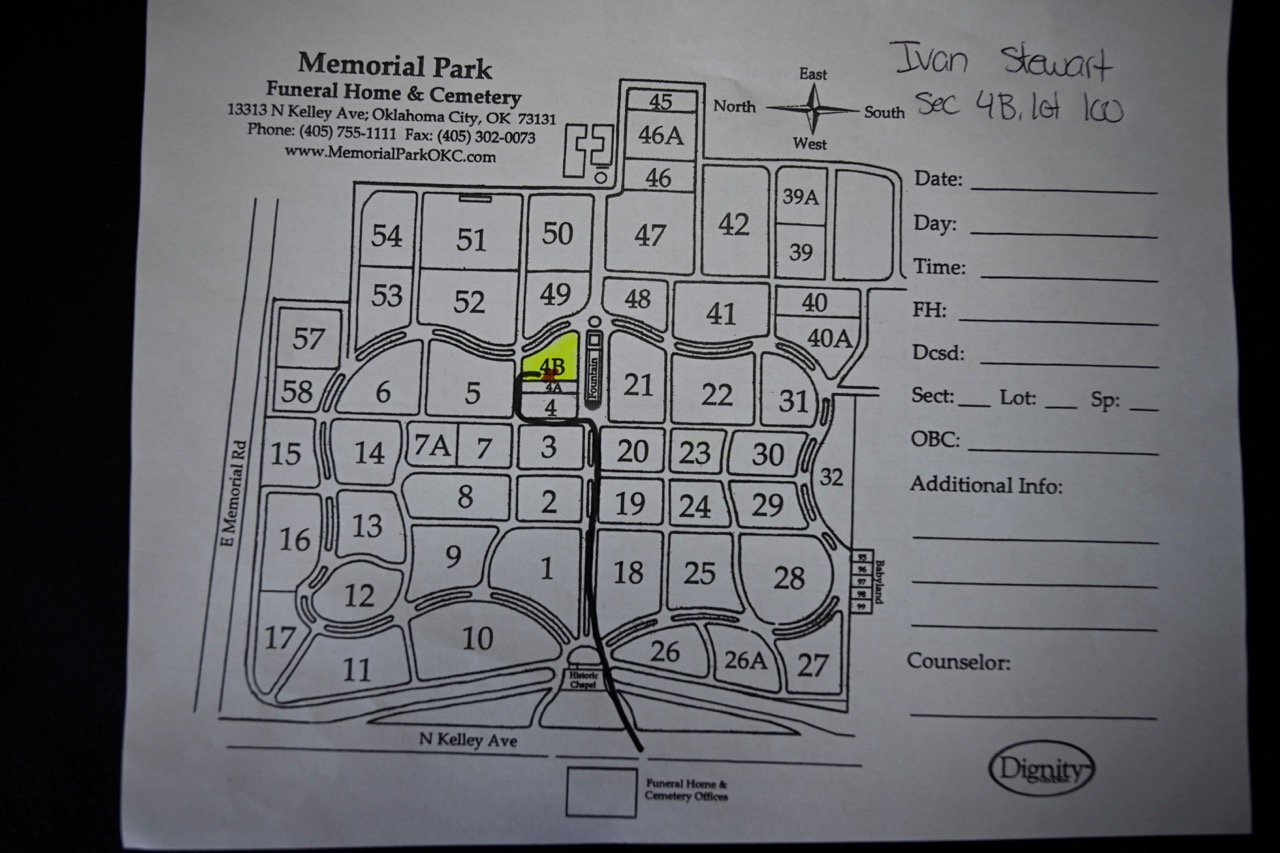
GPS Location of Graves
35°36'21.6"N 97°29'28.4"W
or D.d. 35.606004, -97.491228
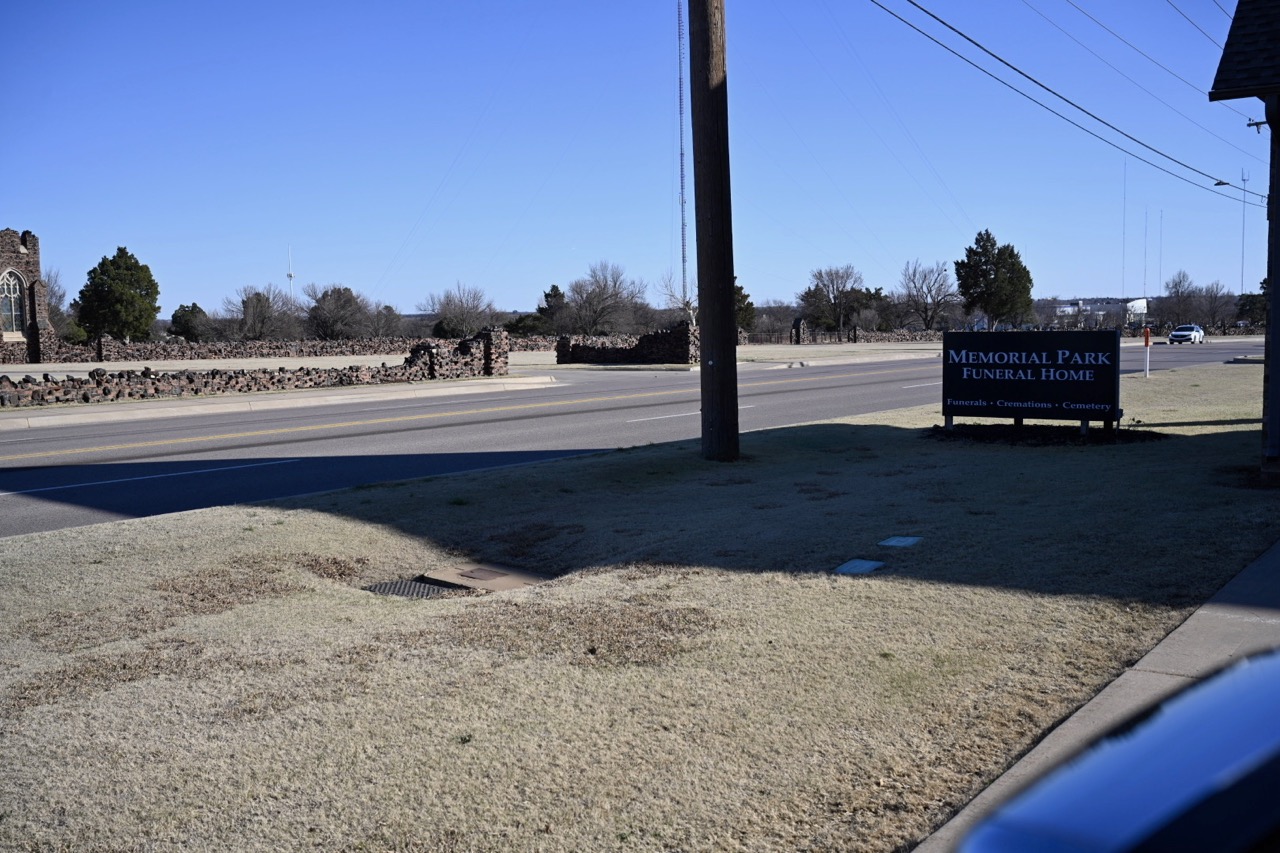
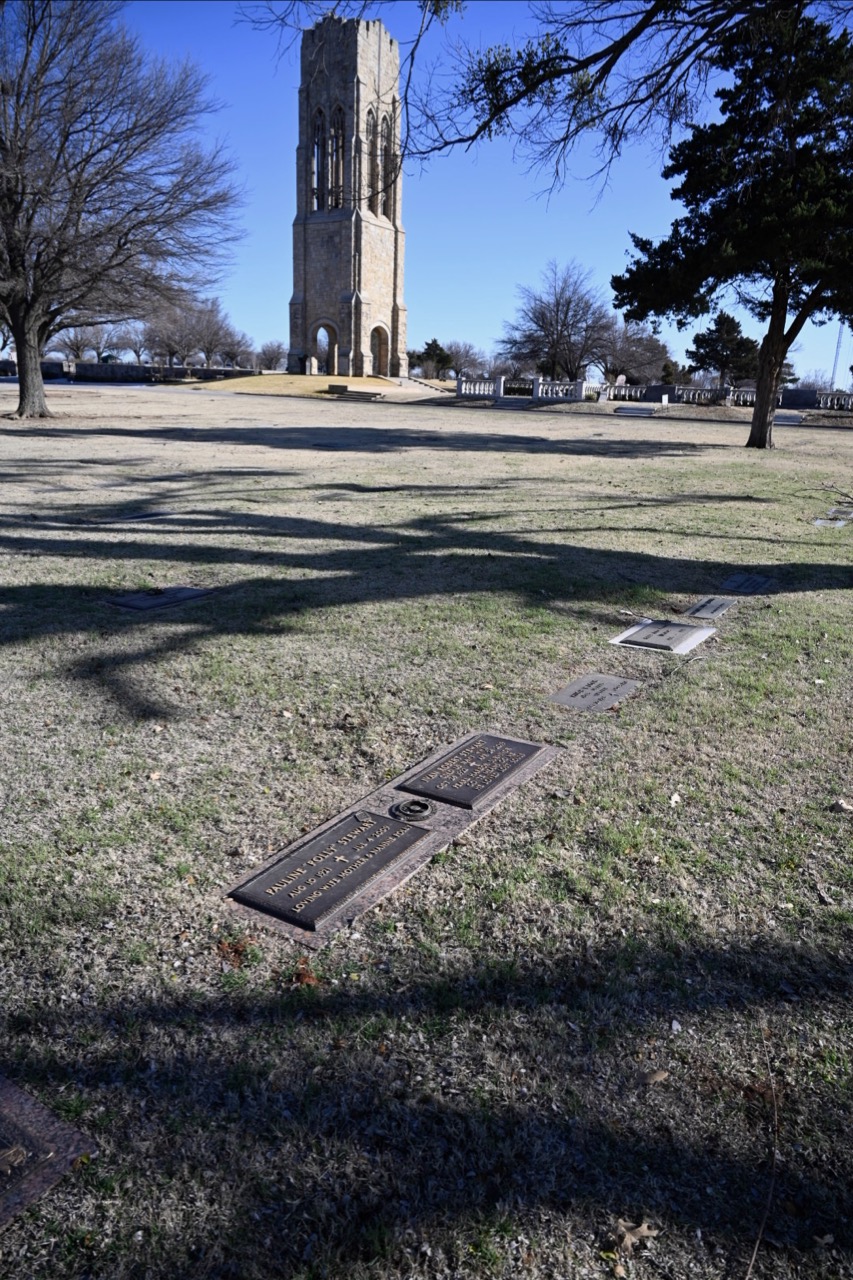
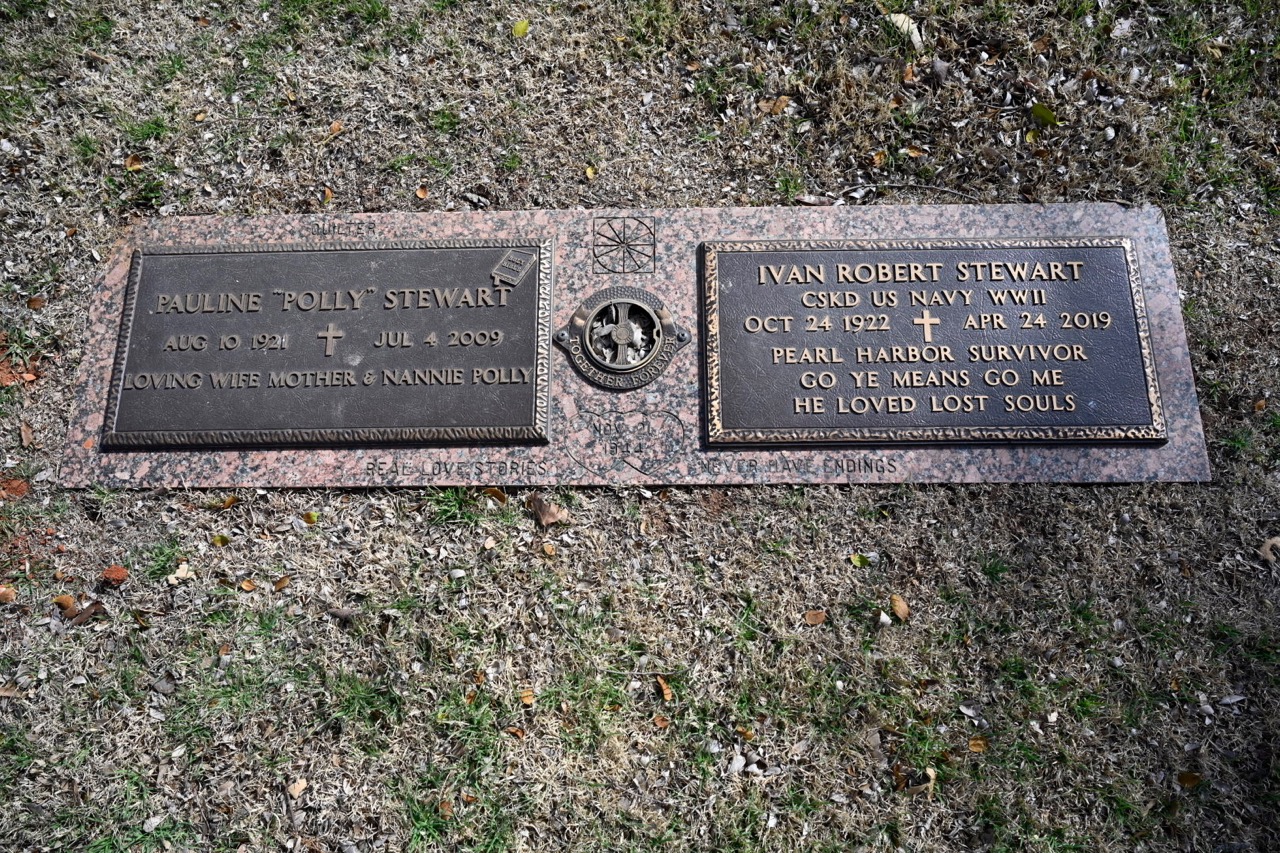
Pauline "Polly" Stewart - August 10, 1921-July 4, 2009 - Loving Wife Mother & Nannie Polly - Quilter
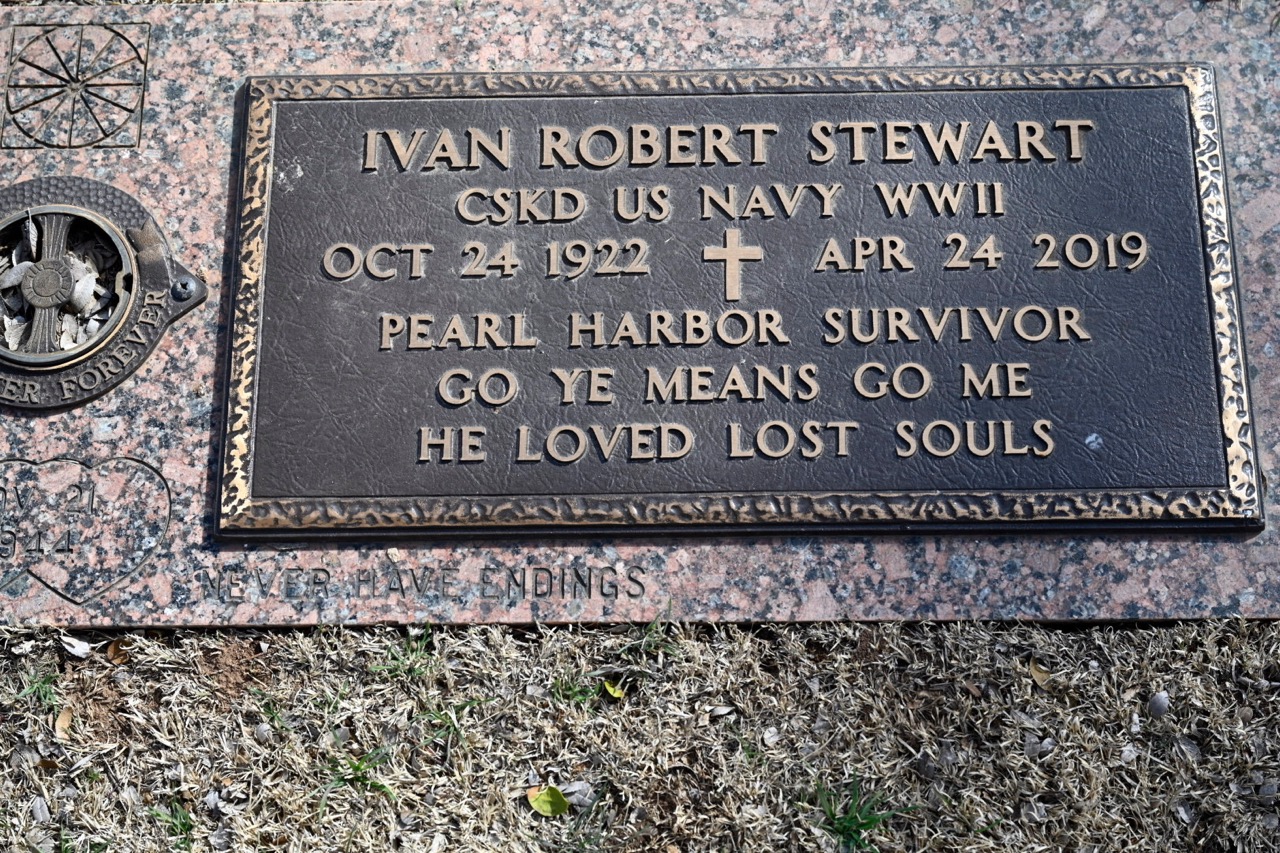
Ivan Robert Stewart - CSKD US Navy WWII - October 24, 1922 - April 24, 2019
Pearl Harbor Survivor | Go Ye Means Go Me | He Loved Lost Souls
Real Love Stories Never Have Endings ( Married November 21, 1944)
Photos Taken 02.21.2026
Webpage Produced 02.27.2026
Courtesy Of Scott Harp
www.TheRestorationMovement.com
Special Recognition: We were first contacted about the passing of Ivan Stewart by Kirk Castleman in 2019. Some of the information was made available then, but opportunity to personally visit the gravesite was not forthcoming by your webeditor. Finally, with the assistance of several people, the page was finally produced. Thanks to Kirk Castleman for being the prime mover in getting the project completed. Thanks to Roy Greenway for going to the cemetery, locating and photographing the gravesite, and also to John H. Williams for assisting in the writing of a most precious and informative biographical sketch.