Jefferson Harrison Jones
1813-1904
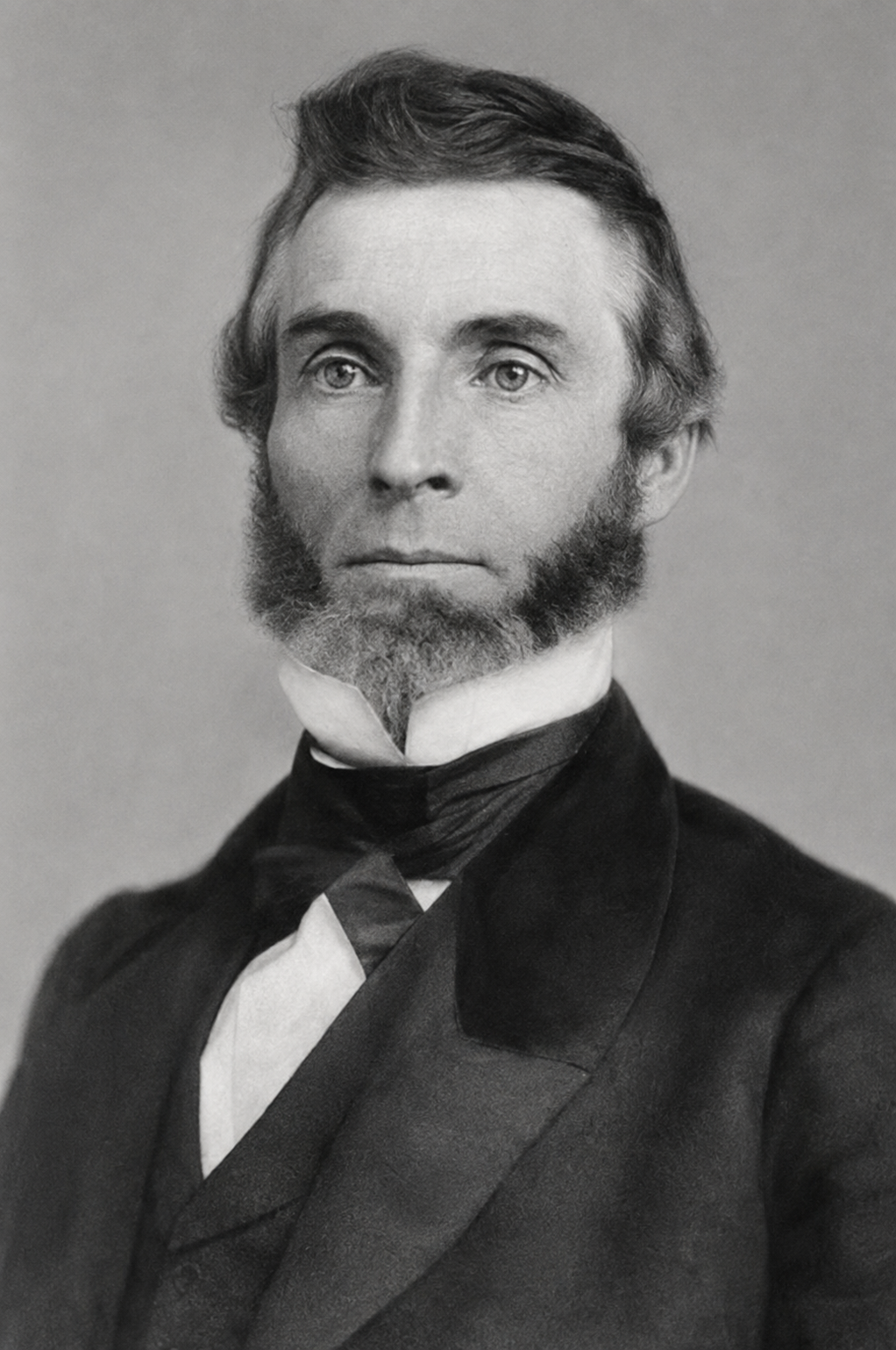

Evangelist, Mentor, and Friend of James A. Garfield
Jefferson Harrison Jones, affectionately known as “Uncle Harry,” was one of the beloved evangelists of the nineteenth-century Restoration Movement. A gifted speaker with a powerful, musical voice, he helped establish congregations, encouraged young preachers, and carried the gospel throughout Ohio and beyond. His friendship with President James A. Garfield brought him into national history, but his influence rested on decades of preaching and personal service among the churches of the Western Reserve.
Jones was born in Trumbull County, Ohio, on June 15, 1813. He was the son of Isaiah Jones (1774-1853) and Sarah Hartford Jones (1780-1824). His first interest in the religious reform associated with Alexander Campbell came through reading the Christian Baptist. Later, in Crawford County, Ohio, he heard John Secrest, a preacher formerly of Kentucky, explain what the early reformers called the “ancient Gospel.” When Secrest returned and preached again, Jones was immersed. He was then in his nineteenth year, placing his baptism about 1831–1832.
The experience remained significant in his recollection. In 1864, M. C. Tiers, in his The Christian Portrait Gallery, identified him as the first person immersed in Whetstone Township, Crawford County, and said that he was also the first person he had ever seen baptized simply upon a profession of faith in Jesus Christ (p. 216). He began preaching almost immediately. The conviction that ordinary people could hear, believe, and obey the gospel became the foundation of his ministry.
Jones possessed particular gifts for evangelistic work. In an era when two ministers often conducted a meeting together, one might present the biblical argument while the other followed with an exhortation urging the hearers to respond. Jones excelled in the latter role. His partnership with Almon B. Green illustrates this arrangement: Green supplied careful reasoning and argument; Jones followed with tenderness, feeling, and persuasive appeals.
The Life of John F. Rowe described Jones as a man of impressive presence whose clear, penetrating voice could reach thousands. Its affectionate portrait suggests that his effectiveness arose from the union of conviction and sympathy. He could make a message felt as well as understood. Later historical accounts remembered him among the leading “singing evangelists” of the Western Reserve.
His results were substantial. At the time its sketch appeared, The Christian Portrait Gallery credited his preaching with more than seven thousand converts, including seven hundred in a single year. Such figures illustrate the extensive effectiveness of his skills to enter the deepest recesses of the heart with the Word of God.
Ohio remained the principal field of his labor. His ministry was associated with Wadsworth, Wooster, Bedford, and the Cleveland area, while evangelistic journeys carried him into Michigan, Pennsylvania, Tennessee, and other states. Much of his work consisted of extended meetings and repeated visits to communities rather than service within a single congregation.
Wooster, Wayne County, Ohio was his first work, and furnishes a notable example of his ability to strengthen a small church. When he moved there in 1844, the congregation numbered only eleven members, including Jones and his wife. A meetinghouse was built, and membership eventually exceeded two hundred. He worked with this church for fourteen years.
Wadsworth also held an enduring place in his life. He married Lauraett Pardee, daughter of Judge Allen Pardee of that community. Paul E. Garrett’s account emphasizes Jones’s continuing attachment to Wadsworth and records his attendance, with Garfield, at a postwar reunion of the Forty-second Ohio Regiment at Steele’s Grove, "where the old Tabernacle once stood."
One of Jones’s most lasting contributions was his encouragement of younger men. John F. Rowe came under his influence during meetings conducted by Green and Jones and was baptized by Jones in 1848. Their relationship continued well beyond Rowe’s conversion. Jones became a companion, adviser, and advocate, helping bring him into contact with leading preachers of the movement.
When Rowe entered Bethany College in September 1850, he carried Jones’s letter of introduction to Alexander Campbell. Jones also sent a characteristically direct message: “Tell Brother Campbell that we want him to make a man of you.” Campbell replied that the result depended upon the material they had sent him. Behind the humor lay a serious commitment to Rowe’s future. When Campbell later recommended a second year of study, Jones helped arrange it. His investment in Rowe extended his influence into another generation of preaching and religious journalism. (The Search for the Ancient Order, vol. 2, pp. 158–159.)
In 1850, Jones also baptized Thomas Munnell at Bethany, Virginia. Munnell would become a prominent preacher, educator, and missionary leader among the Disciples. Alongside his influence on Rowe, this connection illustrates how Jones’s evangelistic work reached men who would themselves shape the movement’s future.
Jones also participated in the beginnings of the Western Reserve Eclectic Institute, later Hiram College. The institution’s historical account places him among the speakers at its opening exercises in 1850. His presence there complements the story of his support for Rowe: he understood that the churches needed educated and capable workers as well as successful evangelistic meetings. (Hiram College and Western Reserve Eclectic Institute: Fifty Years of History, 1850–1900)
The Civil War brought a new responsibility. Jones became chaplain of the Forty-second Ohio Volunteer Infantry, commanded by James A. Garfield. Their friendship belonged to a small circle that also included Isaac Errett and Dr. John P. Robison and his wife. According to the accounts supplied, the five gathered at the Robison home in Bedford before Garfield and Jones departed for military service in 1861. Facing an uncertain future, they pledged to assist one another in trouble. Their fellowship became known as the “Quintinkle.”
The friendship survived the war and Garfield’s rise in public life. In a letter to Robison dated December 13, 1877, Garfield proposed another gathering, either at Robison’s home or at Jones’s home in Mentor, and insisted that Errett attend. The letter offers a personal glimpse of the enduring affection within the group. (Garfield letter, transcribed by RR Auction)
When Garfield died in September 1881 after being shot that July, Jones participated in the funeral observances in Cleveland. The published order of service distinguishes the roles of the old friends: Robison presided at the Public Square pavilion, Errett delivered the principal address there, and Jones was assigned remarks at Lake View Cemetery. His part in the ceremonies united his public role as Garfield’s former chaplain with the private sorrow of a longtime friend. (The Life and Death of James A. Garfield, p. 319)
A newspaper profile published in January 1903 gives a welcome glimpse of Jones near the end of his life. Living in Alliance, Ohio, at eighty-nine, he was reportedly still walking about two miles into town on most days. He had recently preached on “The Way to Be Happy,” and the writer described an engaging conversationalist who delighted in recalling the experiences of his long life. The account remembered him as a man who brought happiness to others through his kindness and service. (The Genoa Tribune, January 16, 1903, p. 6.)
Jones died in 1904. He was laid to rest next to Lauraett, who had died in 1890, in Woodlawn Cemetery in Wadsworth, near the grave of John F. Rowe—a fitting association for a preacher whose work included both bringing people to faith and helping them find their own field of service.
His surviving record is scattered among church histories, biographies of friends, and recollections of meetings. Yet a consistent portrait emerges: a persuasive evangelist, an attentive mentor, and a faithful friend. The affectionate name “Uncle Harry” preserves something that numerical reports cannot—the personal warmth with which Jefferson Harrison Jones carried out his long ministry.
-Scott Harp, 09.08.2026
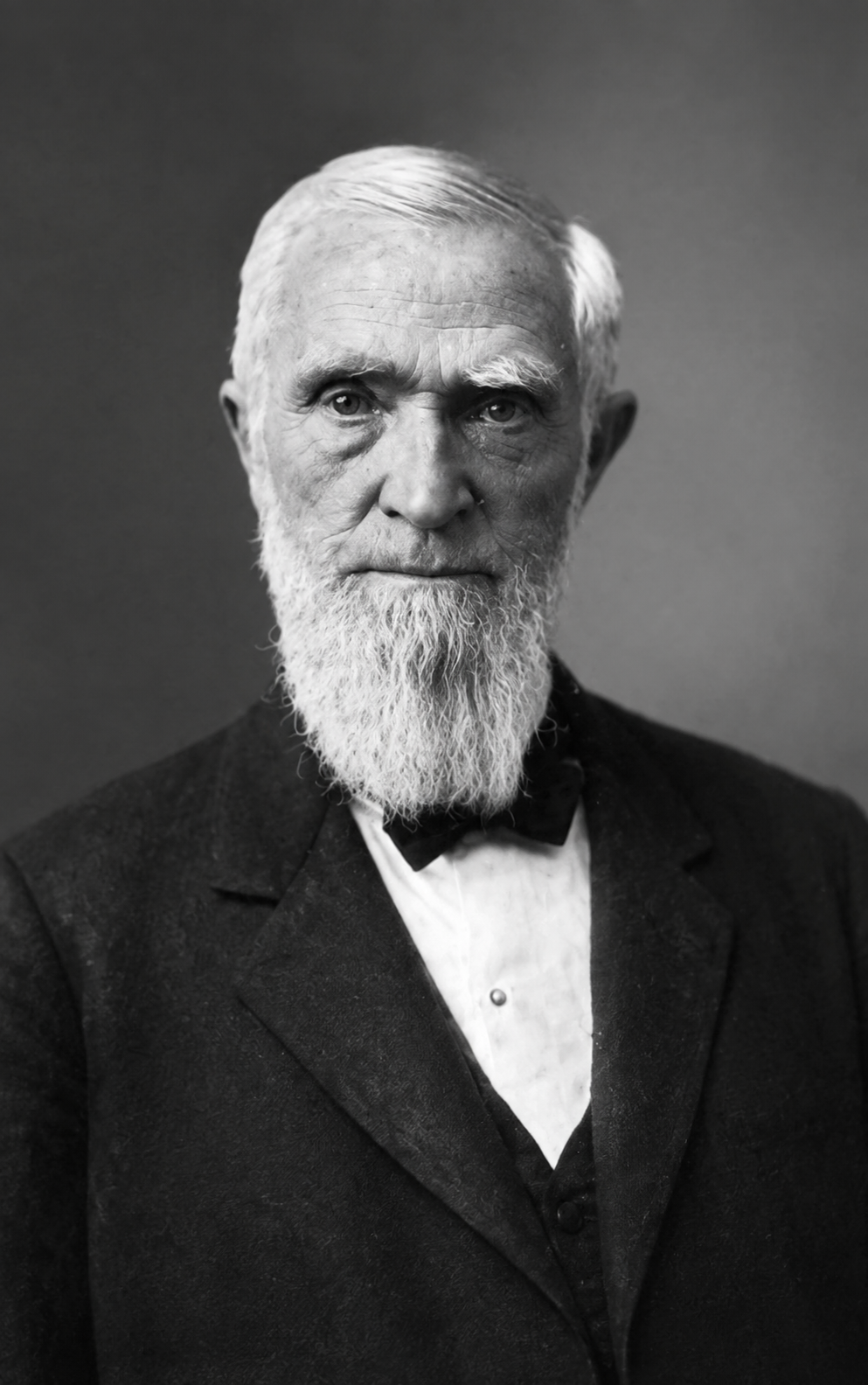
Reports
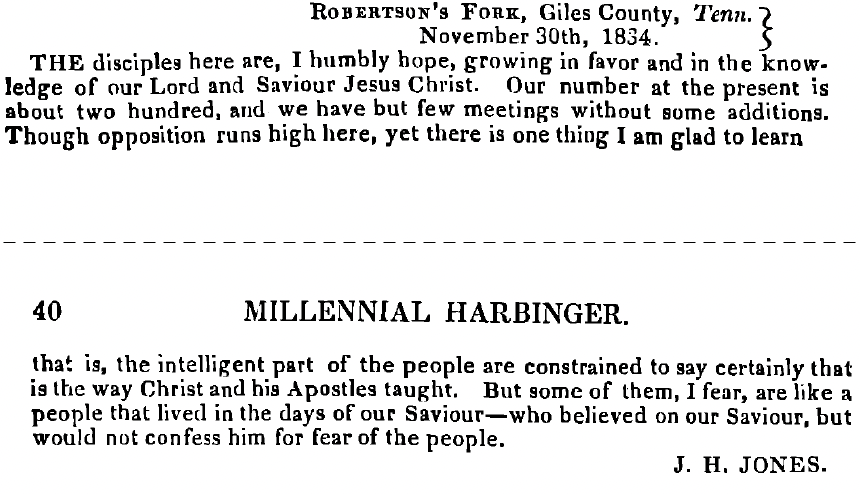
Report by J. Harrison Jones to Alexander Campbell's
Millennial Harbinger, 1835, pps. 39-40, Vol. 6, No. 1, January, 1835.

Report from J. Harrison Jones in 1841 to Campbell's
Millennial Harbinger, p.335, New Series, Vol. 5, No. 7, July, 1841.
Note: Report Says 1831, but misprinted. Cited ref. is correct.
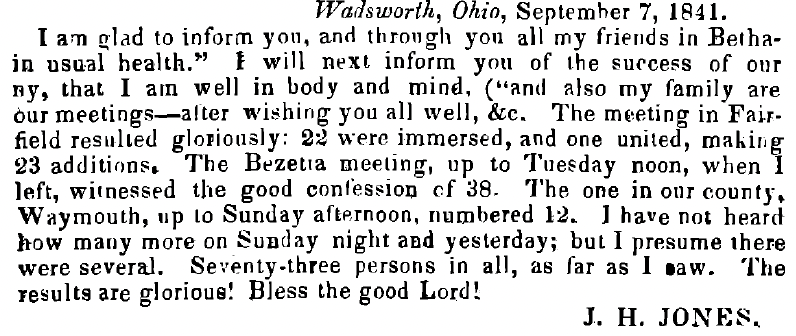
Report from J. Harrison Jones to Alexander Campbell's
Millennial Harbinger, 1841, p.522, New Series, Vol. 5, No. 11.
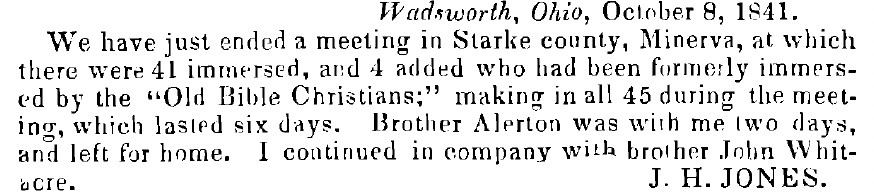
Report from J. Harrison Jones to Alexander Campbell's
Millennial Harbinger, 1841, p.526, New Series, Vol. 5, No. 11.
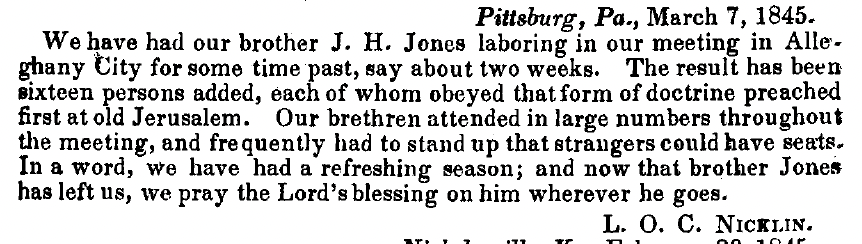
Report sent to Alexander Campbell by L. O. C. Nicklin, a member
of the church in Alleghany City (Pittsburg, PA) who told
of the
success of J. Harrison Jones in a recent meeting. 1846, p.297.
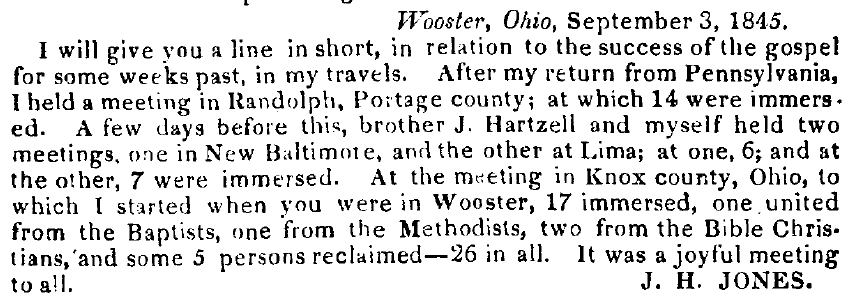
Report sent to Alexander Campbell's
Millennial Harbinger, 1845, p.571, Third Series, Vol. 2, No. 12, December 1845.
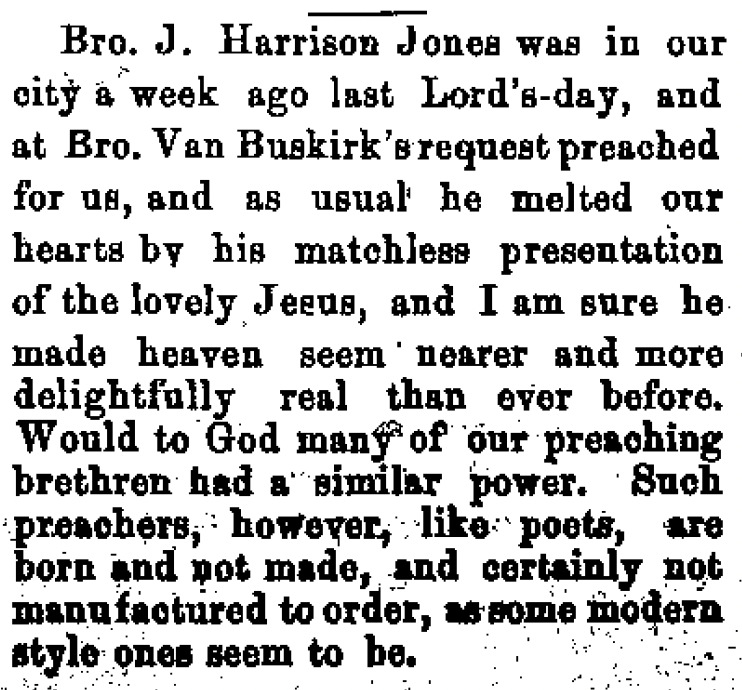
Christian Leader, November 4, 1886, p.5 Vol 1. #5
A report by J. Perry Elliott, under the title of Sundries -
unclear of the location. Perhaps Cincinnati, Ohio.
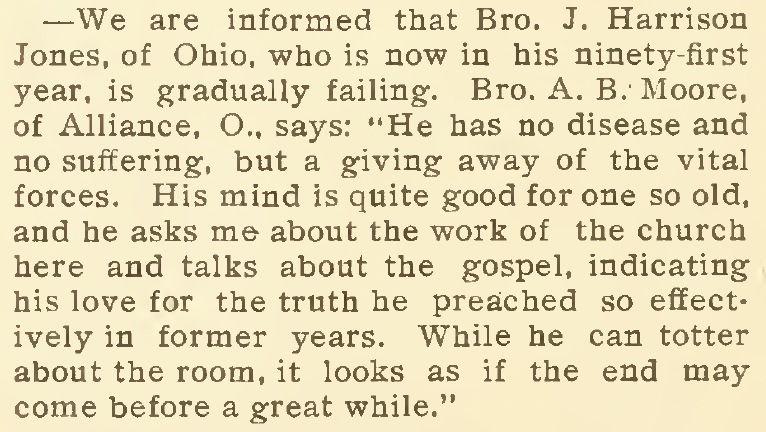
Source: The Christian-Evangelist, March 3, 1904, p. 290
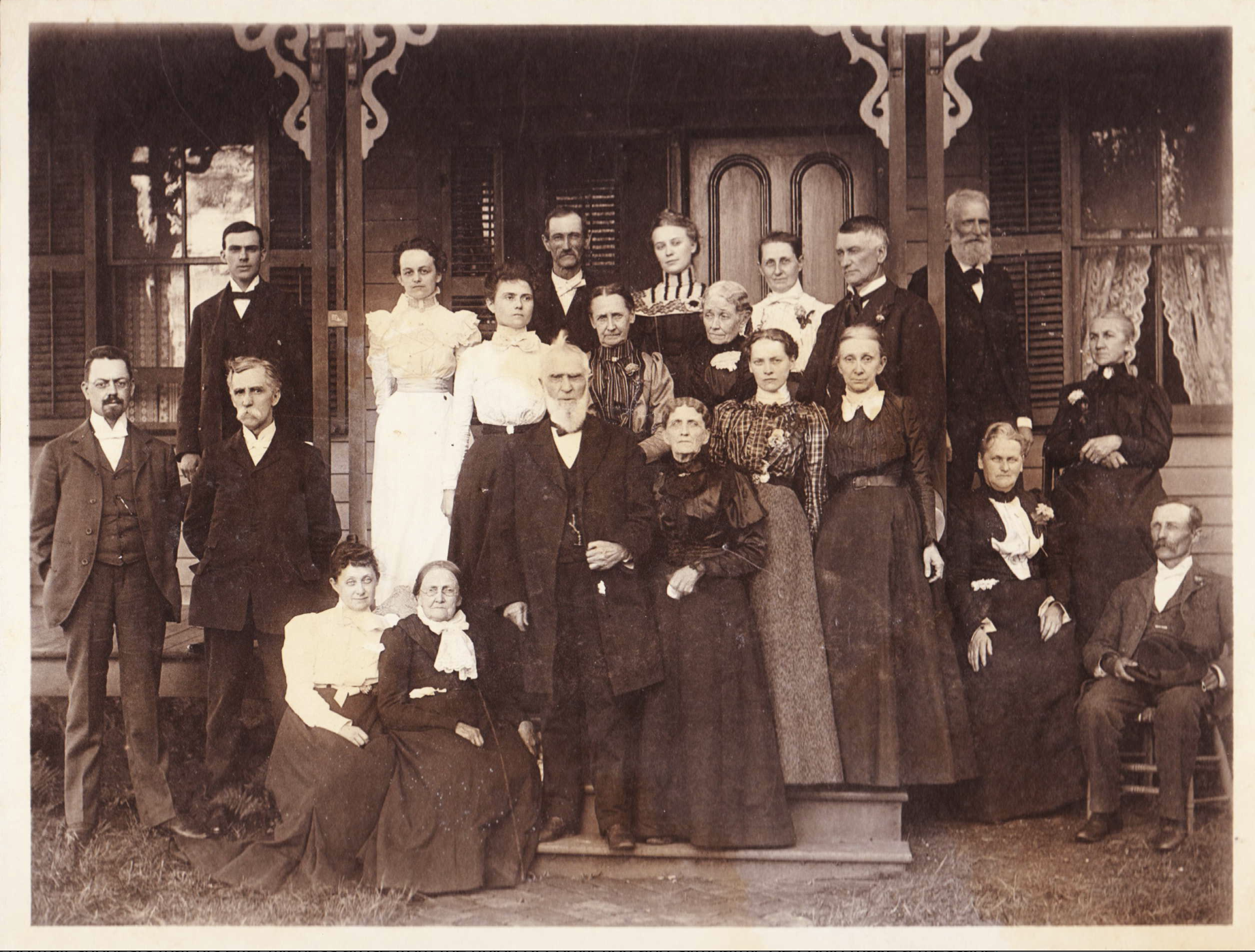
Group photo of the 50th wedding anniversary of Harrison Jones and Loretta Pardee Jones, front center. Over Mrs. Jones' left shoulder is her 16 year old granddaughter, Elizabeth Jones. Behind Elizabeth is her mother, Francis Hestin Jones and her father, William Jones. Also in this photo, but unknown as to who, is Elizabeth Jones' other grandfather and her step-grandmother but likely the couple standing at the right rear. May 17, 1886.
Source: Ancestry.com
Directions To Grave
The Jones family plot is located in Wadsworth, Ohio. Located southwest of Cleveland, and due west of Akron, is the best general description of where the family is buried. So, from Cleveland head south on I-77. At Akron take I-76 West toward Wadsworth. Take Exit 7, and head south on Hwy. 57. Turn left on Greenwich Road. The road will become College Street. Then look for the cemetery on your left. Enter the Woodlawn Cemetery to the left. Travel past the first road to the left, and continue on until you get to the flag pole. Stop the car and look toward the left, past the flagpole to the NW, and you will see the Rowe family plot. John F. Rowe was a powerful leader in the Restoration Movement himself. (Note: I visited the Rowe monument several years ago without realizing the Jones plot was just steps away.) But, be sure to note the significance of the Rowe family. Just behind the monument is the Jones monument. Also buried in the cemetery is Paul E. Garrett, historian and church leader.
GPS Location of the Grave
41°01'43.1"N 81°44'02.6"W
or D.d. 41.028644,-81.734047
Section 11
GPS Location
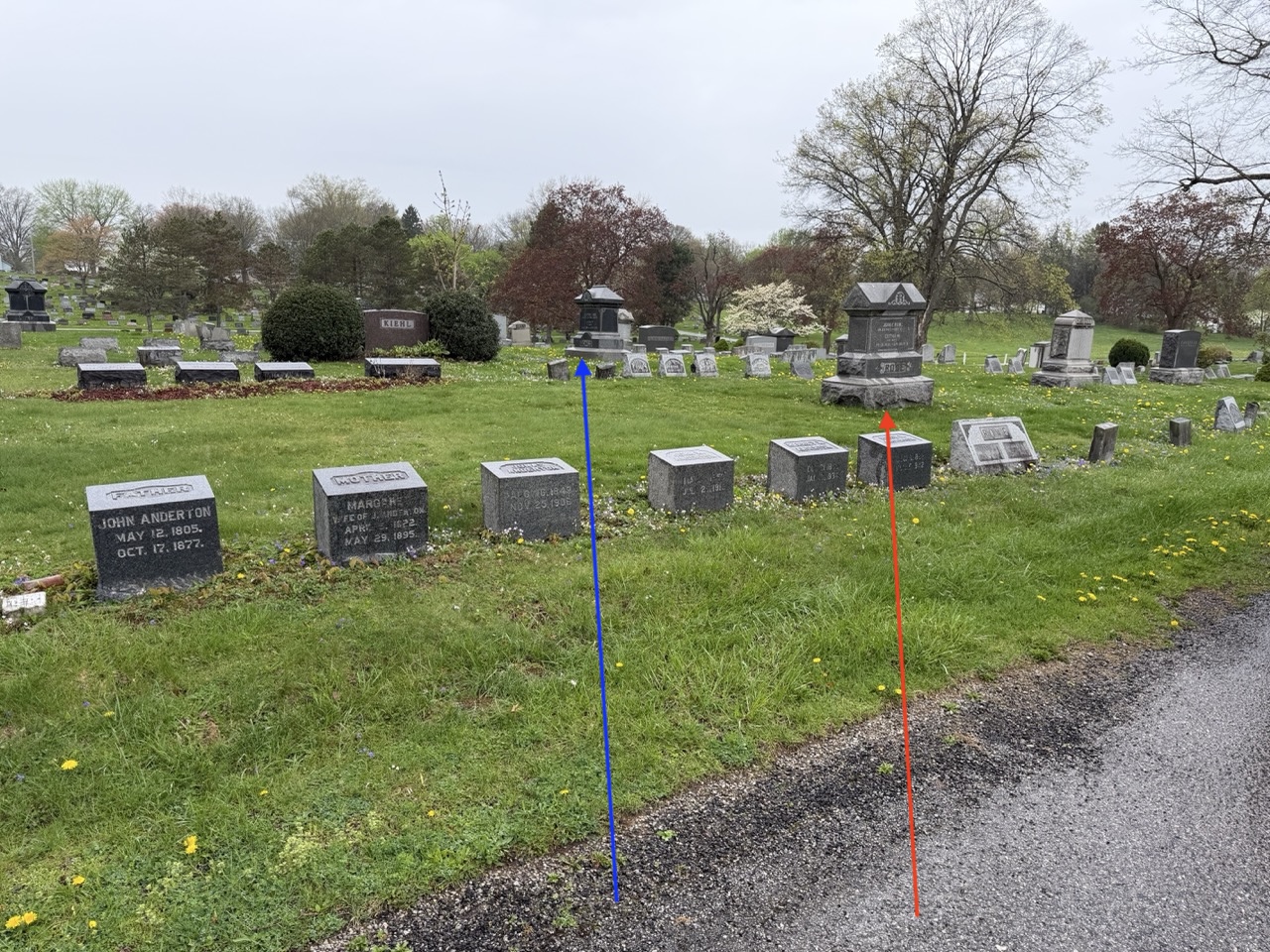
Grave of J. H. Jones (Blue Arrow) & Grave of John F. Rowe (Red Arrow)
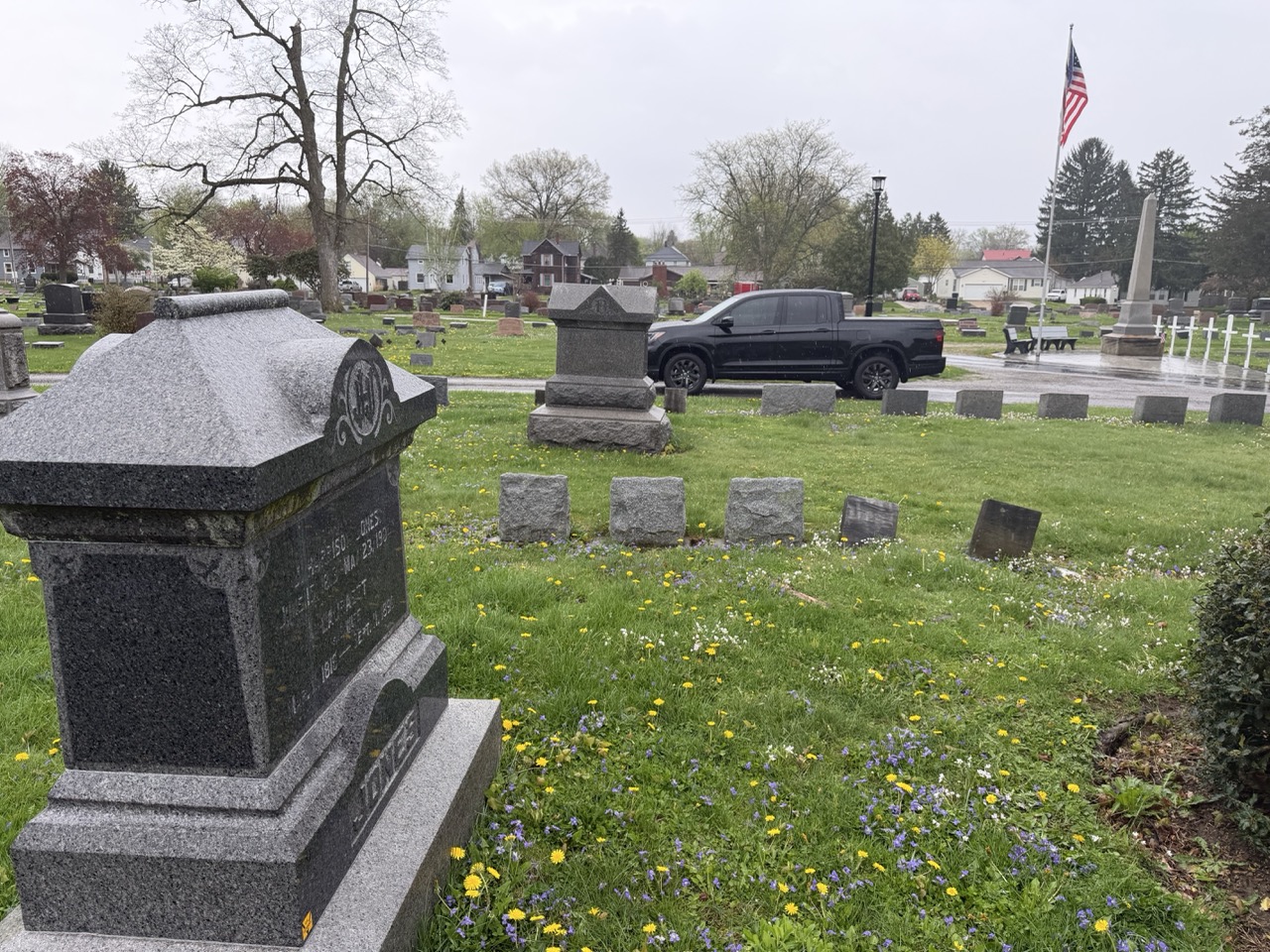
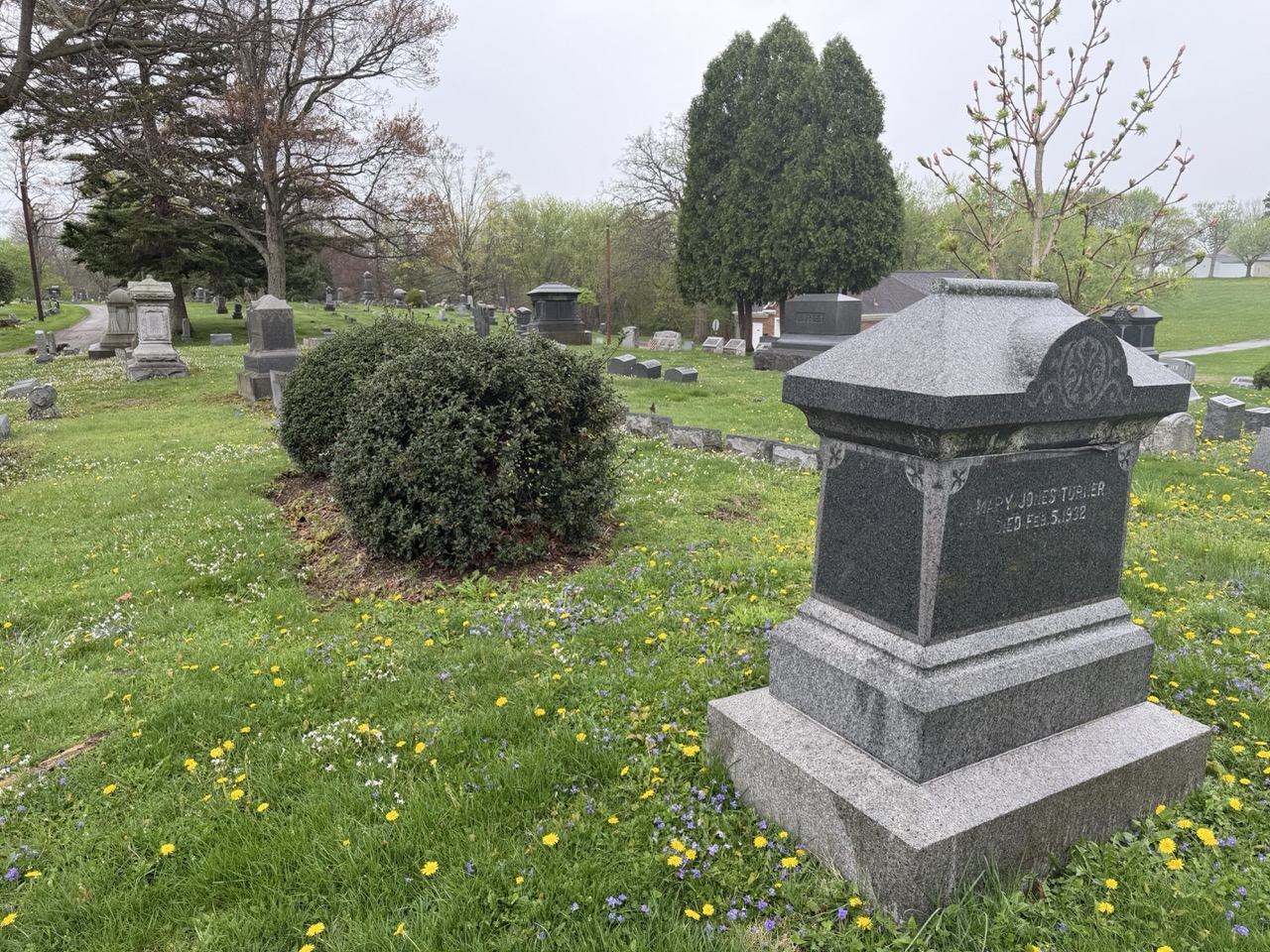
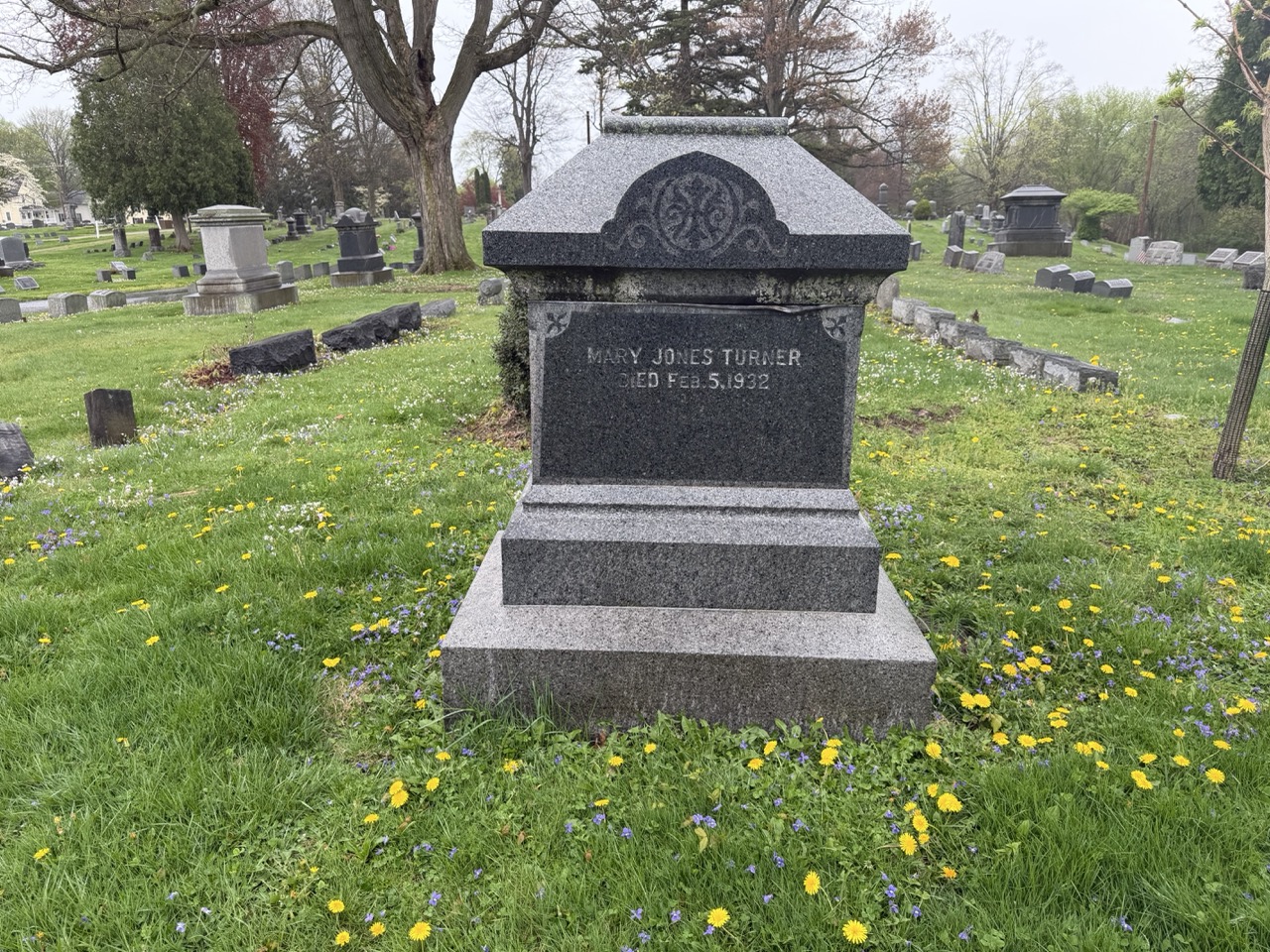
Mary Jones Turner
Died February 5, 1932
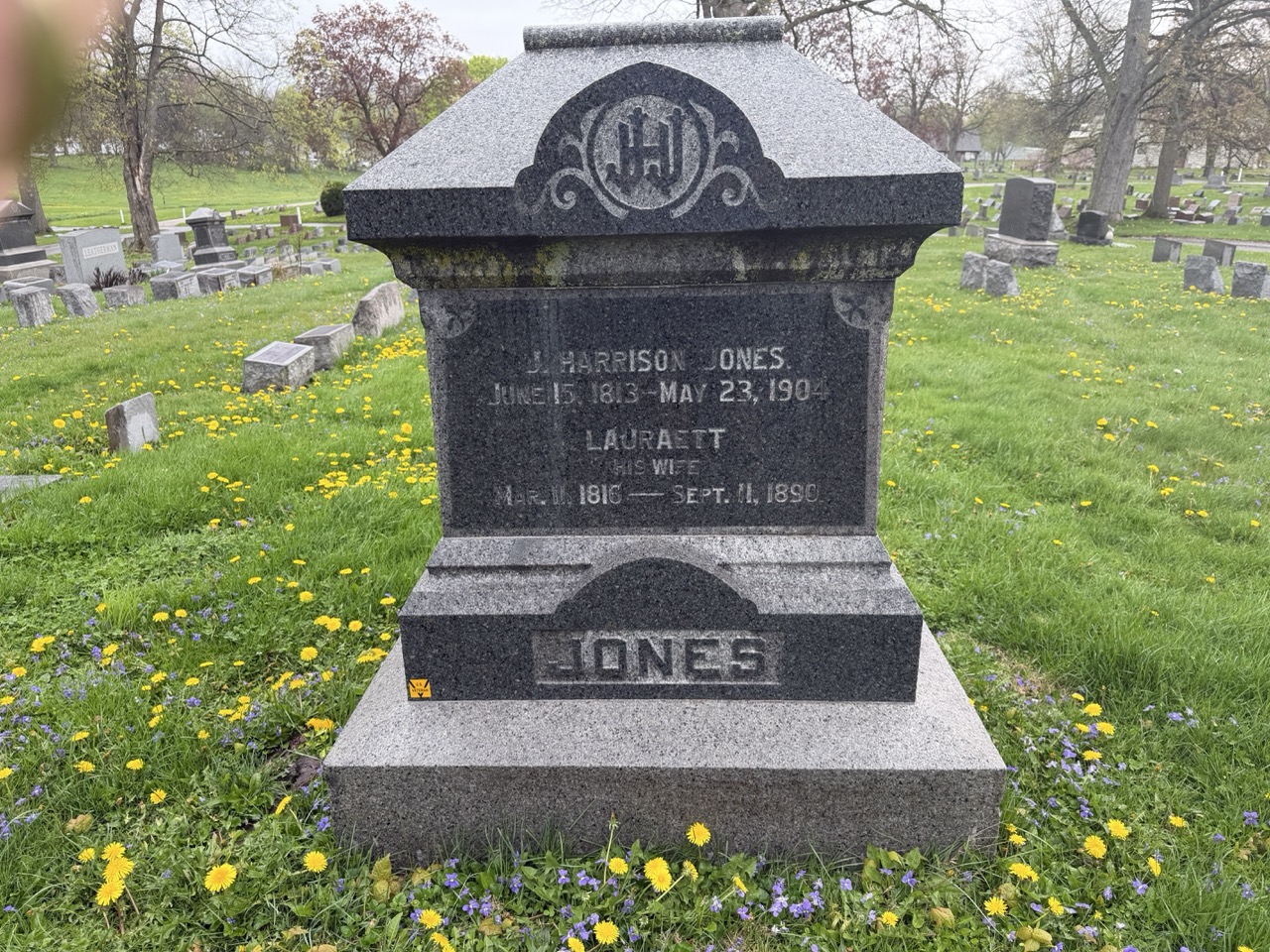
J. Harrison Jones
June 15, 1813 - May 23, 1904
Lauraett
HIS WIFE
March 11, 1816 - September 11, 1890
Photos Taken - 04.18.2026
Webpage produced - 09.07.2026
Courtesy Of Scott Harp
www.TheRestorationMovement.com
Special Recognition: It was an extreme pleasure for your webeditor to spend April 16-22, 2026 in the state of Ohio. Hundreds of miles were traversed and a good number of graves of gospel preachers of yesteryear were located. Also, while in the state, I thorough enjoyed preaching a Gospel Meeting at the Alkire Road church of Christ in SW Columbus.